A warped pool cue can throw your shot off by more than a quarter inch at standard seven-foot table distances — and in most cases, improper storage is the culprit. If you've been leaning your sticks against the wall or tucking them under the table between sessions, you're slowly ruining cues that may have cost you anywhere from $50 to several hundred dollars. A quality pool cue rack solves that problem completely, and in 2026 there are more solid options available across every price point than ever before.
Choosing the right rack comes down to a handful of decisions: floor-standing versus wall-mounted, how many cues you need to store, the material (steel, hardwood, or ABS plastic), and whether the rack fits the aesthetic of your table games setup. If you're also curious about how your game room's other gear stacks up, our guide on billiards vs pool vs snooker is worth a read — it puts the whole cue sports world in context. Below, we've rounded up seven of the best pool cue racks available right now, tested them against real-world use cases, and broken down exactly who each one is right for.
Whether you're outfitting a dedicated billiard room, a basement rec space, or a commercial club environment, there's a rack on this list that fits your needs. We've covered floor stands, wall-mounted hardwood racks, and budget-friendly plastic options, so you can compare them side by side before spending a dime. And if you want to protect your table investment alongside your cues, don't miss our companion piece on how to clean a pool table and extend its life — the two go hand in hand.
Contents
Our Top Picks for 2026
- #PreviewProductRating
- Bestseller No. 1
 Rating:

- Bestseller No. 2
 Rating:
 - Bestseller No. 3
 Rating:
 - Bestseller No. 4
 Rating:
 - Bestseller No. 5
 Rating:
 - Bestseller No. 6
 Rating:
 - Bestseller No. 7
 Rating:
Product Reviews
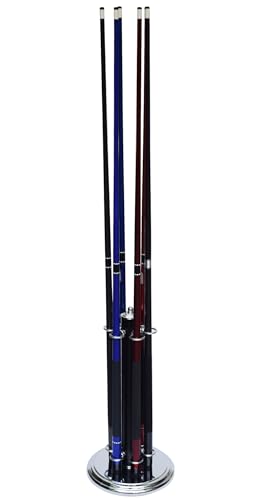
1. Hathaway Westmont 25-in Floor Pool Cue Rack — Best Freestanding Floor Rack
If you're not ready to drill holes in your walls, the Hathaway Westmont is the cleanest freestanding solution in this roundup. It stores up to six cues in a compact 12-inch diameter base, which means it slides neatly into a corner without eating up the floor space you need for your actual game. The powder-coated steel center post gives it a modern industrial look that doesn't feel cheap, and the brushed stainless accents add a subtle premium touch that you'd expect from a rack at a higher price point. Assembly is minimal — the post drops into the base and the cue slots snap into position — so you'll have it set up in under ten minutes without hunting for tools.
Day to day, the Hathaway Westmont performs exactly as advertised. The six cue slots hold sticks securely upright without any wobble, which is the whole point — keeping your cues vertical prevents the gravity-driven bending that causes warping over time. The base is stable enough that a stray elbow won't send everything crashing down, though it's obviously not as permanently fixed as a wall-mounted option. The smooth, easy-to-clean powder-coat surface means chalk dust and dust in general just wipe off with a soft cloth, which is a small but genuinely appreciated detail if your game room sees regular use.
Where this rack has limits is capacity — six cues is enough for a home setup, but if you host regular game nights or have multiple players with personal sticks, you'll feel the pinch. The floor-standing design also means it can tip if bumped with any real force, so placement matters more than it would with a wall mount. That said, for a single household with a couple of dedicated sticks and a few house cues, this one checks every box at a fair price in 2026.
Pros:
- Compact 12-inch base fits easily into corners or tight spaces
- Durable powder-coated steel construction with brushed stainless accents
- No wall mounting required — completely freestanding and repositionable
- Easy to assemble and clean with minimal maintenance
Cons:
- Limited to six cues, which may not be enough for larger households
- Less stable than wall-mounted options if placed in a high-traffic area
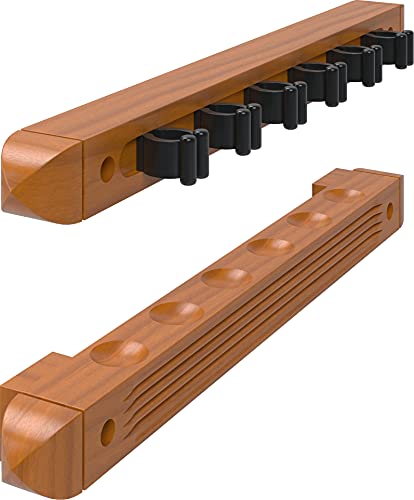
2. Fat Cat 2-Piece Wall Mounted Hardwood Billiard/Pool Cue Rack — Best Classic Wood Wall Mount
Fat Cat has been a trusted name in billiard accessories for years, and this 2-piece hardwood wall rack is one of the reasons why. The design is straightforward and timeless — two separate mounting pieces, one at the top for the cue butts and one lower down for the shafts, working together to hold six cues flush against the wall in a way that looks intentional rather than improvised. The classic wood finish blends naturally with most game room décor, whether you're going for a traditional pub feel or a more modern rec room aesthetic. The warm tone of the hardwood gives it an elevated look that plastic alternatives simply can't replicate.
Installing the Fat Cat rack requires two mounting points per piece, which means four wall anchors total — nothing a basic drill and stud finder can't handle in about 20 minutes. Once it's up, the rack holds cues firmly and keeps them separated to prevent shaft-to-shaft contact that can cause finish wear over time. Because the rack presses your cues flat against the wall, it saves floor space entirely, which is a big advantage if your game room is on the smaller side. The two-piece design also makes it straightforward to adjust the spacing between the upper and lower pieces to accommodate cues of different lengths, including longer snooker-style sticks.
The main trade-off here is that this rack isn't quite as visually decorative as some of the more ornate options on the list — it's clean and functional rather than a statement piece. Hardware is included, though reviewers occasionally note that the provided anchors are on the lighter side, so you might want to swap in your own for a more permanent installation. For the price, though, it's hard to beat the combination of real hardwood construction and reliable cue protection.
Pros:
- Real hardwood construction with a warm, classic finish
- Space-saving wall-mount design keeps floors completely clear
- Two-piece system allows for adjustable spacing to fit various cue lengths
Cons:
- Requires wall drilling — not ideal for renters or temporary setups
- Included mounting hardware could be more robust
3. Skylety 2-Piece Pool Stick Holder Wall Rack — Best Budget Wall-Mount Option
If your primary goal is affordable, functional wall storage without the premium price tag of hardwood, the Skylety 2-piece rack is worth your attention. It holds six cues using a combination of an ABS plastic frame and EVA foam cue clips, which is a smarter material choice than it might sound — the foam conforms slightly around each cue to grip it securely without scratching the shaft or tip. The full mounting hardware kit is included in the package, which means you're not making a separate hardware store run before you can get this thing on the wall.
Installation is genuinely simple, even if you're not particularly handy with a drill. The instructions are clear about confirming the mounting height based on your cue length before you commit to drilling, which is a thoughtful touch that prevents the most common installation mistake. Once mounted, the two-piece wall layout gives you a similar profile to the Fat Cat above — cues rest against the wall with tips up and butts down, keeping them perfectly vertical and warp-free. The EVA foam clips hold each cue individually, so pulling one out doesn't disturb the others the way a shared channel design might.
The honest trade-off with the Skylety is that ABS plastic simply doesn't carry the same visual weight or long-term durability as hardwood or steel. It's a perfectly functional rack and the material quality is better than cheap imports, but if your game room has a high-end look and feel, this one might look slightly out of place next to premium furniture. For a basement rec room, a garage setup, or a shared space where you just need reliable cue storage without spending much, it's a smart, practical choice that delivers well above its price point in 2026.
Pros:
- Complete mounting hardware included — ready to install out of the box
- EVA foam cue clips protect cue shafts and tips from scratches
- Affordable price point makes it accessible for casual players
- Individual cue slots prevent cross-contamination between sticks
Cons:
- ABS plastic construction lacks the premium feel of wood or steel alternatives
- May not blend as naturally with upscale game room décor
4. 9TH SHOP Pool Cue Holder Floor Stand — Best Heavy-Duty Metal Floor Rack
The 9TH SHOP floor stand is the option you reach for when you want the freedom of a freestanding rack combined with the durability and look of commercial-grade equipment. Built entirely from heavy-duty metal with a matte black finish, this rack sits at 11 inches wide by 11 inches deep by 24 inches tall, giving it a stable footprint that doesn't feel like it'll tip at the first opportunity. The metal ring design has been specifically upgraded to eliminate inward-facing protrusion points — a smart engineering choice that protects your cue shafts from the kind of pressure marks and finish damage that poorly designed rings can cause over time.
The 9TH SHOP rack holds six cues simultaneously, and unlike some floor stands where the cues feel loosely corralled in a shared space, each slot here keeps sticks properly separated and upright. It's equally at home in a private billiard room and a commercial billiards club, which speaks to its build quality — you wouldn't buy a rack for a club if it couldn't handle daily handling by multiple players. The matte black finish is neutral enough to work with virtually any décor, from industrial-modern game rooms to more traditional setups. If your space trends toward dark wood tones and leather furniture, the black metal actually complements that look quite well.
The only real caveat is that at 24 inches tall, this rack is shorter than some players might expect — it's sized for cues in the standard 57- to 58-inch range, and very long custom cues might overhang in a way that feels unstable. For the overwhelming majority of players with standard-length sticks, though, that's a non-issue. As a floor stand, it's also slightly more prone to tipping than a wall-mounted option in high-traffic spaces, though the wide base minimizes that risk considerably compared to thinner-profile designs.
Pros:
- Heavy-duty metal construction designed for both home and commercial use
- Upgraded ring design prevents damage to cue shaft surfaces
- Matte black finish is versatile and complements most game room styles
- Stable 11x11-inch base reduces tipping risk compared to narrower stands
Cons:
- 24-inch height may not accommodate unusually long custom cues comfortably
- Floor placement means it can still be displaced in very high-traffic areas
5. Mizerak 6-Cue Hardwood Wall Rack — Best for Cue Preservation
Mizerak is one of the oldest and most respected names in billiard accessories, and this 6-cue hardwood wall rack reflects the brand's commitment to straightforward quality. Made from solid hardwood with a polished finish, it mounts directly to your wall and holds cues vertically, which is the storage position that billiard professionals and cue makers uniformly recommend for preventing warp. The construction is notably dense for a rack in its category — this doesn't feel like particle board with a veneer, it feels like real wood, and the finish reflects light evenly in a way that looks clean in any game room setting.
The warp-resistant storage angle is worth dwelling on, because it's the core functional value of any cue rack. According to cue sports equipment standards, even minor warping of a cue shaft can measurably affect aiming accuracy and ball deflection, particularly at longer distances. Storing cues vertically and off the floor, as the Mizerak design does, eliminates the gravitational stress that causes that warping over months and years of use. For players who've invested in mid-range or higher-end cues, this is a non-trivial benefit that justifies the wall-mount installation effort entirely.
Installation is standard for a wall-mounted rack — find your studs or use appropriate drywall anchors and mount the two-piece bracket system. The cues hang vertically once mounted, and the polished hardwood frame looks sharp against most wall colors. The main limitation is the same as any 6-cue wall rack: capacity is fixed, and if you have a growing collection or frequently host players who bring their own sticks, you'll want something with more slots. For a household with a dedicated table and a regular rotation of six or fewer cues, though, this is one of the cleanest and most durable options in the category.
Pros:
- Solid hardwood construction with a polished, game-room-ready finish
- Vertical mounting position actively prevents cue warping over time
- Trusted Mizerak brand with a long track record in billiard accessories
Cons:
- Wall mounting requires drilling — not suitable for renters
- Capacity capped at six cues, which may feel limiting for larger collections
6. Ozone Billiards Roman-Style Two-Piece Wall Rack — Best for Décor-Forward Game Rooms
If you've put real thought and money into your game room's aesthetics, the Ozone Billiards Roman-style rack is the one that earns its place on the wall as a visual element, not just a storage solution. The mahogany stain finish is rich and deep, with carved detailing that sets it apart from every other rack on this list in terms of decorative quality — it looks like something you'd see mounted in an upscale billiard hall or a well-appointed home bar rather than a mass-market accessory. Ozone Billiards is a specialty retailer focused exclusively on billiard room equipment, and that focus shows in the attention to detail here.
The two-piece wall rack format is tried and true — upper piece holds the cue tips or butts, lower piece supports the opposite end, keeping all six cues perfectly vertical. The Roman-style architectural detailing on the wood framing gives it a classical symmetry that photographs well and integrates seamlessly with darker wood tones, green felt table surfaces, and traditional game room color palettes. If your room features a mahogany or walnut pool table surround, this rack becomes a cohesive design choice rather than an afterthought. Installation follows the standard two-piece wall mounting process, requiring a few anchor points and a level to ensure everything lines up cleanly.
Functionally, it performs on par with the other hardwood wall racks in this roundup — six cues stored vertically, off the floor, with good separation between shafts. The premium comes from the aesthetic craftsmanship, so if you're focused purely on utility and don't care about decorative detail, one of the simpler options above might be a better value. But if your game room is a genuine showpiece and you want a rack that contributes to that impression, this one is worth every dollar of the price premium over plainer alternatives.
Pros:
- Roman-style carved detailing makes it a decorative feature, not just storage
- Rich mahogany stain integrates beautifully with traditional game room aesthetics
- Specialty billiards brand with focused expertise in room accessories
Cons:
- Premium aesthetic comes at a higher price than plainer hardwood alternatives
- Traditional style may feel out of place in modern or minimalist game rooms
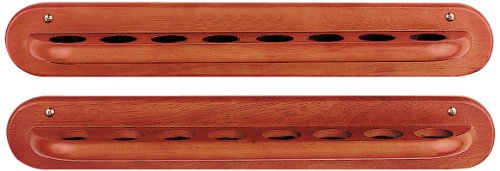
7. HJ Scott 8-Cue Wall Rack, Black — Best for High-Capacity Storage
Every other rack on this list maxes out at six cues, and for a lot of households that's perfectly sufficient. But if you've got a growing collection, host regular game nights, or run a small commercial billiard setup where players bring their own sticks, the HJ Scott 8-cue wall rack solves a capacity problem that the other options simply can't. Two extra slots might sound minor, but in practice that's the difference between having room for house cues plus personal sticks, or constantly having to lean extras against the wall and defeating the whole purpose of the rack in the first place.
The black finish gives it a sharp, modern look that works well in both home and commercial settings — it's not as decoratively detailed as the Ozone Roman-style rack, but it's clean and professional-looking in a way that doesn't draw attention for the wrong reasons. Wall mounting keeps it permanently fixed, which is the right call for a rack storing eight cues — the combined weight of a full load of sticks would make a freestanding version genuinely unstable. Installation follows the standard two-piece wall-mount process, and at the larger size you'll definitely want to hit actual studs rather than relying on drywall anchors alone.

Where the HJ Scott earns its place on this list is in the specific niche it fills. If you're comparing it to a six-cue wall rack and you only have four sticks right now, the six-cue version is probably sufficient and more proportionate to your wall space. But if you're already hitting six and know your collection will keep growing, buying the 8-cue version once is smarter than wall-mounting a six-cue rack and then going through the whole process again six months later. Think of it as buying ahead of your needs for a one-time installation cost. Understanding the nuances between different cue sports might also help you determine how many sticks you truly need — our piece on 8-ball vs 9-ball pool covers the equipment differences between game formats in useful detail.
Pros:
- 8-cue capacity exceeds every other option on this list by two slots
- Clean black finish works in both home and light commercial environments
- Wall-mounted design provides the stability needed for a fully loaded rack
Cons:
- Requires stud mounting for full eight-cue load — drywall anchors alone aren't ideal
- Less decorative than wood-grain or carved alternatives
How to Pick the Best Pool Cue Rack
Floor-Standing vs. Wall-Mounted: Which Type Fits Your Setup?
This is the first decision to make, and it's largely driven by your living situation and how permanent you want the installation to be. Wall-mounted racks like the Fat Cat, Mizerak, and HJ Scott options require drilling into your wall, which delivers maximum stability and keeps your floor space completely unobstructed. If you own your home and have a dedicated game room, wall mounting is almost always the better long-term choice — the rack becomes a fixed part of the room rather than something you're repositioning around your furniture. The trade-off is that installation takes more planning and effort upfront, and you're committing to specific anchor points on your wall.
Floor-standing racks like the Hathaway Westmont and 9TH SHOP models, on the other hand, require zero wall commitment. You can place them anywhere, move them easily when you rearrange furniture, and take them with you if you move. The key limitation of floor stands is stability — a wall-mounted rack with proper anchors is essentially immovable, while a floor stand can tip if bumped with enough force. If you have small children or pets in the space, this is a real consideration, since a tipping rack full of cues creates both a mess and a safety hazard. Weigh the flexibility of floor placement against the stability of a permanent wall mount based on how you actually use your game room.
Capacity: How Many Cues Do You Actually Need to Store?
Most racks on the market hold six cues, which is the right number for the majority of home setups — a couple of personal sticks plus a few house cues for guests covers most scenarios comfortably. The calculus changes if you're an avid collector, if multiple household members each have their own dedicated cue, or if you're setting up a rack in a semi-commercial environment like a bar or rec center. In those cases, the 8-cue HJ Scott becomes a more sensible purchase, since running out of slots defeats the purpose of having a rack at all and forces the bad habits — leaning cues against walls, leaving them on tables — that cause warping and damage.
It's also worth thinking about where your collection might be in a year or two. Cue collecting is a surprisingly common progression for players who start casual and gradually get more serious about the game. Buying one slot more than you currently need is usually better than buying exactly to your current collection size and immediately feeling the constraint.
Material and Durability: Steel, Hardwood, or Plastic?
Each material brings distinct trade-offs in terms of durability, aesthetics, and price. Hardwood racks — like the Fat Cat, Mizerak, and Ozone options — offer a warm, traditional look that ages gracefully and blends naturally with most game room furniture. Solid hardwood is genuinely long-lasting, though it's susceptible to humidity changes over time in the same way any wood product is. Steel racks like the Hathaway Westmont and 9TH SHOP floor stand offer industrial durability with minimal maintenance — the powder-coat finish resists scratches and cleans easily without any special care. ABS plastic options like the Skylety are the most budget-accessible and are more resistant to moisture than wood, but they don't carry the same visual weight or longevity as the premium alternatives.
Consider where the rack will live. A basement game room with variable humidity might be better served by a steel or plastic rack than by hardwood, while a climate-controlled dedicated billiard room is where hardwood's aesthetic advantages really shine without the durability concerns.
Cue Protection: Slots, Clips, and Contact Points
Every rack on this list keeps cues vertical, which is the single most important factor in preventing warping. Beyond that, the design of the cue contact points matters for protecting your shaft finish and tip. Individual cue slots or clips — like the EVA foam clips on the Skylety or the separated ring openings on the 9TH SHOP — are preferable to open-channel designs where cues can rest against each other. Shaft-to-shaft contact can cause finish abrasion over time, particularly if cues are frequently inserted and removed. If you've invested in cues above the entry-level price range, individual slot separation is a feature worth prioritizing.
What People Ask
What is the best way to store pool cues to prevent warping?
The most effective method is storing cues vertically and upright, which is exactly what any rack on this list provides. When a cue is stored horizontally or leaned at an angle, gravity applies continuous pressure along the shaft, which gradually causes bending over months of storage. Storing vertically eliminates that gravitational stress entirely. Temperature and humidity stability also matter — keeping cues in a climate-controlled space prevents the wood from expanding and contracting unevenly, which is another common cause of warping in shaft-heavy cues.
How many cues should a pool cue rack hold?
For most home setups, a 6-cue rack is the practical sweet spot. It comfortably accommodates two personal cues, a break cue, and two or three house cues for guests — covering the majority of home game scenarios. If you host regular game nights with players who bring their own sticks, or if multiple people in your household each have a dedicated personal cue, stepping up to an 8-cue rack like the HJ Scott makes sense. For commercial or club environments, even more capacity may be warranted, but the 6-8 cue range covers virtually all residential needs in 2026.
Is a floor-standing or wall-mounted pool cue rack better?
Neither is universally better — it depends on your space and priorities. Wall-mounted racks are more stable, save floor space entirely, and look more integrated into a dedicated game room. Floor-standing racks are portable, require no installation, and work well in apartments or temporary setups. If you own your home and have a permanent billiard setup, wall mounting is generally the preferred choice among serious players. If you're renting or want flexibility, a quality floor stand like the Hathaway Westmont or 9TH SHOP model is the practical alternative.
Can pool cue racks damage cue shafts?
A poorly designed rack with sharp protrusion points or a shared open channel can cause cosmetic scratches or finish abrasion on cue shafts over time, especially with frequent use. Higher-quality racks address this through individual padded clips (like EVA foam), smooth ring openings without interior protrusions (like the upgraded rings on the 9TH SHOP), or precisely machined wooden slots that hold cues without contact along the shaft body. When evaluating a rack, pay attention to what material and design the cue contact points use — that's where long-term shaft protection actually happens.
Do I need a special rack for two-piece pool cues?
No — virtually all of the racks on this list accommodate standard two-piece cues without any special modification. Two-piece cues, which break down at the joint for transport and storage, can be stored either assembled or disassembled. Most players store them assembled in a rack to avoid repeatedly joining and separating the cue, which can wear the joint threads over years of use. The standard 57- to 58-inch assembled length fits all racks reviewed here without issue.
How do I mount a wall pool cue rack securely?
The most secure installation anchors directly into wall studs rather than relying solely on drywall anchors. Use a stud finder to locate studs before drilling, and if the rack's mounting points don't align with studs, use heavy-duty toggle bolts rated for the combined weight of the rack plus a full load of cues. Most cues weigh between 18 and 21 ounces, so a fully loaded 8-cue rack could carry close to 12 pounds of cues in addition to the rack's own weight. Mounting level is also important — use a bubble level to ensure both pieces of a two-piece rack are perfectly aligned horizontally before finalizing your anchor screws.
Buy on Walmart
- Hathaway Westmont 25-in Floor Pool Cue Rack – Powder-Coated — Walmart Link
- Fat Cat 2-Piece Wall Mounted Hardwood Billiard/Pool Cue Rack — Walmart Link
- Skylety 2 Pieces Pool Stick Holder Pool Cue Rack for 6 Cue W — Walmart Link
- 9TH SHOP Pool Stick Holder, Pool Cue Rack, Pool Cue Holder F — Walmart Link
- Mizerak 6-Cue Hardwood Wall Rack – Billiard Cue Holder – War — Walmart Link
- Ozone Billiards Roman-Style Two-Piece Wall Rack - 6 Pool Cue — Walmart Link
- HJ Scott 8-CUE Wall Rack, Black — Walmart Link
Buy on eBay
- Hathaway Westmont 25-in Floor Pool Cue Rack – Powder-Coated — eBay Link
- Fat Cat 2-Piece Wall Mounted Hardwood Billiard/Pool Cue Rack — eBay Link
- Skylety 2 Pieces Pool Stick Holder Pool Cue Rack for 6 Cue W — eBay Link
- 9TH SHOP Pool Stick Holder, Pool Cue Rack, Pool Cue Holder F — eBay Link
- Mizerak 6-Cue Hardwood Wall Rack – Billiard Cue Holder – War — eBay Link
- Ozone Billiards Roman-Style Two-Piece Wall Rack - 6 Pool Cue — eBay Link
- HJ Scott 8-CUE Wall Rack, Black — eBay Link
Next Steps
- Decide whether a floor-standing or wall-mounted rack fits your space and installation preferences, then use that as your first filter to narrow down the list above.
- Count your current cue collection and estimate where it might be in the next year or two — then choose a rack with at least one or two extra slots to grow into.
- Check the current price on Amazon for your top one or two candidates, since prices in this category shift frequently and the best-value option can change week to week.
- Read through the full user reviews on Amazon for your shortlisted rack, paying particular attention to comments about long-term durability and installation experience.
- Once your rack is set up, revisit our guide on how to clean and maintain your pool table to make sure your whole billiard setup stays in top condition through 2026 and beyond.


About Mike Jones
Mike Jones grew up in the golden age of arcade and home gaming — a childhood shaped by Atari classics like Pitfall, Frogger, and Kaboom that gave him a lifelong appreciation for games of all kinds. These days he covers the full breadth of tabletop and family gaming: board games, card games, yard games, table games, and game room setup, with a particular focus on finding the games that bring different groups together. At GamingWeekender, he covers game reviews, buying guides, and recommendations for families, friends, and hobbyists who take their leisure seriously.
You can get FREE Gifts. Or latest Free phones here.
Disable Ad block to reveal all the info. Once done, hit a button below