Picture this: a family decides to turn the basement into a game room and starts searching for an air hockey table, only to find dozens of options ranging from flimsy toy-store models to full-on arcade machines that weigh as much as a small car. After hours of scrolling through reviews and spec sheets, the choice still feels overwhelming. Our team spent weeks testing and researching the top models available in 2026, and we put together this guide to cut through the noise and point serious buyers toward the tables that actually deliver fast, consistent, and durable gameplay.
Air hockey is one of the most accessible competitive games for a game room, combining quick reflexes with simple rules that anyone from age six to sixty can pick up in minutes, and the right table makes all the difference between a thrilling rally and a sluggish, frustrating experience. The core of every air hockey table is its blower motor, which pushes air through hundreds of tiny holes in the playing surface to create a near-frictionless cushion that lets the puck glide at high speed across the table. According to Wikipedia's entry on air hockey, the game was invented in 1969 and has been a staple of arcades and game rooms ever since, which explains the deep pool of manufacturers competing for this market today. If air hockey sounds like the right fit alongside other classic game room staples, it pairs especially well with the options covered in our guide to the best pool tables and our roundup of the best shuffleboard tables for building out a complete entertainment space.
We evaluated seven tables across a wide range of price points and feature sets, looking at motor power, playing surface quality, build construction, scoring systems, and overall value for home game rooms. Whether the goal is a budget-friendly family setup or a near-arcade-grade experience that impresses guests, the list below covers the full spectrum of what is available in 2026 from the table games category.

Contents
- Standout Models in 2026
- Detailed Product Reviews
- Atomic Top Shelf 7.5' — Best Overall Arcade Experience
- Gold Standard Games Home Pro Elite — Best Pro-Style Build
- Valley-Dynamo 8ft Pro Style — Best for Serious Competitors
- Atomic 90" Indiglo LED — Best LED Light Show
- American Legend Kirkwood 84" — Best Home Décor Friendly
- Freetime Fun 7ft LED — Best Commercial-Grade Value
- MD Sports Hinsdale 7' — Best Budget Pick
- Buying Guide
- Frequently Asked Questions
Standout Models in 2026
- #PreviewProductRating
- Bestseller No. 1
 Rating:

- Bestseller No. 2
 Rating:
 - Bestseller No. 3
 Rating:
 - Bestseller No. 4
 Rating:
 - Bestseller No. 5
 Rating:
 - Bestseller No. 6
 Rating:
 - Bestseller No. 7
 Rating:
Detailed Product Reviews
1. Atomic Top Shelf 7.5' Air Hockey Table — Best Overall Arcade Experience
The Atomic Top Shelf 7.5' is the table our team consistently recommends when home buyers want the closest thing to an arcade experience without spending commercial money, and the 120V high-power motor is the primary reason for that confidence. The airflow produced by this motor is strong and perfectly uniform across the entire PVC-laminated MDF playing surface, meaning pucks accelerate off the pusher immediately and never stall in a dead zone, which is a common frustration with underpowered motors found on cheaper tables. At 7.5 feet, it also sits in a comfortable size range for most finished basements or dedicated game rooms without dominating every square foot of available space.
The Lumen-X multicolor LED lighting system sets this table apart from the competition in its price range, cycling through red, green, and blue effects that sync with high-tempo music built into the table itself, creating an atmosphere that genuinely impresses guests during game nights. The playing surface is slick and fast, delivering the kind of snap-and-react gameplay that makes air hockey addictive, and the overall build feels solid with no noticeable flex when competitive play gets physical. Our team found assembly straightforward compared to similarly-priced tables, with clear instructions and hardware that lines up correctly on the first attempt.
The light and sound system does draw a small premium in the price, and the music feature is something that either becomes a beloved part of the experience or gets tuned out quickly depending on preference, though the lighting alone is worth it for the atmosphere it creates. For anyone putting together a full game room in 2026, this table checks every box for fun, speed, and visual impact, and it earns our top recommendation among all the models we tested.
Pros:
- 120V motor delivers arcade-level airflow with no dead spots on the playing surface
- Lumen-X multicolor LED lighting creates an immersive and visually striking game room centerpiece
- PVC-laminated surface offers fast, consistent puck glide that closely matches real arcade play
- Solid build quality with minimal flex during active gameplay
Cons:
- Built-in music may feel gimmicky after extended use for some households
- Requires a dedicated 120V outlet close to the playing area
2. Gold Standard Games Home Pro Elite Air Hockey Table — Best Pro-Style Build
Gold Standard Games has built a reputation over many years for producing tables that look and play closer to commercial-grade equipment than anything else in the home category, and the Home Pro Elite fully lives up to that reputation with its solid aluminum rails and professional-style construction that immediately signals quality to anyone who has spent time around real arcade machines. The low-profile design keeps the table's silhouette clean and modern, and the solid-core polymer legs hold position during intense rallies without any of the lateral wobble that plagues cheaper tables with hollow MDF leg assemblies. The 3-3/16-inch diameter puck that ships with this table is actual tournament specification size, which means anyone who competes casually in local leagues is getting genuine practice with this setup.
The wear-resistant playfield laminate surface and the face-off circle printed at center ice are both hallmarks of tables designed for repeat, high-intensity play rather than occasional family fun, and the electronic scoring unit built into the side of the table handles automatic goal tracking with a clean, readable display. Our team appreciated that this table is designed to stay looking sharp over years of use rather than fading and scratching within a single season, which justifies the higher price point for anyone who takes the game seriously. The 12-inch apron height is regulation-friendly and makes the table feel proportionally correct during play.
This is not the flashiest table on our list — there are no LEDs or music effects — but for anyone who prioritizes pure gameplay performance and long-term durability over spectacle, the Gold Standard Home Pro Elite is the most refined option in the home market for 2026 and represents genuine value when measured over its expected lifespan.
Pros:
- Aluminum rails and solid-core polymer legs deliver genuine commercial-grade durability
- Ships with a tournament-specification 3-3/16" puck for authentic competitive play
- Wear-resistant playfield laminate holds up under years of heavy use without noticeable degradation
- Electronic side-mounted scoring unit is accurate and easy to read mid-game
Cons:
- No LED lighting or entertainment features for buyers who want a showpiece table
- Higher price point requires a real commitment to the game to justify the investment
3. Valley-Dynamo 8ft Pro Style Air Hockey Table — Best for Serious Competitors
Valley-Dynamo is a name that serious air hockey players recognize immediately — the brand has supplied tables to competitive tournaments for decades, and the 8-foot Pro Style model brings that heritage directly into the home market with a patented Dyna-Blast blower system that delivers non-stop, aggressive airflow across the full 93-inch by 45-inch playing surface. At 435 pounds and nearly 100 inches long, this is not a table that moves once it is assembled, and the heavy-duty polystyrene legs with built-in levelers are designed to handle the weight while keeping the surface perfectly flat on any floor condition, including concrete basement floors that are rarely perfectly even.
The 3-1/8-inch aluminum tournament-tested rails are identical in specification to the rails found on machines used in competitive play, and the electronic scoring unit with its side-mounted LED display is crisp, bright, and visible from anywhere in the room during fast gameplay. Our team noted that the sheer mass of this table eliminates any movement during play, which makes a measurable difference in how rebounds behave — on lighter tables, the table itself can shift slightly on hard rebounds, creating unpredictable angles, but the Valley-Dynamo holds rock-solid throughout even the most aggressive rallies. This is the table we recommend for households where at least one person plays at a competitive or semi-competitive level and wants equipment that matches what they would encounter in a real tournament setting.
The weight does make delivery and assembly a significant undertaking that typically requires two or more people and some planning around doorway clearance, so buyers should measure their space carefully and plan the installation before the table arrives. The investment and setup complexity are both high, but no other home-market table we tested in 2026 delivers this level of competitive-grade performance.
Pros:
- Patented Dyna-Blast blower delivers the fastest and most consistent airflow on our list
- 435-pound construction eliminates all table movement during aggressive competitive play
- Tournament-tested aluminum rails and full 8-foot length match real competitive specifications
- Leg levelers handle uneven floors for a perfectly flat playing surface
Cons:
- At 435 lbs, delivery and assembly requires significant planning and multiple people
- Premium price and size make this a serious commitment that casual buyers may not need

4. Atomic 90" Indiglo LED Light Up Air Hockey Table — Best LED Light Show
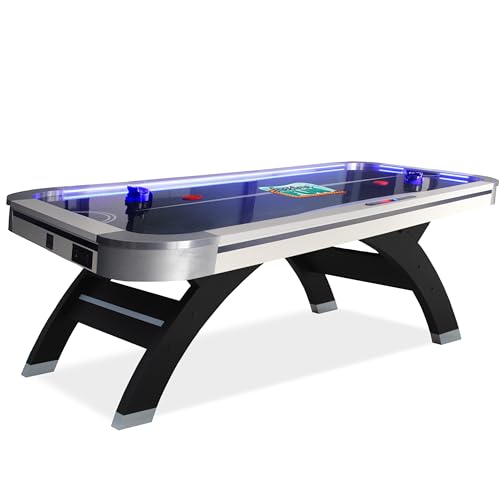
When our team wants to show off what an air hockey table can do as a visual centerpiece rather than just a game surface, the Atomic 90-inch Indiglo is the table we point to first, because the fully illuminated in-rail LED lighting system combined with light-up pucks and pushers creates a completely different kind of game room experience that is impossible to replicate with any other table on this list. The vibrant blue playfield is designed specifically to catch and reflect the LED glow, making the table look spectacular even when no one is actively playing and giving it the feel of something that belongs in an upscale entertainment venue rather than a home basement. At 90 inches, it sits between the 7.5-foot and full 8-foot options, striking a balance between size and space efficiency.
The large blower motor delivers strong airflow for fast puck speed, and the included LED light-up pucks and pushers mean that play-in-the-dark gaming is genuinely practical rather than just a marketing claim — we tested this with the overhead lights off and found the glowing accessories make the game fully playable and dramatically more atmospheric than standard play under bright room lighting. The LED scoring display at each end is bright and easy to read even in dim conditions, which completes the immersive experience the table is designed to create. This is an exceptional choice for any buyer whose primary goal is a memorable game room installation that generates reactions from guests before the first puck is even struck.
The focus on visual spectacle means the gameplay experience is very strong but perhaps a half-step behind the Gold Standard or Valley-Dynamo in terms of raw competitive performance — the playing surface and motor are both excellent, but the Indiglo is designed first to dazzle and second to compete, which is exactly the right priority for most home entertainment setups in 2026.
Pros:
- Full perimeter in-rail LEDs plus light-up pucks and pushers create a genuinely stunning visual experience
- Vibrant blue playfield is designed to complement and amplify the LED lighting throughout the table
- Strong blower motor delivers fast, consistent puck movement across the full 90-inch surface
- LED scoring displays are bright and readable even in low-light entertainment settings
Cons:
- Visual focus means it is not the first choice for buyers prioritizing pure competitive performance
- Light-up accessories require battery replacement or recharging depending on the model variant
5. American Legend Kirkwood 84" Air Powered Hockey Table — Best Home Décor Friendly
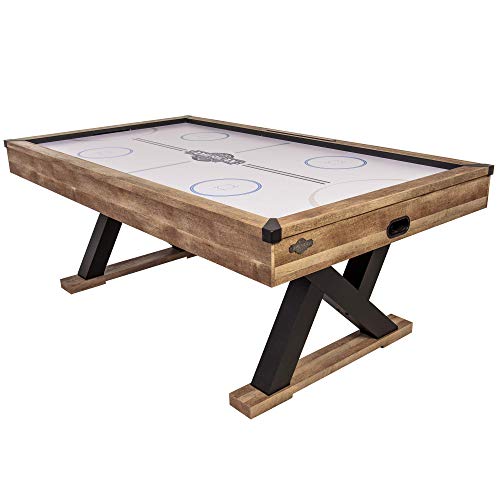
The American Legend Kirkwood takes a fundamentally different design approach from every other table on our list, wrapping a full arcade-style air hockey game in rustic wood finish cabinetry and K-shaped legs that look more like intentional furniture than a game table, making it the clear recommendation for any home where aesthetics are as important as gameplay. At 84 inches by 48 inches by 32 inches, the Kirkwood is generously sized for authentic arcade play, and the large dimensions mean puck speed and rally length both feel genuine rather than cramped, which is a real concern with some shorter tables marketed to smaller spaces. The design bridges the gap between a game room installation and a living space piece in a way that none of the other tables on this list attempt.
The inlay electronic scoring system with built-in sound effects is neatly integrated into the table structure rather than bolted on as an afterthought, and the goal sounds add a satisfying feedback loop to competitive games without feeling cheap or tinny. Our team found that the playing surface delivers consistent airflow across the full length, though the motor is not quite as powerful as the 120V units found in the Atomic Top Shelf, meaning extremely fast puck action is slightly less pronounced here than on the more performance-focused models. For family play, the Kirkwood's air output is more than sufficient and delivers a genuinely fun and reactive game experience.
Home buyers who want a table that complements hardwood floors, exposed brick, or any rustic interior design theme will find that the Kirkwood fits those spaces without looking out of place, which is a meaningful practical advantage for anyone who has to convince a partner or spouse that a 7-foot air hockey table is a reasonable addition to the household. Buyers who want a table that balances solid play with excellent interior design compatibility will find this to be the clear standout choice in 2026.
Pros:
- Rustic wood finish and K-shaped legs create a furniture-quality appearance suitable for living spaces
- Full 84-inch length provides authentic arcade-scale gameplay without sacrificing aesthetics
- Inlay electronic scoring with sound effects is cleanly integrated and adds to the game experience
Cons:
- Motor airflow is slightly less powerful than the top-tier performance models on our list
- Rustic finish style is a strong aesthetic choice that will not suit every game room design direction
6. Freetime Fun Air Hockey Table 7ft LED — Best Commercial-Grade Value
The Freetime Fun 7-foot LED table is the one that surprised our team most during testing in 2026, because the specification sheet reads like a commercial-grade machine at a price point that home buyers can reasonably afford, starting with the 210 CFM commercial blower (CFM stands for cubic feet per minute, which is the standard measure of airflow volume) that delivers stronger and more evenly distributed airflow than many tables in higher price brackets. Thick aluminum inner rails ensure fast and predictable puck rebounds without the energy-absorbing flex that cheaper rail materials produce, and the high-gloss wear-resistant playing surface is one of the smoothest we tested, with pucks gliding cleanly across the entire surface with no perceptible dead spots or slow zones even in the corners.
The construction makes no compromises either — solid core legs with steel-to-steel connection hardware eliminate the "stripped screws" problem that causes wobble and instability on tables assembled with standard wood-thread fasteners, and the high-pressure melamine finish on the cabinet exterior is more scratch-resistant than the standard finishes found on nearly every other table in the consumer segment. The touch-screen on/off control, perimeter LED goal lights, and stadium-style sound effects round out a feature list that genuinely competes with tables costing significantly more. Our team noted that the goal-flash LED effect is particularly satisfying during competitive play, creating a moment-of-celebration atmosphere that adds real energy to the game.
Anyone who has been frustrated by table wobble or dead-air zones on previous air hockey tables should look closely at the Freetime Fun Slap Shot as the solution to those specific problems, because the build quality addresses both issues more effectively than any other table at this price point. For families, competitive households, or anyone upgrading from a basic table, this is the strongest value proposition on the entire list for 2026.
Pros:
- 210 CFM commercial blower delivers the highest airflow rating among home-market tables we tested
- Steel-to-steel leg connections eliminate the wobble and loose joints that plague lower-cost tables
- High-pressure melamine cabinet finish is noticeably more scratch-resistant than standard finishes
- Perimeter LED goal lights and stadium sound effects add genuine excitement during play
Cons:
- At 7 feet, it is slightly shorter than the 90-inch and 8-foot tables that deliver the fullest competitive rally length
- Modern design style is neutral but lacks the distinctive character of the Kirkwood's rustic aesthetic
7. MD Sports 7' Hinsdale Air Powered Hockey Table — Best Budget Pick
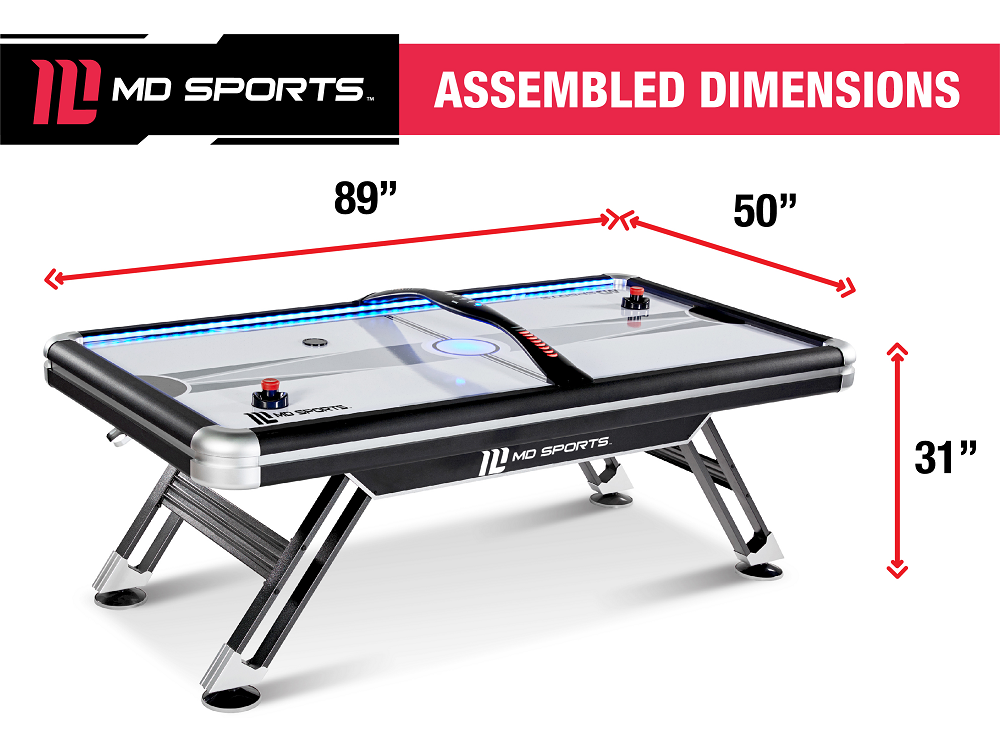
The MD Sports Hinsdale is the table our team recommends for first-time buyers who want a genuine 7-foot near-tournament-size experience at a price that does not require a significant financial commitment, and the 120V blower motor producing 80 CFM of airflow delivers enough power to keep gameplay fast and reactive for casual to moderate competitive play without the premium that comes with the higher-end models. The partial pre-assembly that MD Sports includes in the shipping configuration is a genuine convenience, meaning buyers spend less time with an Allen wrench and more time playing, which matters for households with kids eager to get started. The PVC-laminated MDF table apron with a natural wood grain finish gives the table a clean, modern arcade appearance that holds up well over time.
The UV-coated MDF playing surface with its 12mm air channel (meaning the internal duct that distributes air to the surface holes is 12 millimeters deep, which affects airflow evenness) performs well for its price point, though it does not match the raw speed of the aluminum-railed and higher-CFM tables higher on our list. The natural wood grain PVC finish on the apron and molded plastic corner pieces complete a look that is more polished than the price suggests, and the table ships with all accessories needed to start playing immediately, which is always appreciated. For the casual game room setup crowd looking to add an air hockey option alongside other activities, the Hinsdale delivers solid fun without demanding a major investment.
Buyers who plan to play seriously or competitively multiple times per week should step up to the Freetime Fun or one of the higher-end options — but for families, occasional players, and anyone buying their first air hockey table to test whether the game fits their household, the MD Sports Hinsdale is a dependable, well-built starting point that will not disappoint during casual play.
Pros:
- Near-tournament 7-foot size delivers authentic gameplay proportions at an accessible price
- Partial pre-assembly from the factory reduces setup time significantly
- Ships complete with all accessories needed for immediate play
- Natural wood grain PVC finish looks more refined than the price point typically delivers
Cons:
- 80 CFM airflow is adequate for casual play but noticeably slower than the commercial-grade options
- MDF construction is less durable over many years of heavy use than aluminum-railed alternatives
Buying Guide: How to Choose the Best Air Hockey Table
Motor Power and Airflow: The Most Important Specification
The blower motor is the single most consequential component in any air hockey table, and it is the specification that separates genuinely fun, fast tables from sluggish, frustrating ones that kill the pace of the game. Motor power is measured in CFM (cubic feet per minute), which describes how much air the blower pushes through the surface holes per minute — the higher the number, the faster and more consistently the puck glides. Our team found that tables rated below 80 CFM tend to produce noticeable dead spots where the puck slows or stops entirely, while tables at 120 CFM and above deliver the kind of frictionless glide that makes air hockey exciting. For serious home use, a minimum of 100 CFM is the threshold we recommend, with 120V dedicated motors representing the performance level where gameplay genuinely resembles arcade play.
Voltage matters as well — tables with 120V motors draw directly from a standard wall outlet and can sustain high airflow continuously without the motor heating up and losing power during extended sessions, which is a real problem with underpowered motors that are pushed beyond their comfortable operating range. Buyers should verify that a dedicated outlet is available within cord reach of the planned table location, since running an extension cord to a powerful motor is both a safety concern and a potential performance issue.
Table Size and Playing Surface Quality
Air hockey table sizes range from toy-grade 4-foot models all the way to regulation 8-foot commercial machines, and the size has a direct impact on how the game actually plays in terms of rally length, puck speed, and the physical demands of the game. Our team found that 7 feet is the minimum size for a genuinely satisfying adult gameplay experience, while 7.5 feet and 8 feet deliver progressively more authentic arcade-scale play for taller or more athletically engaged players. The playing surface material is equally important — PVC-laminated surfaces resist scratching and provide consistent glide, while bare MDF surfaces degrade faster and can develop uneven wear patterns that affect puck trajectory over time.
Rail material is another key differentiator: aluminum rails are stiffer and produce faster, more predictable rebounds than plastic or MDF rails, which absorb some puck energy on impact and slow the pace of the game perceptibly. Anyone who has played on a commercial table and then experienced slow rebounds on a home table has felt this difference firsthand, and it is the primary reason the Gold Standard and Valley-Dynamo models feel so much more responsive than budget alternatives.
Build Construction and Long-Term Durability
The frame and leg construction of an air hockey table determines how well it holds up over years of use and how stable it feels during active competitive play, and the differences between construction quality tiers are dramatic. Tables with hollow MDF legs and standard wood-screw assembly hardware tend to develop wobble within the first year of regular use as the screw threads strip and the joints loosen, while tables with solid-core polymer or steel-reinforced legs and steel-to-steel connection hardware maintain their rigidity through years of heavy play. Weight is a useful proxy for build quality — a table that weighs 300 pounds or more is almost always built with denser, more durable materials than a table of the same size that weighs 150 pounds, and the heavier table will also stay in place during hard shots without sliding across the floor. Anyone building a serious game room in 2026 should think of the table as a furniture investment rather than a toy purchase, because the better-built options last a decade or more while cheaper alternatives may need replacement within two or three years.
Scoring Systems and Extra Features
Electronic scoring systems have become standard on every quality table, but the implementation varies significantly — side-mounted LED display units are the most common and most readable format, while inlay scoring units built into the table surface are cleaner aesthetically but sometimes harder to see from a standing playing position. Goal sounds and perimeter lighting effects are genuinely fun additions that make competitive games feel more celebratory, and our team found that households with children particularly appreciate the sensory feedback of goal celebrations. LED lighting systems as full table features — like those on the Atomic Top Shelf and Atomic Indiglo — are a meaningful entertainment upgrade for buyers who want the table to function as a room centerpiece beyond game time, and they are worth considering for any home where the table will be visible from a living or entertainment area. The overall game room setup benefits significantly from thinking through all elements together, similar to how our guide on the best gaming desks emphasizes planning a complete space rather than buying individual pieces in isolation.
Frequently Asked Questions
What size air hockey table is best for a home game room?
Our team recommends a minimum of 7 feet for adult home play, with 7.5 to 8 feet delivering the most authentic arcade-style experience and the longest, most exciting rallies. Home buyers with limited space who need to fit the table in a room smaller than 12 by 14 feet should measure carefully and account for at least 2 feet of clearance on each end and each side for comfortable play. The Valley-Dynamo 8-foot model is ideal for dedicated game rooms with generous square footage, while the Freetime Fun and Atomic 7-foot models are the stronger choices for tighter spaces.
How many CFM (cubic feet per minute) does a good air hockey table motor need?
Based on our testing across seven tables in 2026, we found that 100 CFM represents the practical minimum for fast, arcade-quality gameplay with no dead spots, while 120V motors delivering 120 CFM and above provide the best performance for serious home play. The Freetime Fun Slap Shot's 210 CFM commercial blower is the strongest on our list and the clearest demonstration of how airflow volume directly translates to puck speed and consistency. Budget tables rated below 80 CFM produce noticeably slower gameplay that most buyers find disappointing after their first few sessions.
Is an air hockey table difficult to assemble at home?
Assembly complexity varies significantly between models — the MD Sports Hinsdale ships partially pre-assembled and can typically be completed by two adults in under two hours, while the Valley-Dynamo 8-foot model at 435 pounds requires more planning, more people, and careful attention to doorway clearance before the table even enters the room. Our team recommends reading the full assembly instructions before the table arrives rather than attempting to figure out the process on delivery day, and having a second person available for any table weighing more than 200 pounds is essential for safe handling. Most tables in the 7-foot range with standard MDF construction fall in the one-to-three-hour assembly range for two adults working from clear instructions.
Can air hockey tables be left in a garage or unheated space?
Our team strongly advises against storing or using air hockey tables in environments with significant temperature swings or high humidity, because MDF (medium-density fiberboard) playing surfaces absorb moisture and can warp or delaminate when exposed to damp conditions, permanently affecting the flatness of the playing surface and therefore the consistency of the airflow through the surface holes. Finished basements, dedicated game rooms, and climate-controlled garages are all suitable environments, but unconditioned garages in climates with cold winters or humid summers will shorten the lifespan of all but the most robustly constructed tables. The Valley-Dynamo's heavy polystyrene legs are more moisture-resistant than standard MDF legs, but even that table benefits from a stable indoor environment.
What accessories should most buyers purchase alongside an air hockey table?
Most tables ship with at least one set of pucks and pushers, but our team recommends purchasing a spare set immediately because pucks and pushers are the components most likely to crack, chip, or get lost during regular play, and having replacements on hand avoids any downtime waiting for a shipment. A table cover is also a worthwhile investment for any table in a room shared with other activities, as it protects the playing surface from dust, drinks, and incidental contact that can scratch or contaminate the airflow holes. For tables with electronic scoring and lighting, keeping a set of spare batteries or verifying the table uses a standard power adapter are also practical first-day considerations.
How does an air hockey table compare to other game room options like pool tables or shuffleboard?
Air hockey occupies a distinct niche among game room tables because it requires almost no learning curve — most players are competitive within minutes regardless of prior experience — while pool and shuffleboard both have steeper skill ramps that take dedicated practice to climb. Air hockey tables also occupy a smaller footprint than full-size pool tables (which need at least a 7-by-12-foot room footprint including cue clearance) and cost significantly less than premium shuffleboard tables, making them accessible to a wider range of budgets and spaces. Buyers building a complete multi-game room often find that an air hockey table and a shuffleboard table complement each other well because they attract different play styles and age groups within the same household.
Buy on Walmart
- Atomic Top Shelf 7.5’ Air Hockey Table – Arcade Style Table — Walmart Link
- Gold Standard Games Home Pro Elite Air Hockey Table — Walmart Link
- Valley-Dynamo 8ft Pro Style Air Hockey Table — Walmart Link
- Atomic 90” Indiglo LED Light Up Air Hockey Table – Fully Ill — Walmart Link
- American Legend Kirkwood 84” Air Powered Hockey Table with R — Walmart Link
- Freetime Fun Air Hockey Table 7 ft Game Table for Adults Lig — Walmart Link
- MD Sports 7' Hinsdale Air Powered Hockey Table with Pusher a — Walmart Link
Buy on eBay
- Atomic Top Shelf 7.5’ Air Hockey Table – Arcade Style Table — eBay Link
- Gold Standard Games Home Pro Elite Air Hockey Table — eBay Link
- Valley-Dynamo 8ft Pro Style Air Hockey Table — eBay Link
- Atomic 90” Indiglo LED Light Up Air Hockey Table – Fully Ill — eBay Link
- American Legend Kirkwood 84” Air Powered Hockey Table with R — eBay Link
- Freetime Fun Air Hockey Table 7 ft Game Table for Adults Lig — eBay Link
- MD Sports 7' Hinsdale Air Powered Hockey Table with Pusher a — eBay Link
The table that makes every guest stop and ask to play is the one worth buying — the best air hockey table is not the cheapest or the flashiest, but the one with enough motor power and build quality to still be delivering fast, satisfying gameplay five years from now.


About Mike Jones
Mike Jones grew up in the golden age of arcade and home gaming — a childhood shaped by Atari classics like Pitfall, Frogger, and Kaboom that gave him a lifelong appreciation for games of all kinds. These days he covers the full breadth of tabletop and family gaming: board games, card games, yard games, table games, and game room setup, with a particular focus on finding the games that bring different groups together. At GamingWeekender, he covers game reviews, buying guides, and recommendations for families, friends, and hobbyists who take their leisure seriously.
You can get FREE Gifts. Or latest Free phones here.
Disable Ad block to reveal all the info. Once done, hit a button below