Picture this: you've cleared out space in the basement, told yourself you're finally going to build the game room you've been dreaming about, and now you're standing in front of a screen scrolling through shuffleboard tables wondering why some cost $400 and others cost $4,000. It's a fair question, and the answer matters a lot more than most people realize before they buy. A table that's too short, too flimsy, or too fancy for your actual space will frustrate you every time you play.
Shuffleboard has made a serious comeback in 2026. What was once a staple of bars and rec centers has found its way into home game rooms across the country — and for good reason. The game is easy to learn, genuinely competitive, and appeals to everyone from kids to grandparents. If you're building out your table games collection, a shuffleboard table is one of the most social additions you can make. But choosing the right one means understanding size, playfield quality, construction, and budget before you commit.
We've dug deep into the 2026 market and put together honest reviews of seven shuffleboard tables across different sizes, price points, and styles. Whether you have room for a compact 9-footer or a full bar-length 22-footer, there's something here for you. Let's break it down.
Contents
- Standout Models in 2026
- Our Hands-On Reviews
- Hathaway Excalibur 9-Ft — Best Budget 9-Footer
- Hathaway Merlot 12-Ft — Best Mid-Range 12-Footer
- Barrington Billiards Coventry 12-Ft — Best Industrial Style
- VEVOR 9-Ft 2-in-1 — Best for Variety
- Atomic Azure LED 9-Ft — Best for Game Room Aesthetics
- Atomic Platinum Classic 9-Ft — Best Classic Pick
- Playcraft Telluride 22-Ft — Best Premium Large Table
- What to Look For When Buying
- FAQs
- Next Steps
Standout Models in 2026
- #PreviewProductRating
- Bestseller No. 1
 Rating:

- Bestseller No. 2
 Rating:
 - Bestseller No. 3
 Barrington Billiards 12' Coventry Shuffleboard Table with Scratch-Resistant Playfield and 8 Puck SetRating:
 - Bestseller No. 4
 Rating:
 - Bestseller No. 5
 Rating:
 - Bestseller No. 6
 Rating:
 - Bestseller No. 7
 Rating:
Our Hands-On Reviews
1. Hathaway Excalibur 9-Ft Shuffleboard Table — Best Budget 9-Footer
If you're new to shuffleboard and want to see whether you'll actually use the table before spending serious money, the Hathaway Excalibur is the place to start. At 9 feet long, it fits comfortably in most finished basements or rec rooms without dominating the space. The rustic driftwood finish gives it a laid-back, cabin-style look that works well in casual settings — this isn't a table trying to look like serious bar furniture, and that's okay. It's honest about what it is: an accessible entry point to the game.
The poly-coated playfield is one of the better features at this price. Puck glide is smooth and consistent, and you won't be fighting the surface on every shot. The built-in abacus scorers (sliding bead scorekeepers mounted on the side rails) are a nice touch — no phone apps or paper scorecards needed. The X-pattern base keeps things stable, and the carpeted gutters along the sides help dampen the sound of pucks that drift off the playing surface. Assembly is manageable for one person with basic tools, though two people will make it easier.
Where it shows its budget roots is in the engineered wood cabinet construction. It does the job, but don't expect the feel of a solid hardwood table. The 9-foot length is also a real limitation for serious players — at this size, the game plays faster and leaves less room for strategy compared to longer formats. Still, for families, casual play, or anyone just getting started, the Excalibur delivers solid value. You get eight pucks (four blue, four red), a brush, and wax right out of the box, so you're ready to play from day one.
Pros:
- Smooth poly-coated playfield with consistent puck action
- Built-in abacus scorers on both sides
- Carpeted gutters reduce noise and keep pucks contained
- Complete set — pucks, brush, and wax included
- Rustic driftwood finish looks great in casual game rooms
Cons:
- Engineered wood cabinet is not as durable as solid wood options
- 9-foot length limits strategic depth for experienced players
- Levelers work but require patience to get perfectly even
2. Hathaway Merlot 12-Ft Shuffleboard Table — Best Mid-Range 12-Footer
The Merlot is where Hathaway gets serious. Stepping up to 12 feet makes a real difference — the extra length opens up the game considerably, adding a layer of strategy and pacing that shorter tables simply can't replicate. The walnut finish is warm and rich, the kind of look that fits naturally alongside pool tables and bar carts without looking out of place. At 144 inches long by 24 inches wide, it's a commitment in terms of floor space, but if you have the room, this is a table worth making space for.
The playfield here is a genuine standout. 1.75-inch solid birch butcher block (a thick, layered wood surface) coated with 10 layers of lacquer is the kind of construction you typically see on tables at a higher price point. That depth of finish means pucks glide consistently and the surface holds up to heavy use over time. The solid 1-inch wood aprons (the side panels framing the playfield) and double-paneled legs give this table a sturdy, planted feel — it doesn't wobble during play, even with enthusiastic throws. Built-in 1.5-inch leg levelers let you compensate for uneven floors.
There's a climate adjuster system (adjustable brackets under the playfield that allow for slight bowing correction) which is a feature you don't usually see until you spend significantly more. Wood warps with humidity changes, and having that adjustment capability preserves your playing surface over time. The package includes eight pucks, a brush, and wax — everything to start playing immediately. If you're looking for the sweet spot between price and quality, the Merlot hits it cleanly. It outperforms its price tag in almost every area that matters for gameplay.
Pros:
- 1.75-inch solid birch butcher block playfield with 10-layer lacquer finish
- Climate adjusters protect against wood warping over time
- Solid 1-inch wood aprons and double-paneled legs for excellent stability
- 12-foot length adds real strategic depth to the game
- Walnut finish is elegant and versatile for game room décor
Cons:
- Requires more floor space — not suitable for smaller rooms
- Assembly takes time and is easier with a second person
3. Barrington Billiards 12' Coventry Shuffleboard Table — Best Industrial Style
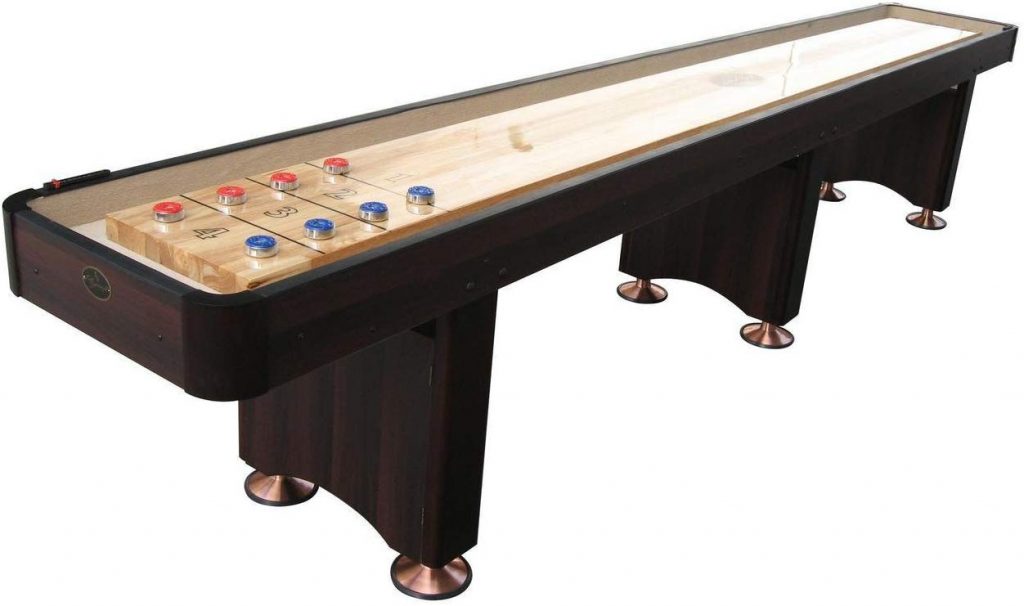
The Coventry takes a different visual approach than every other table in this roundup. Where most shuffleboard tables lean into warm wood tones, this one goes industrial — metal legs with black baked paint, a painted wood veneer apron, and a look that's closer to a loft apartment than a traditional game room. If your space has concrete floors, exposed brick, or a modern aesthetic, the Coventry will fit right in. It ships mostly preassembled, which is a genuine advantage over the competition and earns it real points for convenience.
The 12-foot playfield uses 1.75-inch solid wood in a butcher block design with a scratch-resistant poly coating. Puck action is fast and smooth, and the poly coating does a good job of protecting the surface through heavy play sessions. Two cup holders and a phone shelf built into both ends of the table are small but genuinely useful details — small conveniences that matter when you're mid-game and need somewhere to set your drink. The metal legs provide solid stability, and the industrial frame means this table isn't going to flex or shift during play.
The MDF apron with painted wood veneer finish gives a high-end furniture look at a mid-range price, though MDF (medium-density fiberboard, a manufactured wood product) isn't as robust as solid wood if it ever takes on moisture. That's something to keep in mind if your game room experiences humidity swings. That said, for most indoor environments this is a non-issue. The Coventry also includes an 8-puck set to get you started. For buyers who want a table that doubles as a design statement, this one delivers without the premium price tag of boutique brands.
Pros:
- Distinctive industrial design with metal legs and modern finish
- Ships mostly preassembled — significantly easier setup
- Built-in cup holders and phone shelf on both ends
- 1.75-inch solid wood butcher block playfield with poly coating
- Fast, consistent puck action right out of the box
Cons:
- MDF apron is vulnerable to moisture — avoid damp environments
- Industrial aesthetic won't suit every game room style
4. VEVOR 9-Ft 2-in-1 Shuffleboard and Bowling Combo — Best for Variety
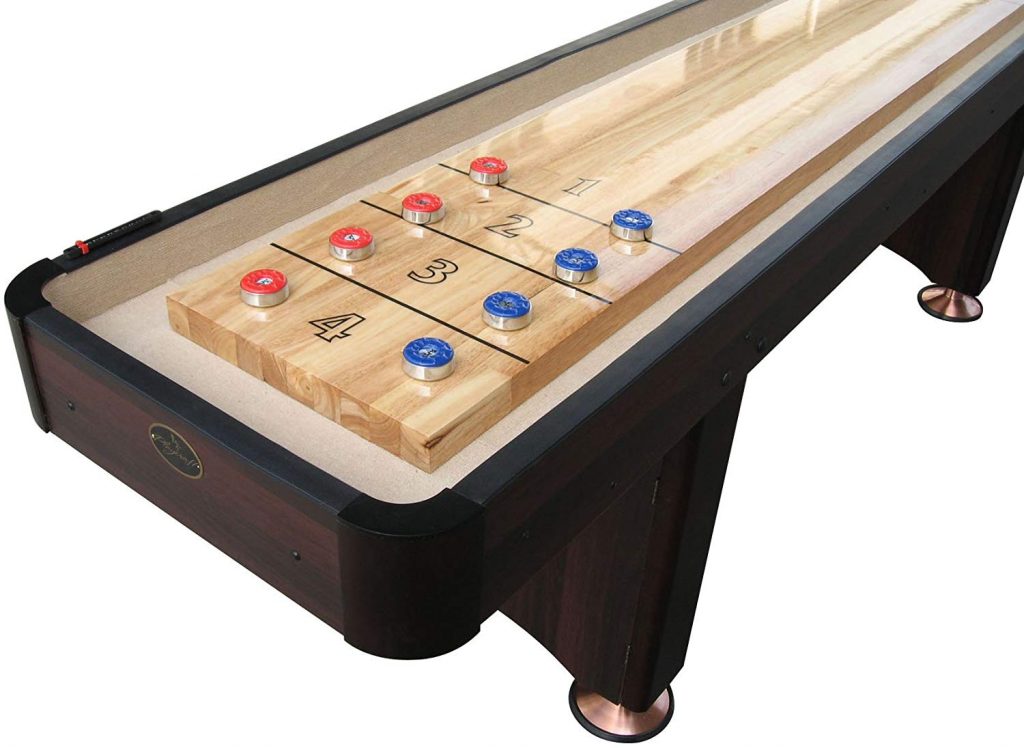
VEVOR takes an interesting angle with their 9-foot table by bundling in a bowling game mode alongside traditional shuffleboard. The concept is simple: set up the included bowling pins at one end and roll pucks toward them instead of playing standard shuffleboard scoring zones. It's a format that works especially well if you have kids in the mix, since the bowling mode is immediately intuitive and gets younger players involved without needing to explain the rules of shuffleboard. Speaking of getting kids involved, if you're building out your game library beyond the table itself, check out our picks for top family board games that pair well with game room nights.
The 9-foot playfield features a poly-coated surface with a glossy, scratch-resistant finish — the same basic spec you'd expect at this size. Puck action is smooth and the surface holds up well to the repeated throwing involved in the bowling format, which can be harder on a surface than standard shuffleboard play. The table's legs are adjustable and provide a stable base. VEVOR is a brand known for value-focused manufacturing, and that shows here — the materials are functional rather than premium, but they serve the purpose well for casual and family use.
If you're an experienced shuffleboard player looking for a training table or serious game room centerpiece, this probably isn't your pick. The 9-foot length limits the game, and the construction won't impress anyone used to premium tables. But if you have a diverse household — kids who want something engaging, adults who want to play shuffleboard, and you're working with limited space — the VEVOR 2-in-1 is a genuinely clever solution. It's one of the few tables in this price range that actually earns its keep by doing two things reasonably well.
Pros:
- Two games in one — shuffleboard and bowling modes
- Great for families with younger children
- Glossy, scratch-resistant poly-coated playfield
- Adjustable legs for stability on uneven floors
- Complete accessories included out of the box
Cons:
- Construction quality is functional but not premium
- 9-foot length limits serious shuffleboard play
5. Atomic 9' Azure LED Shuffleboard Table — Best for Game Room Aesthetics
The Azure is the most visually dramatic table in this roundup, and it earns that distinction. LED lighting runs along the side rails and legs, throwing a cool glow across the room when the lights are low. The graphite laminate cabinet paired with black carpeting creates a clean, dark look that photographs beautifully and genuinely impresses guests. If your game room setup prioritizes atmosphere as much as gameplay, this table delivers something none of the others can match. It's the shuffleboard equivalent of a gaming setup with RGB lighting — functional, but designed to make a statement.
Beyond the aesthetics, the gameplay experience holds up. The poly-coated playfield provides smooth, fast puck action, and the LED scoring system is a clever update to the traditional abacus design — illuminated scoring squares slide together along the rail, making it easy to track scores even in a dimly lit room. Eight LED pucks (which glow during play) and shuffleboard powder are included, so the visual experience carries through to the actual game. This is also a 9-foot table, which as noted elsewhere has its strategic limitations, but for casual play and entertainment it's more than adequate.
The graphite finish and LED features come at a premium over basic 9-foot alternatives, so you're paying for the experience as much as the hardware. The table isn't targeting serious competitive players — it's targeting people who want their game room to feel like an event. If that's you, the Azure is worth every dollar of the price difference. If you purely care about playfield quality and length-for-dollar value, other tables here will serve you better. This one is for people who want their friends to say "wow" when they walk in.
Pros:
- Integrated LED lighting along rails and legs creates a stunning visual effect
- LED scoring system is easy to read in low light
- Includes 8 LED-glow pucks for a fully immersive experience
- Graphite laminate and black carpeting look sharp in modern game rooms
- Smooth poly-coated playfield delivers consistent puck performance
Cons:
- Premium price for a 9-foot table — you're partly paying for aesthetics
- LED components add complexity that could eventually require maintenance
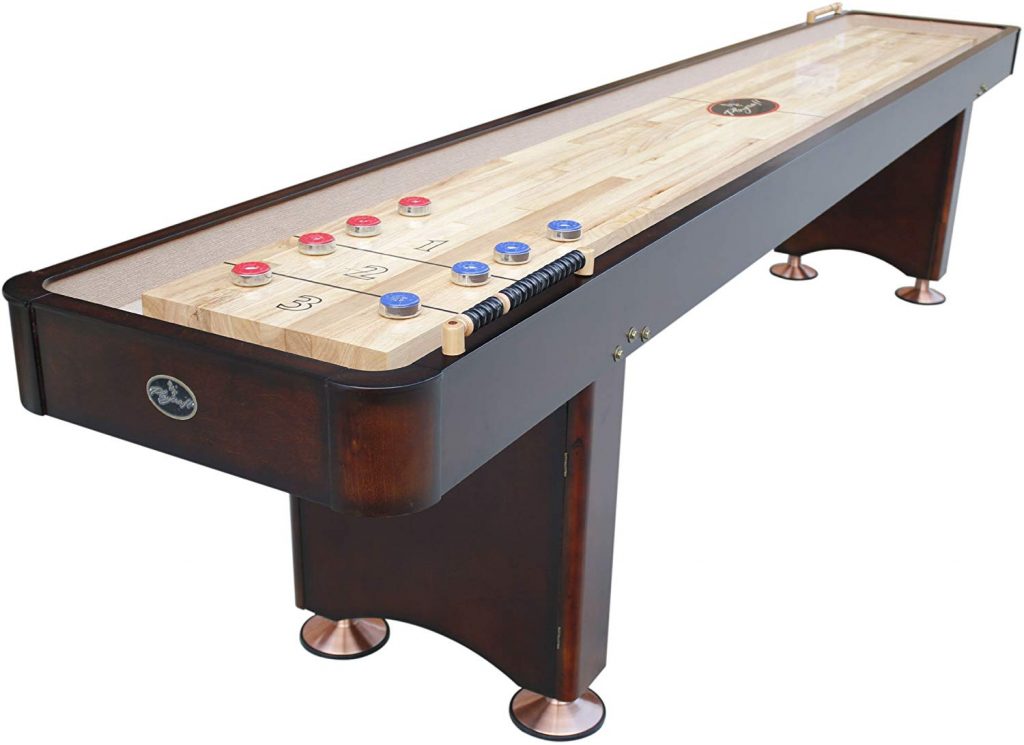
6. Atomic Platinum Classic 9-Ft Shuffleboard Table — Best Classic Pick
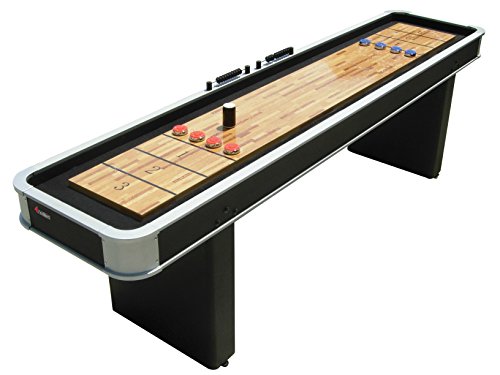
The Atomic Platinum Classic is exactly what it sounds like — a no-frills, well-built 9-foot table that gets the fundamentals right without trying to impress you with extras. Atomic is a respected name in game room furniture, and the Platinum Classic represents their standard-bearer approach to the category: quality construction, reliable playfield, clean aesthetics. The platinum finish has a neutral, timeless look that fits almost any game room without fighting for attention.
The poly-coated playing surface delivers smooth, fast puck action that serious casual players will appreciate. It's a consistent surface that doesn't require a lot of break-in time — you can wax it and start playing right away. Pedestal legs with levelers provide optimum stability and allow you to dial in a perfectly flat playing surface regardless of your floor condition. The pedestal-style legs also give the table a slightly more furniture-grade appearance than standard bracket legs, adding to the overall quality impression without inflating the price.
This is a table for someone who knows what shuffleboard is, wants a reliable table at home, and doesn't need a bowling mode, LED lighting, or a 22-foot runway. It fits into most game rooms easily, plays well from day one, and will hold up to years of regular use. It's the kind of table you buy when you've done your research and know exactly what you need. If you're someone who also enjoys games like bocce in the backyard, you might appreciate our breakdown of the best bocce ball sets for outdoor play — a great complement to an indoor shuffleboard setup.
Pros:
- Reliable poly-coated playfield with fast, consistent puck glide
- Pedestal legs with levelers for stable, level play
- Clean, neutral platinum finish works in any game room
- Trusted Atomic brand with proven durability
- Fits in most game rooms without floor space sacrifice
Cons:
- No standout special features — purely functional
- 9-foot length remains the primary limitation for advanced play
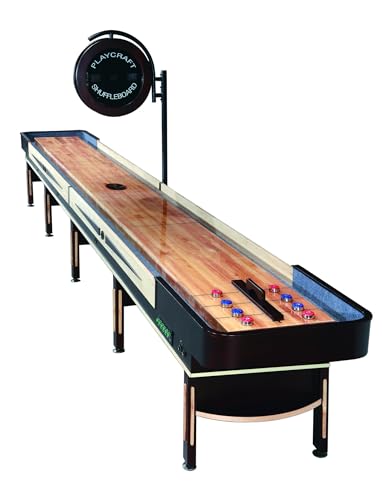
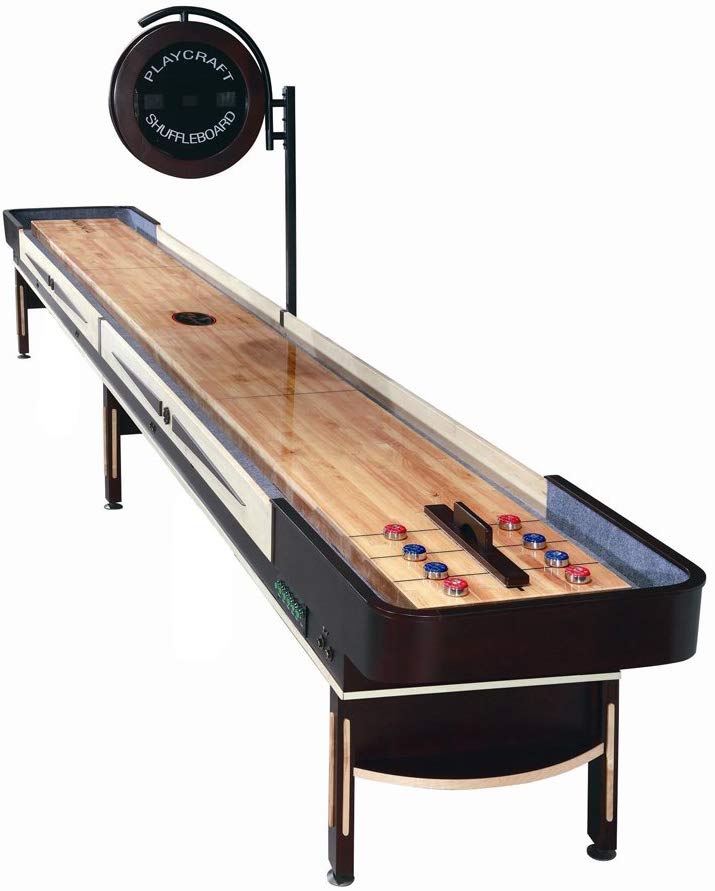
7. Playcraft Telluride Espresso 22-Ft Shuffleboard Table — Best Premium Large Table
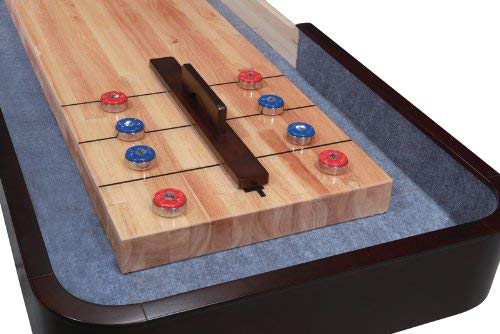
The Playcraft Telluride is a different category of purchase entirely. At 22 feet, this is a competition-regulation length shuffleboard table built with furniture-quality construction and a price tag to match. The rich espresso finish and hardwood edge-glued vertical stave butcher block playfield (a construction method using narrow vertical strips of hardwood glued together for maximum stability and surface consistency) put it squarely in the premium tier. If you've ever played on a top-tier bar table and wondered what it would be like to have that experience at home, this is what that looks like.
The 22-foot length changes the entire nature of the game. Pucks travel farther, strategy becomes more deliberate, and the game slows down in the best possible way — more like chess, less like a party game. The hardwood butcher block playfield is the kind of surface that rewards consistent waxing and technique, and the 24-inch electronic scorer with a Lexan (clear polycarbonate) face adds a modern convenience touch to an otherwise traditional table. The 22-foot version ships with a 2-piece playfield (joined at the middle), which requires careful alignment during setup but is a practical necessity at that length for shipping purposes.
This table demands a dedicated room with serious clearance — you'll need well over 25 feet of total length to play comfortably, plus width to move around. It's not a casual purchase. But for the serious enthusiast, someone converting a garage or basement into a proper game room, or anyone who hosts regular games and wants the real experience, the Telluride delivers at every level. Playcraft's build quality is well-established, and this table is built to last decades with proper maintenance. It's worth comparing notes on other substantial game room investments — for instance, if you're also looking at larger table options, our best bubble hockey table guide covers another premium segment of the market well.
Pros:
- Full 22-foot competition length for authentic, strategic gameplay
- Hardwood edge-glued vertical stave butcher block playfield — outstanding surface quality
- Beautiful furniture-quality espresso finish
- 24-inch electronic scorer with Lexan face
- Built for decades of use with proper care
Cons:
- Requires very large dedicated space — not practical for most homes
- Significant investment — premium price tier
- 2-piece playfield requires careful alignment during assembly
What to Look For When Buying Shuffleboard Tables
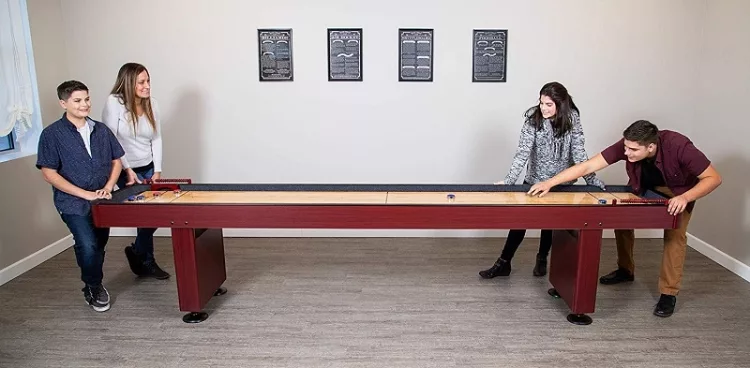
Table Length: The Most Important Decision You'll Make
Length is the single biggest factor in your buying decision, and it affects everything — how the game plays, how much space you need, what the table costs, and how serious the gameplay can get. Here's a simple breakdown for 2026 buyers:
- 9 feet — Entry level, compact, great for families and casual play. Works in most finished basements. Fast-paced game with limited strategy.
- 12 feet — The sweet spot for most home buyers. Adds meaningful length without requiring a dedicated large room. Strategy becomes more relevant.
- 14–18 feet — Enthusiast territory. Great for regular players who want a real game. Requires a dedicated room with significant clearance.
- 20–22 feet — Competition/bar length. Serious investment in space, money, and commitment to the game.
As a general rule of thumb, add at least 3 feet to each end of the table for comfortable throwing stance. So a 12-foot table needs roughly 18 feet of total room length minimum. Measure your space first, then shop — don't work backwards from the table you like.
Playfield Quality: Where Performance Lives
The playfield (the surface you slide pucks across) is the heart of the table. Better playfields mean more consistent, enjoyable gameplay and longer service life. Here's what to look for:
- Thickness — 1.75 inches or more is the standard for quality home tables. Thicker playfields resist warping better over time.
- Material — Solid wood (maple, birch, vertical stave hardwood) outperforms engineered wood (MDF, laminate). Solid wood can be refinished; MDF cannot.
- Coating — Poly coating is standard on most consumer tables and provides good puck glide. Lacquer (10+ layers) is superior and more durable. Some premium tables use both.
- Climate adjusters — Wood moves with humidity. Tables with built-in adjustment brackets let you compensate for seasonal warping and maintain a flat playfield year-round.
Construction and Stability: Don't Ignore the Frame
A wobbly table kills the game. The frame, legs, and apron all contribute to how stable and pleasant the table feels during play.
- Leg design — Pedestal legs are generally more stable and better-looking than simple bracket legs. Levelers on all legs are non-negotiable for uneven floors.
- Cabinet material — Solid wood aprons outlast MDF. For humid environments (garages, basements without climate control), solid wood or metal frames are far more durable than MDF.
- Gutters — Carpeted gutters dampen sound and keep errant pucks from bouncing off the table. Rubber gutters work too but can be noisier.
- Weight — Heavier tables tend to be more stable and better built. A table that feels light and hollow usually is.
Accessories, Scoring, and Long-Term Costs
Most tables include the basics — eight pucks, a brush, and wax. That's enough to start, but keep in mind that shuffleboard wax (also called powder or sand) is a recurring consumable. You'll need to wax and brush the table before every play session to maintain proper puck speed. Factor this into your long-term ownership cost.
- Scoring systems — Abacus-style bead scorers are reliable and simple. Electronic scorers are convenient but add potential failure points. LED scorers (like the Atomic Azure) are the newest option.
- Puck quality — Budget pucks included with entry-level tables are fine to start, but serious players often upgrade to weighted, precision-machined pucks for more consistent play.
- Maintenance — Budget a small amount for wax and occasional playfield conditioning. A well-maintained playfield lasts significantly longer and plays better than a neglected one.
FAQs
What size shuffleboard table is best for a home game room?
For most home buyers in 2026, a 12-foot table is the sweet spot. It delivers a genuinely strategic game without requiring a massive dedicated room. If you only have space for 9 feet, that works too — it's still fun, just faster-paced. If you have the room for 14 feet or more and play regularly, go as long as your space allows. The longer the table, the better the game.
How much room do I need around the table?
Add at least 2–3 feet on each end for throwing clearance, and at least 2 feet on each side to walk around comfortably. So a 12-foot table ideally needs a room that's at least 17–18 feet long and 8 feet wide. Measure your space carefully before buying — shuffleboard tables are not easy to return once assembled.
How do I maintain a shuffleboard table?
Maintenance comes down to three things: waxing, brushing, and climate control. Before each game, spread a light layer of shuffleboard powder (wax/sand) across the playfield and brush it evenly. Keep the room's humidity relatively stable — extreme swings cause wood to warp. If your table has climate adjusters, use them seasonally. Wipe the playfield clean with a dry cloth after play and cover it when not in use to reduce dust buildup.
What's the difference between shuffleboard powder and silicone spray?
Shuffleboard powder (also called wax or sand) is the traditional surface conditioner — tiny granules that reduce friction and let pucks glide smoothly. Silicone spray is a liquid alternative that some players prefer for a slightly different feel. Most consumer tables and manufacturers recommend powder for regular use, and it's what's typically included in table packages. Silicone spray can work well but may require more frequent reapplication.
Can a shuffleboard table be used outdoors?
Standard shuffleboard tables are not designed for outdoor use. Exposure to moisture, temperature swings, and direct sunlight will warp and damage the playfield quickly. If you want outdoor shuffleboard, look specifically for tables marketed as outdoor or weatherproof models — they use different materials and coatings designed to handle the elements. None of the tables reviewed here are suitable for permanent outdoor placement.
Is shuffleboard hard to learn?
Not at all — shuffleboard is one of the easiest table games to pick up. The basic rules are simple: slide pucks toward the scoring zones at the far end and try to outscore your opponent. You can explain the core game to a new player in about two minutes. The depth comes from strategy and touch (learning how hard to throw, how to knock opponent pucks off the scoring zones), which develops naturally over a few sessions. It's genuinely one of the most accessible games you can add to a game room.
Buy on Walmart
- Hathaway Excalibur 9-Ft Shuffleboard Table for Great for Fam — Walmart Link
- Hathaway Merlot 12 Foot Shuffleboard Table for Family Game R — Walmart Link
- Barrington Billiards 12' Coventry Shuffleboard Table with Sc — Walmart Link
- VEVOR Shuffleboard Table, 9 ft Shuffleboard for Family Game — Walmart Link
- Atomic 9' Azure LED Shuffleboard Table – Light‑Up Rails & Le — Walmart Link
- Atomic 9’ Platinum Classic Shuffleboard Table – Smooth Poly‑ — Walmart Link
- Playcraft Telluride Espresso 22’ Shuffleboard Table — Walmart Link
Buy on eBay
- Hathaway Excalibur 9-Ft Shuffleboard Table for Great for Fam — eBay Link
- Hathaway Merlot 12 Foot Shuffleboard Table for Family Game R — eBay Link
- Barrington Billiards 12' Coventry Shuffleboard Table with Sc — eBay Link
- VEVOR Shuffleboard Table, 9 ft Shuffleboard for Family Game — eBay Link
- Atomic 9' Azure LED Shuffleboard Table – Light‑Up Rails & Le — eBay Link
- Atomic 9’ Platinum Classic Shuffleboard Table – Smooth Poly‑ — eBay Link
- Playcraft Telluride Espresso 22’ Shuffleboard Table — eBay Link
Next Steps
- Measure your room first. Take exact measurements of your available floor space (length and width) before looking at specific tables. Rule out anything that won't fit with proper clearance on all sides.
- Check current prices on Amazon. Shuffleboard table prices fluctuate, and several of these models go on sale at different times of year. Click through to Amazon to see today's live price before making a final decision.
- Compare playfield specs side by side. Use the comparison table above to weigh playfield thickness, material, and coating across the models that fit your budget and space — these details have the biggest impact on how much you'll enjoy the table long-term.
- Order shuffleboard powder separately. Most included wax supplies run out quickly. Add a quality shuffleboard powder to your order so you're ready to maintain the table from day one without waiting for a second shipment.
- Plan for assembly day. Even mostly preassembled tables (like the Barrington Coventry) are heavy and awkward to position. Arrange for at least one other person to help on assembly day, and clear the room completely before the table arrives.


About Mike Jones
Mike Jones grew up in the golden age of arcade and home gaming — a childhood shaped by Atari classics like Pitfall, Frogger, and Kaboom that gave him a lifelong appreciation for games of all kinds. These days he covers the full breadth of tabletop and family gaming: board games, card games, yard games, table games, and game room setup, with a particular focus on finding the games that bring different groups together. At GamingWeekender, he covers game reviews, buying guides, and recommendations for families, friends, and hobbyists who take their leisure seriously.
You can get FREE Gifts. Or latest Free phones here.
Disable Ad block to reveal all the info. Once done, hit a button below