Which Family Feud board game actually delivers that electric game-show energy at home — and which ones fall flat after the first round? We tested every major option on the market, and the Spin Master Big Buzzer Edition kept rising to the top of our pile every single time. That said, anyone shopping for a Family Feud experience has more choices than ever heading into 2026, from retro card games to adult-only late-night editions, and the right pick really does depend on who is sitting around the table.
Family Feud has been a household name for decades, and its board game adaptations have grown into a surprisingly diverse category. We covered everything from electronic buzzer sets to DVD-based formats, kids-versus-adults editions, and even a naughty after-hours version. The board game market has seen a genuine surge in Family Feud products, and quality varies quite a bit. Some nail the game-show atmosphere beautifully. Others sacrifice fun for cheap components. Our team spent time with each option to help most buyers cut through the noise.
Whether a household is looking for something that bridges the generation gap, a fast-paced party starter, or a nostalgic throwback to the 1970s original, there is a version of Family Feud worth considering. For anyone who enjoys cooperative party games more broadly, our Best Cooperative Board Game roundup covers some excellent alternatives as well. Now, let us get into what we found.

Contents
Standout Models in 2026
- #PreviewProductRating
- Bestseller No. 1
 Rating:

- Bestseller No. 2
 Rating:
 - Bestseller No. 3
 Rating:
 - Bestseller No. 4
 Rating:
 - Bestseller No. 5
 Rating:
 - Bestseller No. 6
 Rating:
 - Bestseller No. 7
 Rating:
Detailed Product Reviews
1. Spin Master Family Feud Big Buzzer Game — Best Overall for Game Night Energy
The Spin Master Big Buzzer Edition is the closest any board game has come to replicating the actual TV show experience. The electronic buzzer board is the centerpiece here — two teams race to slap the buzzer first, just like contestants on the show, and the two distinct sound effects for different rounds add a layer of authenticity that purely card-based games simply cannot match. It is an Amazon exclusive, and that exclusivity shows in the polish of the overall package.
Our team ran this one through several rounds with mixed-age groups, and the Face Off mechanic works exactly as advertised. The hundreds of survey questions keep sessions fresh across multiple game nights, and the Fast-Money Round consistently produced the most laughter of any mechanic we tested across the full lineup. The board itself is sturdy, the buzzer feels satisfying to hit, and setup takes under five minutes. For anyone shopping for a gift that covers ages 8 and up with broad family appeal, this is the edition our team kept returning to as the benchmark.
The one real limitation is that it caps out at two teams, so very large gatherings might feel a little constrained. Still, within that two-team structure, the pacing is tight and the energy stays high throughout. This is the version most buyers will be happiest with on game night.
Pros:
- Authentic electronic buzzer system with two sound modes adds genuine game-show excitement
- Hundreds of survey questions provide strong replay value across many sessions
- Fast-Money Round creates memorable moments and genuine tension
- Solid build quality for the price; setup is quick and intuitive
Cons:
- Limited to two-team format, which can feel restrictive at very large gatherings
- Batteries required and not always included — worth checking before gifting
2. Family Feud Jumbo Card Game Platinum Edition — Best Card-Only Option
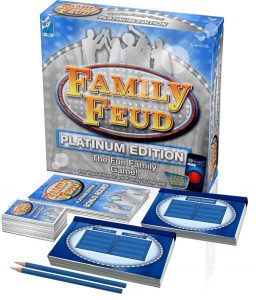
The Platinum Edition leans fully into the card game format and does not try to compete with electronic versions on spectacle. What it offers instead is a clean, portable, no-batteries-required experience that works in more settings — at the kitchen table, on vacation, or packed into a bag for a trip. The jumbo card size is a genuine quality-of-life improvement over standard editions, making questions easy to read across a table without anyone squinting.
Our team appreciated how streamlined this one is. There are no components to lose, no electronic elements to malfunction, and the question bank is substantial. The Platinum branding signals a higher question quality, and in our experience that holds up — the surveys feel current and the answer options are well-calibrated for fun rather than obscurity. It plays fast, which keeps energy up even without a physical buzzer to slam.
Where it falls behind the Big Buzzer Edition is purely in atmosphere. Without the electronic element, the host has to work harder to build tension. That is not a dealbreaker, but most buyers who want the full game-show feel will want to look at buzzer-equipped options. As a compact, easy-to-transport Family Feud experience for 2026, though, this one is hard to fault.
Pros:
- Jumbo card size is easy to read for all ages
- No batteries or electronics — works anywhere without setup hassle
- Strong question bank with well-balanced survey answers
Cons:
- Lacks the game-show atmosphere that electronic versions provide
- Host has to manually manage pacing without buzzer audio cues
3. Imagination Gaming Family FEUD Kids VS Adults Edition — Best for Mixed-Age Households
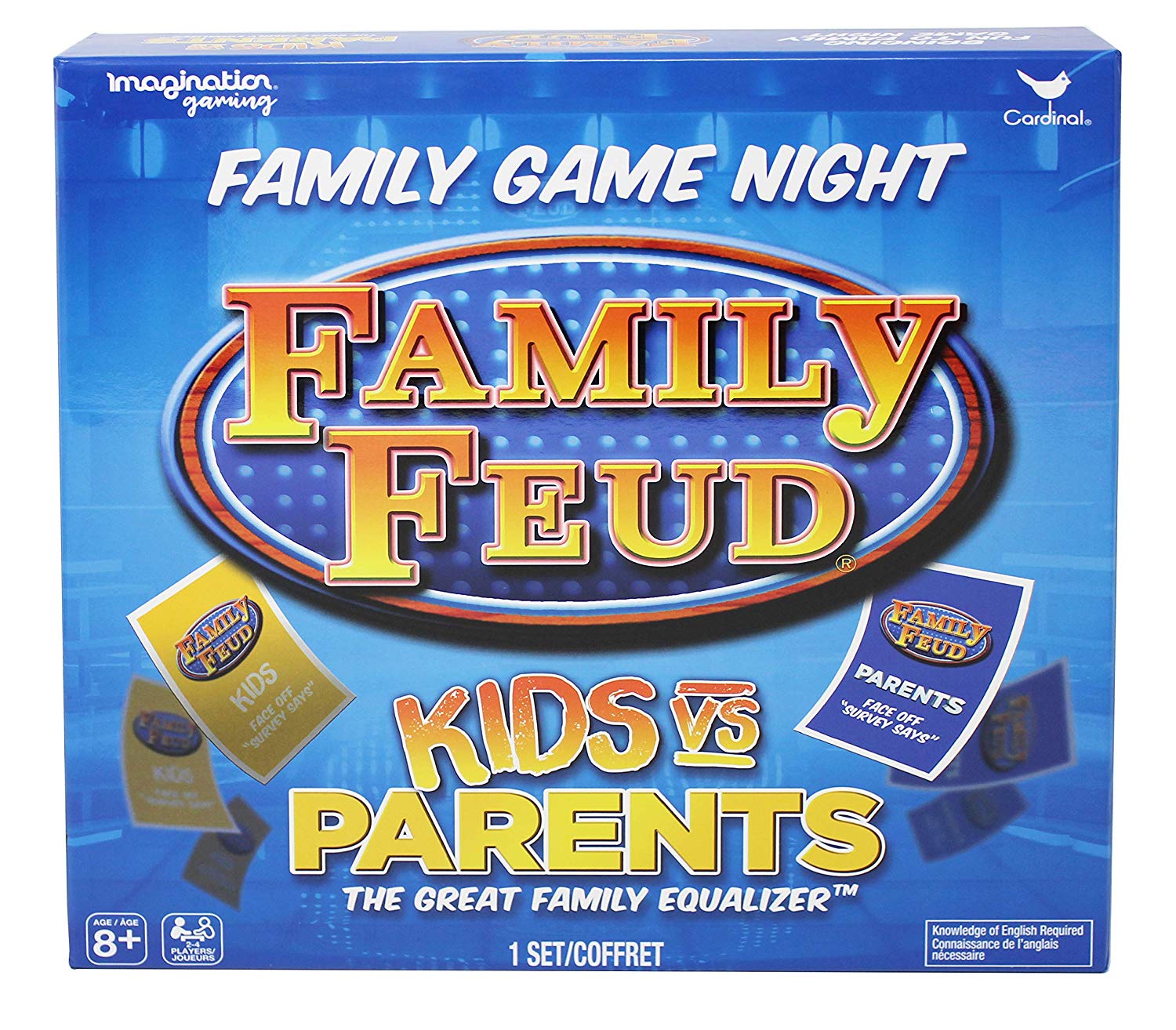
The Kids VS Adults Edition solves a real problem: most party games either skew too young or leave children struggling to keep up with adult-oriented questions. This edition splits the question sets deliberately, giving younger players a fighting chance while keeping adults genuinely engaged. The 150 Face Off Cards and 50 Fast Money Cards represent a solid volume of content, and the division between age groups is thoughtfully done.
What sets this edition apart in 2026 is the complementary Gamestar+ app (a free downloadable application), which brings authentic sound effects and announcer-style narration straight to a phone or tablet. In our testing, this app element genuinely elevated the atmosphere — it is not a gimmick. The scoreboard is dry-erase, which keeps things clean across multiple rounds. Overall component quality is respectable for the price point.
The app dependency is the one variable worth flagging. Anyone without a compatible device or reliable Wi-Fi will miss out on a meaningful chunk of the experience. That said, the card game itself works perfectly well without the app — it just loses some polish. For households with kids aged roughly 7 and up playing alongside adults, this is the edition our team would reach for first. It is also worth considering alongside our Best Teen Murder Mystery Games roundup for households that rotate through different party game formats.
Pros:
- Age-divided question sets create genuinely balanced competition between kids and adults
- Gamestar+ app delivers authentic sound effects and announcer energy at no extra cost
- Dry-erase scoreboard keeps the game tidy and reusable
- Generous question card count supports many play sessions
Cons:
- App experience depends on having a compatible device handy
- Questions skewed toward adults may occasionally feel uneven even with the split format
4. Family FEUD Retro Edition Card Game — Best for Nostalgia Seekers
The Retro Edition is a love letter to the original show, pulling questions directly from 1970s episodes and wrapping everything in a period-appropriate aesthetic. The 120-page gummed pad of survey questions is the headline component — physical, tactile, and genuinely different from the card-based alternatives. The retro stand-up scoreboard with pull-out answer-reveal tabs is a particularly nice touch that most buyers seem to appreciate once they see it in person.
Our team found the 1970s question set to be a double-edged element. The vintage surveys create wonderfully odd moments — answers reflect a very different era of American pop culture — which can be hilarious or baffling depending on the crowd. Older players will find familiar ground. Younger players will encounter a cultural gap that, depending on the group, either adds to the fun or creates friction. It is worth managing expectations on that front.
Component quality is solid throughout. The dry-erase pen, scorecards, and the retro console feel cohesive. This is not the highest-energy version of Family Feud available, but it is the most characterful. Anyone who grew up watching the original show — or anyone shopping for a gift for someone who did — will find genuine charm here that the modern editions cannot replicate.
Pros:
- Authentic 1970s questions create a unique nostalgic experience
- 120-page gummed question pad provides substantial long-term content
- Retro scoreboard with reveal tabs is a genuinely clever physical design
Cons:
- 1970s question content may feel dated or inaccessible to younger players
- Lower energy ceiling compared to buzzer-equipped editions
5. Family Feud Survey Says DVD Game — Best for Home Theater Setups
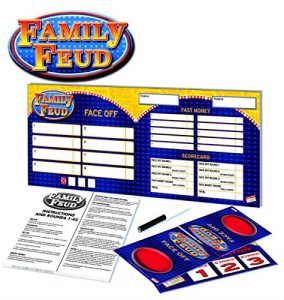
The Survey Says DVD Game is the oldest format in this roundup and it shows — but that is not entirely a bad thing. The core concept is sound: plug a DVD into a player connected to a TV, and the screen acts as the game board, running questions and tracking scores in a format that everyone in the room can see simultaneously. For households with a DVD player still in active service and a TV as the focal point of the living room, this setup creates a communal screen-based experience that card games cannot replicate.
The age recommendation runs from 12 to 17 and up through adults, and the question content reflects that broader range fairly well. Our team noted that the DVD format does create an obvious limitation in 2026: households without a functioning DVD player are simply locked out. The format has aged, and the question content feels dated compared to newer editions. It is best understood as a legacy option at this point — worthwhile for specific setups, less so as a primary recommendation for most buyers today.
If a household has the right setup, the big-screen presentation does add something. It is also typically available at lower price points than newer editions, which can make it appealing for budget-conscious shoppers who already own the necessary hardware. Just go in with realistic expectations about the question content's age.
Pros:
- Big-screen TV display creates a genuinely communal viewing experience
- Often available at lower price points than current card-based editions
- Works well for larger gatherings where everyone can see the screen
Cons:
- Requires a functioning DVD player — increasingly rare hardware in 2026
- Question content feels dated compared to modern editions
- No flexibility to add new questions or refresh the content
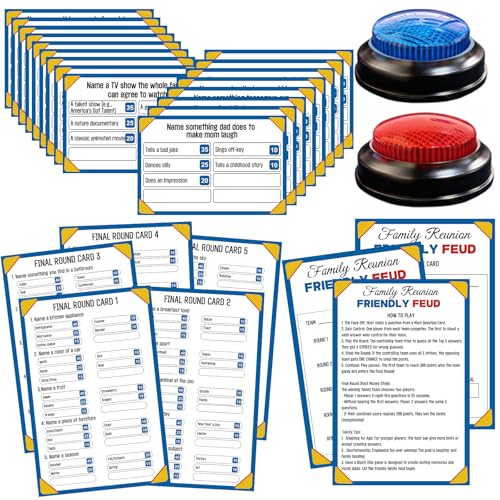
6. Xminc Family Friendly Feud Game — Best Budget Buzzer Option
The Xminc buzzer game is a newer entrant in the Family Feud-style category, and it punches reasonably well for its price tier. The two interactive buzzers with light and sound effects are the standout feature — they work reliably and add the competitive edge that purely card-based formats miss. The included question card deck is family-friendly across ages, and the scorecards handle the scoring mechanics simply without requiring any digital component.
Where Xminc distinguishes itself is as a party and team-building option. The buzzer format turns any group into instant competitors, and the light-up feedback element makes it clear who hit the button first without any arguments. Our team found it particularly effective as an ice-breaker at larger gatherings — it requires no learning curve and gets competitive almost immediately. The "just open and play" promise is genuine; setup time is essentially zero.
The question card volume is lighter than official Family Feud editions, and the survey questions do not carry the licensed brand's depth of content. For households that specifically want the Family Feud brand and its deep question banks, the Spin Master option is the better call. But for a budget-friendly buzzer game that captures the spirit of the format for parties and team events, Xminc delivers solid value. It also pairs well as a warm-up game before heavier options from our card game night toolkit.
Pros:
- Light-up buzzers with sound create immediate competitive energy at zero learning cost
- Fully self-contained — no app, no batteries required for the cards
- Excellent as an ice-breaker at parties, reunions, and team-building events
Cons:
- Smaller question card volume compared to official licensed editions
- Not an official Family Feud product — lacks brand question depth and variety
7. Family FEUD Late Late Night Edition — Best for Adult Game Nights
The Late Late Night Edition exists for one purpose: to give adults a version of Family Feud that does not pull any punches. The 400 survey questions across 200 double-sided cards are decidedly not family-friendly, and the product makes absolutely no pretense about that. Our team tested this one at an adult game night and it delivered exactly what it promises — plenty of naughty laughs, competitive guessing, and the genuine surprise of how many people agree on the survey answers in question.
The question quality is the real test for this category, and the Late Late Night Edition passes it. The surveys feel genuinely surveyed rather than artificially edgy — the humor lands because the answers reflect actual human thinking, just on topics that would not make the daytime broadcast. The dry-erase scoreboard and included marker are functional, and the 400-question volume means this takes a very long time to exhaust.
The obvious limitation is the audience — this is strictly an 18-plus game, and the packaging makes that clear. It would be a genuinely poor gift for any household with children. But for adult game nights, work parties (in the right office culture), or gatherings of close friends looking for something with more edge than standard party games, this is a well-executed option. The format is familiar enough that no one needs a rules explanation, which keeps the night moving.
Pros:
- 400 questions (200 double-sided cards) provide exceptional content volume for adult audiences
- Authentic Family Feud format means zero learning curve for anyone who knows the show
- Survey-based humor lands more naturally than artificially edgy trivia alternatives
Cons:
- Strictly adult content — completely inappropriate for households with children present
- No buzzer or electronic element; relies entirely on host energy
Choosing the Right Family Feud Board Game: A Buying Guide
Consider Who Is Playing
The single most important factor is the audience. A households with kids aged 8 to 14 will get the most out of a buzzer-equipped edition like the Spin Master Big Buzzer Game or the Kids VS Adults Edition — these are designed to keep younger players genuinely competitive. Mixed-adult groups hosting game nights will likely gravitate toward the Platinum Card Edition or the Late Late Night Edition depending on how family-friendly the evening needs to be. Matching the edition to the specific crowd is more important than any other consideration. According to Family Feud's Wikipedia entry, the show has aired since 1976 and built its appeal on universal survey-based questions — that legacy is reflected in how editions are divided by audience today.
Electronic vs. Card-Based: What the Difference Actually Means
Electronic editions with buzzers — the Spin Master and the Xminc options — deliver a more visceral game-show experience. The competitive act of physically hitting a buzzer first changes the energy of the room in a way that reading from cards simply does not. Card-based editions are quieter, more portable, and more forgiving of imperfect hosting. Neither format is inherently better. The question is what a given group will respond to more. Households that want maximum game-show atmosphere should prioritize buzzer editions. Households that travel with games or play in smaller, quieter settings may prefer card-only formats.
Question Volume and Replay Value
Replay value in Family Feud board games comes almost entirely from question variety. More cards means more sessions before questions start repeating. The Late Late Night Edition's 400-question deck and the Retro Edition's 120-page gummed pad both offer strong longevity in this regard. The app-supplemented Kids VS Adults Edition also benefits from the potential to update or expand via digital content. Anyone expecting to play more than a dozen sessions should prioritize editions with higher question counts or digital expansion capability. The Jumbo Platinum Edition lands in the middle of the pack here — solid but not exceptional on raw volume.
Portability and Setup Convenience
Purely card-based options win on portability by default. The DVD Edition requires hardware that most households no longer carry on trips. The buzzer editions require more table space and battery management. For most buyers, the ideal choice involves thinking about where the game will actually be played most often. Kitchen table game nights favor the card editions. Living-room family nights with a dedicated table benefit from buzzer editions. Anyone planning to bring a game to gatherings, vacations, or events should weight portability more heavily in the decision. This is a different kind of consideration than what applies to outdoor games covered in our backyard game roundups, but the portability logic is the same.
Questions Answered
What is the best Family Feud board game for young children?
The Kids VS Adults Edition from Imagination Gaming is the strongest option for households with younger players. The question sets are specifically divided by age group so that children are answering age-appropriate questions rather than competing directly against adult knowledge. The accompanying app also adds sound effects and energy that younger players tend to respond well to. The Spin Master Big Buzzer Edition works for ages 8 and up as well, though without a dedicated kids' question set.
Do any of these Family Feud games require a phone or internet connection?
Most editions do not require a phone or internet connection to play. The Kids VS Adults Edition and the Late Late Night Edition both reference a companion app (Gamestar+), but both games function fully without it — the app only adds sound effects and atmosphere. The Xminc buzzer game and the Spin Master Big Buzzer Edition are completely self-contained. The DVD Edition requires a DVD player but no internet. Only the app-enhanced editions benefit meaningfully from a connected device.
How many players can play Family Feud board games?
Most editions support two teams of varying sizes, which means they technically scale from four players upward without an upper limit on team size — larger teams simply huddle and agree on answers together. The Spin Master Big Buzzer Edition specifically structures play around two competing teams. Card-based editions like the Platinum and Retro editions are more flexible about team composition. The DVD Edition also works with multiple players watching the shared screen. For very large groups of 12 or more, card editions with visible answer reveals tend to work better than buzzer editions where only one person buzzes in.
Is there a Family Feud game specifically for adults?
Yes — the Late Late Night Edition is explicitly designed for adult audiences and contains 400 survey questions that are decidedly not family-friendly. It uses the standard Family Feud format but with content calibrated for grown-up game nights. The packaging and product description make the adult nature of the content very clear. It is a well-reviewed option among adult party game enthusiasts who already know the show's format and want a version without content restrictions.
What makes the Retro Edition different from other Family Feud games?
The Retro Edition pulls its question content directly from 1970s episodes of the original Family Feud television show, giving it a genuinely different question set from any modern edition. The surveys reflect the cultural attitudes and pop culture references of that era, which creates a nostalgic atmosphere for older players and a somewhat baffling but often funny experience for younger ones. It also uses a distinctive physical format — a gummed pad of tear-away question sheets — rather than cards, along with a retro-styled scoreboard that looks different from any other edition on the market.
Are Family Feud board games good for team building or office parties?
Family Feud formats work exceptionally well for team building because the survey-based question structure encourages group thinking and discussion rather than individual trivia knowledge. The Xminc buzzer edition is particularly well-suited to this context because it requires no learning curve and creates competitive energy immediately. The Kids VS Adults Edition and the Platinum Card Edition also work well in professional settings since their content is clean and broadly accessible. The Late Late Night Edition is appropriate only in office cultures where adult humor is explicitly welcome and expected by all participants.
Buy on Walmart
- Spin Master Family Feud Big Buzzer Game, Amazon Exclusive “B — Walmart Link
- Family Feud Jumbo Card Game Platinum Edition — Walmart Link
- Imagination Gaming Family FEUD Kids VS Adults Edition Card G — Walmart Link
- Family FEUD Retro Edition Card Game, 1970s Episodes’ Questio — Walmart Link
- Family Feud Survey Says DVD Game — Walmart Link
- Xminc Family Friendly Feud Game with 2 Answer Buzzers, Fun T — Walmart Link
- Family FEUD Late Late Night Edition Card Game, Anything but — Walmart Link
Buy on eBay
- Spin Master Family Feud Big Buzzer Game, Amazon Exclusive “B — eBay Link
- Family Feud Jumbo Card Game Platinum Edition — eBay Link
- Imagination Gaming Family FEUD Kids VS Adults Edition Card G — eBay Link
- Family FEUD Retro Edition Card Game, 1970s Episodes’ Questio — eBay Link
- Family Feud Survey Says DVD Game — eBay Link
- Xminc Family Friendly Feud Game with 2 Answer Buzzers, Fun T — eBay Link
- Family FEUD Late Late Night Edition Card Game, Anything but — eBay Link
The right Family Feud game is not the one with the most features — it is the one that matches the room full of people sitting around the table.


About Mike Jones
Mike Jones grew up in the golden age of arcade and home gaming — a childhood shaped by Atari classics like Pitfall, Frogger, and Kaboom that gave him a lifelong appreciation for games of all kinds. These days he covers the full breadth of tabletop and family gaming: board games, card games, yard games, table games, and game room setup, with a particular focus on finding the games that bring different groups together. At GamingWeekender, he covers game reviews, buying guides, and recommendations for families, friends, and hobbyists who take their leisure seriously.
You can get FREE Gifts. Or latest Free phones here.
Disable Ad block to reveal all the info. Once done, hit a button below