Picture a coach standing in a sporting goods store, phone in one hand and a printed list of bowling machine specs in the other, trying to figure out whether a 55mph automatic feeder justifies the price difference over a handheld sidearm thrower. It happens constantly. The market for cricket training equipment has expanded noticeably heading into 2026, and the sheer variety of options — from full-featured electric machines to compact manual aids — makes the decision genuinely complicated. This guide cuts through the noise.
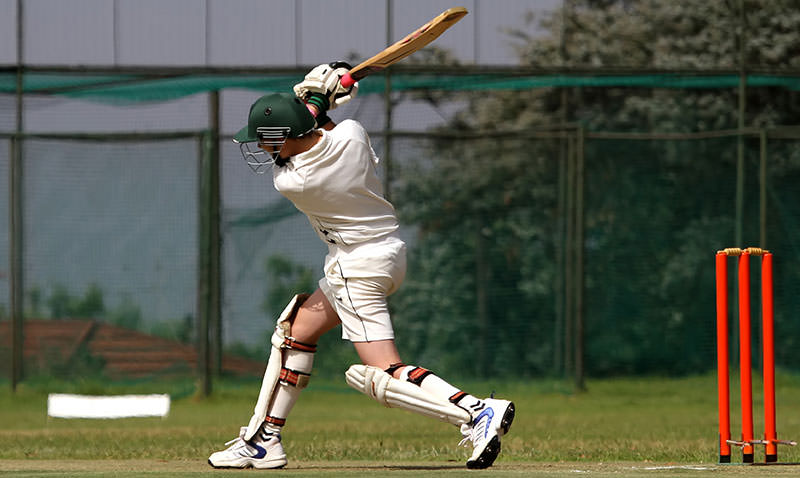
Cricket bowling machines serve a single core purpose: delivering consistent, repeatable deliveries so batters can groove their technique without relying on a tired arm. The best models in 2026 do far more than that — they replicate swing, vary pace, and integrate feeders that keep practice sessions rolling without constant interruption. Whether the goal is developing a junior player's footwork or sharpening a seasoned club batter's pull shot, the right machine changes the quality of every net session. Finding it requires understanding what actually separates a capable training tool from a frustrating waste of money.
This roundup covers three distinct tiers of cricket bowling machine, from a portable electric unit with an automatic ball feeder to a lightweight handheld sidearm that coaches can wield for targeted drills. Each has been evaluated on speed range, build quality, portability, ball compatibility, and real-world training utility. Buyers who also enjoy other precision sports equipment will find familiar evaluation criteria here — much like reviewing the best badminton sets, the difference between a budget option and a purpose-built piece of kit becomes obvious the moment it's in use. For a broader look at recreational game equipment across categories, the game room section offers additional guidance.
Contents
Standout Models in 2026
- #PreviewProductRating
- Bestseller No. 1
 Rating:

- Bestseller No. 2
 Rating:
 - Bestseller No. 3
 Rating:
In-Depth Reviews
1. FORZA V55 Cricket Bowling Machine — Best Overall
The FORZA V55 represents the most complete standalone training solution in this roundup. Delivering balls at speeds up to 55mph (90kph), it covers the full range of recreational and club-level batting practice — from a junior batter learning to read line and length, all the way to an adult club player working on pace. Speed adjustment is the cornerstone of skill development with any bowling machine, and the V55 gives coaches and players a genuine progression path rather than forcing them to train at a fixed, arbitrary pace. The machine arrives ready for structured sessions: no complicated assembly, no specialist tools.
The automatic 12-ball feeder is the standout feature for solo practitioners. Deliveries arrive at 10-second intervals, which is close enough to replicate real batting rhythm without feeling frantic. Twelve balls per load sounds modest, but in practice it means a batter can work through a full set of technical repetitions — drive, pull, cut — before needing to collect and reload. The 10-second interval also prevents the mental downtime that kills flow in solo practice. Machines in this price range that skip the feeder require a second person to operate them effectively, which immediately limits their utility for home or individual training.
At just 12lbs (5.5kg), the V55 is light enough for one person to carry from a car to a net without strain. The corrosion-resistant coated steel legs handle outdoor surfaces without flexing or sinking, an important detail that cheaper machines routinely get wrong. The unit runs on mains power with a battery cable option (battery sold separately), giving it genuine flexibility across facilities with and without pitchside sockets. The build quality punches above its price point, and the combination of portability, feeder automation, and speed range makes this the most practical all-around choice for clubs, coaches, and dedicated home practitioners in 2026.
Pros:
- Up to 55mph speed range supports players from junior to adult club level
- Automatic 12-ball feeder enables fully uninterrupted solo practice sessions
- Extremely portable at 12lbs — one person can set up and pack down without assistance
- Corrosion-resistant steel legs handle outdoor and indoor surfaces reliably
Cons:
- Battery not included — mains-only operation in many setups unless buyers source a compatible battery separately
- Machine balls sold separately, adding to the initial outlay
2. Heater Sports Slider Lite-Ball Cricket Bowling Machine — Best for Beginners
The Heater Sports Slider occupies a specific and useful niche: a safe, affordable introduction to machine-assisted batting practice. The unit uses lite-balls — half the weight of a regulation cricket ball — which reduces the injury risk for young players and casual practitioners significantly. That trade-off is worth understanding upfront. This machine does not replicate the feel of a leather ball pitching on a hard surface. What it does deliver is consistent, repeatable deliveries at adjustable speeds, which is precisely what a beginner needs to build timing and confidence before stepping up to full-weight balls.
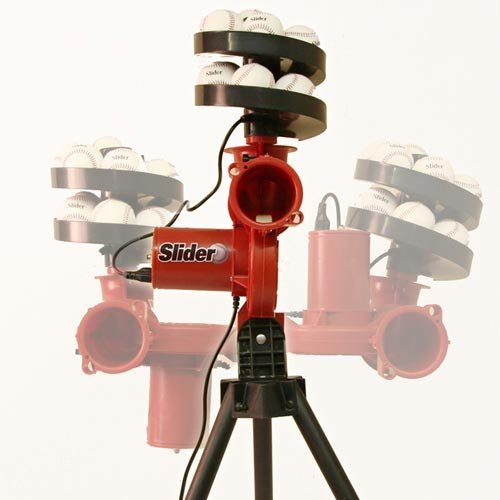
Speed control runs from 0 to 10 on a dial, translating to a practical range of 10 to 80 MPH with lite-balls. That ceiling of 80 MPH is impressive on paper, though most training with this unit happens comfortably in the 20–50 MPH range where beginners can focus on technique rather than survival. The adjustable tripod legs allow the machine to be angled for in-swing, out-swing, and straight deliveries — a meaningful feature for developing players who need exposure to different delivery types. The rotating wheel is enclosed in robust plastic housing, making it genuinely safe for unsupervised junior use, which is a real operational advantage for coaches managing multiple practice stations simultaneously.
The automatic ball feeder removes the need for a second operator, and one lite-ball is included in the box, though buyers will want to purchase a full set before the first serious session. The plastic construction keeps weight low and cost accessible, but it also means this machine is not built for heavy daily use at club or academy level. For recreational players, youth programs, and casual garden practice, the Slider delivers solid value. Serious adult batters will outgrow it quickly, but as an entry point into machine-assisted cricket training, it earns its place.
Pros:
- Lite-ball design makes it safe for young players and beginners of all ages
- Wide speed range (10–80 MPH) accommodates multiple skill levels within the same session
- Adjustable tripod legs simulate straight, in-swing, and out-swing deliveries
- Includes automatic ball feeder for solo practice without a second operator
Cons:
- Lite-balls only — does not replicate the weight or feel of regulation cricket balls
- Plastic construction limits durability for heavy-use club or academy environments
3. Crommie SL Small Adjustable SideArm Ball-Thrower — Best Coaching Tool
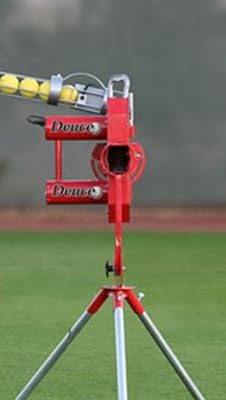
The Crommie SL SideArm is a fundamentally different kind of training tool compared to the two electric machines above, and understanding that distinction determines whether it belongs in a buyer's kit bag. This is a handheld sidearm — a shoulder-friendly throwing aid that a coach, parent, or fellow cricketer uses to project real leather cricket balls at the batter. There is no motor, no feeder, and no autonomous operation. What it provides instead is a compact, coach-controlled delivery mechanism that generates pace from 60kph up to 160kph with a natural ball trajectory that electric machines struggle to replicate at this price point.
The speed ceiling of 160kph is the headline figure, and it is achievable by a physically capable adult using proper technique with the sidearm. More practically, the tool allows coaches to bowl at batters from just 30 feet of space — a significant advantage for indoor facilities, backyard practice areas, and smaller nets where a full run-up is impractical. The short length of the SL Mini also improves ball-sighting for the batter, particularly when drilling from shorter distances, and the unit accommodates both full-pitch and half-pitch deliveries. Compatibility with new leather cricket balls is explicit in the product specifications, which means batters develop feel against regulation-weight deliveries rather than training aids.
The practical limitation is obvious: someone must operate it. Autonomous practice is not possible. However, for coaches working with under-16 players — the stated target demographic — the hands-on control over delivery length, speed, and angle is arguably an advantage rather than a drawback. The coach sees every ball, adjusts in real time, and builds sessions around the batter's specific technical gaps. At this price point, no electric machine offers comparable control over delivery variables. The Crommie SL is not a replacement for a bowling machine; it is a different tool solving a different problem, and for coached sessions it belongs in every cricket bag alongside the stumps and batting gloves.
Pros:
- Works with real leather cricket balls — no compromise on ball weight or feel
- Speed range of 60–160kph covers junior through adult training needs
- Operable in just 30 feet of space — ideal for indoor nets and backyard practice
- Shoulder-friendly design reduces strain for coaches delivering extended sessions
- Compact and lightweight — fits in any cricket bag with no setup required
Cons:
- Requires a second person to operate — no solo practice capability
- Output quality depends on the operator's technique and consistency
Key Features to Consider When Choosing a Cricket Bowling Machine
![Paceman Strike Bowling Machine - Swing For Six With This Bowling Machine [Net World Sports]](https://images-na.ssl-images-amazon.com/images/I/41D0ct3qxTL.jpg)
Speed Range and Progression
The speed range of a bowling machine defines who can use it and for how long. A machine that tops out at 55mph serves junior and recreational club batters well, but an adult batter preparing for competitive club cricket needs exposure to the 70–80mph range. Before purchasing, buyers should map the machine's speed ceiling against the expected skill level of users in 12 to 18 months — not just today. The ability to gradually increase pace is as important as the maximum speed itself. Machines with smooth, incremental speed control encourage progressive overload in training, which is how genuine skill development happens. Fixed-speed or coarsely adjustable machines often force batters into gaps where the delivery is too easy or suddenly overwhelming.
According to the ICC's definitions of cricket bowling, competitive deliveries vary enormously from 60kph spin to 145kph+ fast bowling. For most recreational and club training contexts, a machine covering 20–90mph handles the relevant range. Buyers chasing elite-level preparation will need to look at professional twin-wheel machines well above the price points covered in this guide.
Ball Compatibility and Training Authenticity
Ball compatibility is a non-negotiable consideration that buyers frequently overlook until after purchase. Machines like the Heater Sports Slider operate exclusively with lite-balls — practice tools that weigh half as much as a regulation leather ball. This is fine for pure beginners and young players where safety is paramount, but it creates a fundamental disconnect when the goal is to develop timing and shot selection for real match conditions. The weight of a cricket ball affects bounce characteristics, carry through the air, and the physical sensation of impact on the bat. Training exclusively with lite-balls produces technique that requires recalibration when transitioning to leather. Machines that accept standard or regulation-weight balls — whether through direct compatibility or via purpose-built machine balls — deliver more transferable training adaptations.
![Net World Sports Paceman Bowling Machine [Pro X2] | World Class Batting Training | Adjust Your Lengths](https://images-na.ssl-images-amazon.com/images/I/718GE1FXD7L._SL400_.jpg)
Portability and Setup Requirements
Portability matters far more in practice than many buyers anticipate. A machine that requires two people to transport and 20 minutes to set up will simply be used less. The best cricket training tools earn their keep by being deployed consistently, not stored in a corner because bringing them out is too much effort. Weight, folding mechanism, leg stability on uneven surfaces, and power requirements all factor into real-world usability. Battery operation expands deployment options dramatically — a machine tethered to a mains socket is a machine limited to one or two practice locations. For clubs with multiple nets or coaches who travel to different facilities, battery compatibility is worth the additional cost. Handheld sidearms like the Crommie SL sidestep this problem entirely — nothing to set up, nothing to power, nothing to transport beyond the arm itself.
Automatic Feeders and Solo Practice Capability
An automatic ball feeder transforms a bowling machine from a two-person operation into a genuine solo training tool. For recreational players without access to a dedicated net buddy or coaching partner, this feature is often the deciding factor. Feeders vary in capacity — the FORZA V55 holds 12 balls and delivers at 10-second intervals, which approximates real batting rhythm without sacrificing technical focus between deliveries. Machines without feeders require a second person to load balls, which breaks the batter's concentration and limits the efficiency of short practice windows. Buyers evaluating machines for solo or home training should treat the automatic feeder as a baseline requirement rather than a premium upgrade. Much like choosing the right gear for outdoor sports — whether it's the best horseshoe game sets for backyard use or a cricket machine for garden nets — solo usability defines the long-term value of the investment.
![Net World Sports Paceman Original S2 Cricket Bowling Machine - The Best Way To Master The Art Of Batting [Net World Sports]](https://images-na.ssl-images-amazon.com/images/I/81sj0ILH1tL._SL400_.jpg)
Delivery Variation: Swing, Seam, and Length
A machine that only bowls straight at a fixed length stops being useful the moment a batter has mastered hitting in one zone. The most effective training tools offer some form of delivery variation — adjustable angles for in-swing and out-swing, variable pitch length settings, or operator-controlled placement in the case of handheld aids. Buyers training players who face spin bowling should confirm whether the machine can replicate slower deliveries with appropriate bounce characteristics. For club-level batters working through a structured technical program, the ability to simulate a range of bowling types within a single session is what separates a good machine from a great one. Comparing machines at a similar price point to other precision training equipment categories — like the research behind our roundup of best tetherball sets — the lesson is consistent: delivery consistency paired with adjustable variables produces better training outcomes than raw power alone.
Common Questions
What is the best cricket bowling machine for home use in 2026?
The FORZA V55 is the top recommendation for home use in 2026. Its automatic 12-ball feeder enables fully solo practice sessions, it weighs just 12lbs for easy transport between garage and garden, and its 55mph speed range covers recreational and club-level training without requiring a net facility or second operator. Battery cable compatibility (battery sold separately) further extends its deployment options beyond mains-only setups.
Are lite-ball bowling machines suitable for competitive cricket training?
Lite-ball machines like the Heater Sports Slider are suitable for foundational skill development and junior training, but they are not recommended as the sole training tool for competitive cricketers. The reduced ball weight alters bounce, carry, and impact feel in ways that create a disconnect from real match conditions. Serious competitors benefit from training with regulation-weight machine balls or real leather balls via a handheld sidearm once basic timing has been established.
How fast should a cricket bowling machine go for club-level practice?
For most adult club-level practitioners, a machine covering 30mph to 75mph handles the relevant range of club bowling. The lower end supports technical drills focusing on footwork and shot selection, while the upper end replicates the pace of quicker club bowlers. Machines topping out at 55mph are sufficient for recreational and junior club training. Players preparing for higher-grade competitive cricket will want to source machines with a higher ceiling, typically available in the professional twin-wheel category.
Can a bowling machine replace a coach?
A bowling machine is a training tool, not a replacement for coaching expertise. Machines deliver consistent repetitions that help batters groove technical responses, but they cannot observe, diagnose, and correct technique in real time. The Crommie SL SideArm represents a coach-controlled delivery method that bridges this gap — the operator watches every ball and adjusts delivery variables based on the batter's response. The most effective training programs combine machine-assisted repetition with regular coached analysis.
What balls should be used with the FORZA V55?
The FORZA V55 is designed for use with machine-specific cricket balls rather than standard leather match balls. Machine balls are constructed to withstand the friction of the wheel mechanism, which would quickly damage regulation leather balls. FORZA sells compatible balls separately, and buyers should factor this into the initial outlay. Using the correct ball type also ensures the machine's speed calibration and delivery consistency remain accurate over time.
Is a handheld sidearm worth buying if a bowling machine is already available?
Yes — for coaches and practice groups with multiple players, a handheld sidearm like the Crommie SL complements rather than duplicates a bowling machine. The sidearm offers operator-controlled delivery variation, works with real leather balls, requires zero setup time, and costs a fraction of an electric machine. In coached sessions where the focus is on reacting to natural ball trajectory and movement, the sidearm often produces more realistic training conditions than a machine at the same price point.
Buy on Walmart
- FORZA V55 Cricket Bowling Machine | Up to 55mph Speeds, Auto — Walmart Link
- Heater Sports Slider Lite-Ball Cricket Bowling Machine with — Walmart Link
- Crommie- SL Small Adjustable SideArm Ball-Thrower for Cricke — Walmart Link
Buy on eBay
Key Takeaways
- The FORZA V55 is the best all-around choice for 2026, combining a 55mph speed range, automatic 12-ball feeder, and genuine portability in a single package suited to solo home and club practice.
- The Heater Sports Slider earns its place as the safest and most accessible entry point for juniors and beginners, with lite-ball operation and adjustable tripod legs covering basic swing and straight deliveries at low risk.
- The Crommie SL SideArm is the standout coaching tool in this category — shoulder-friendly, usable in 30 feet of space, and compatible with real leather balls for the most authentic training conditions at any price.
- Buyers should prioritize ball compatibility, automatic feeder availability, and real-world portability over headline speed figures — the machine that gets used consistently will always outperform the machine with the most impressive spec sheet.


About Mike Jones
Mike Jones grew up in the golden age of arcade and home gaming — a childhood shaped by Atari classics like Pitfall, Frogger, and Kaboom that gave him a lifelong appreciation for games of all kinds. These days he covers the full breadth of tabletop and family gaming: board games, card games, yard games, table games, and game room setup, with a particular focus on finding the games that bring different groups together. At GamingWeekender, he covers game reviews, buying guides, and recommendations for families, friends, and hobbyists who take their leisure seriously.
You can get FREE Gifts. Or latest Free phones here.
Disable Ad block to reveal all the info. Once done, hit a button below