Last summer, our team dragged a dusty kickball out of the garage for what was supposed to be a twenty-minute warm-up before a backyard cookout. Four hours later, nobody had gone inside. That's the power of games to play with a ball — they pull people in and refuse to let go, whether it's toddlers rolling a foam sphere across the carpet or retirees perfecting their bocce toss on a Saturday afternoon. For anyone curious about the full range of recreational options beyond ball games, our other games section is worth exploring.
Ball games span every surface, every age group, and nearly every budget. Our team has spent years testing, playing, and comparing dozens of options — from lawn classics like bocce and kickball to arcade-style setups — and we keep landing on the same conclusion: the best ball game is the one that matches both the space and the crowd. A cramped driveway calls for something different than a wide-open park, and a group of five-year-olds has different needs than a competitive adult league night. This guide covers the full spectrum, so finding the right fit is straightforward.
The good news is that ball games don't demand expensive equipment or complicated rulebooks. Most of what we cover below works with minimal gear, a flat surface, and a handful of willing players. The barrier to entry is low. The payoff — in laughter, light exercise, and good-natured competition — is consistently high.
Contents
- Ball Games at a Glance: Finding the Right Fit
- How to Set Up the Most Popular Ball Games
- Mistakes We See Players Make All the Time
- Keeping Ball Equipment Ready to Play
- Quick Fixes When the Game Hits a Snag
- Easy Games to Play with a Ball for Instant Fun
- Tips That Actually Make a Difference
- Frequently Asked Questions
- Next Steps
Ball Games at a Glance: Finding the Right Fit
Before picking up a ball and heading outside, it helps to know what the options look like side by side. The key variables are space requirement, group size, skill floor, and whether the game plays better indoors or out. Our team put together this comparison to make the decision faster.
Indoor Options
Indoor ball games tend to use smaller, lighter balls and self-contained setups. Ping pong is the gold standard for indoor play — fast, competitive, and quick to learn at a basic level. Our experience with the best portable ping pong sets shows that a decent setup doesn't require a dedicated game room; a clip-on net over a dining table gets the job done. Skee-ball is another indoor favorite, especially in a home arcade context — our full breakdown of the best skee-ball machines covers everything from compact countertop models to full arcade-size units. Billiards also earns a spot here: it's a cue-ball sport that rewards precision and patience, and there are far more game variations than most people realize, as our guide to fun billiards games beyond 8-ball and 9-ball covers in detail.
Outdoor Classics
Outdoor ball games have more variety, more room to move, and a different energy entirely. Kickball, four square, bocce, and dodgeball all make the list and shine at cookouts, family reunions, and park meetups where the group is large and mixed in age. The table below lays out the key specs.
| Game | Players | Space Needed | Skill Level | Best Setting |
|---|---|---|---|---|
| Kickball | 6–20+ | Large field | Beginner | Outdoor |
| Four Square | 4 | Small paved area | Beginner | Outdoor / Driveway |
| Bocce Ball | 2–8 | Medium lawn or court | Beginner–Intermediate | Outdoor |
| Ping Pong | 2–4 | One table | Beginner–Advanced | Indoor / Outdoor |
| Skee-Ball | 1–2 | One machine | Beginner–Intermediate | Indoor / Arcade |
| Bowling | 1–6 | Lane or open lawn | Beginner–Advanced | Indoor / Outdoor |
| Beer Pong | 4+ | One table | Beginner | Indoor / Outdoor |
| Dodgeball | 6–20+ | Medium–large court | Beginner | Outdoor / Gym |
How to Set Up the Most Popular Ball Games
Knowing the rules matters, but setup is where most sessions either succeed or fall apart. Our team has run enough of these games to know that a clean, organized start leads to a clean, fun game. The ten minutes spent preparing before play begins pays off every time.
Kickball and Four Square
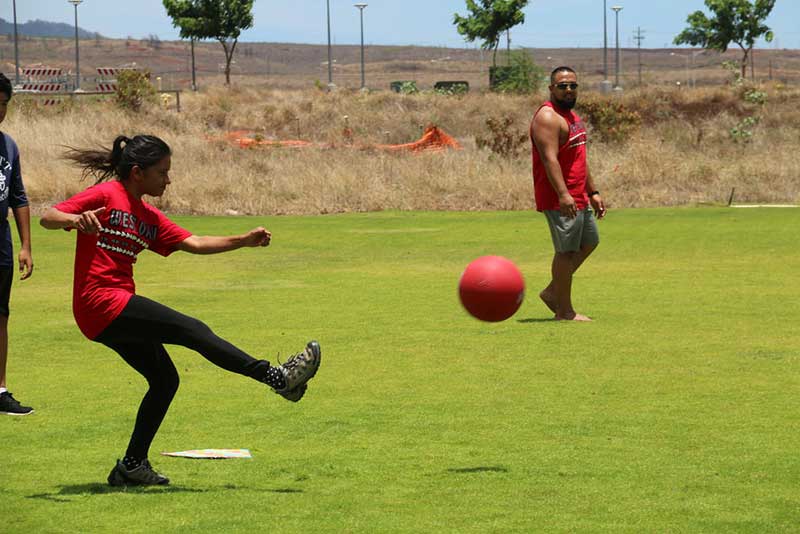
Kickball follows the same basic structure as baseball — bases, innings, outs — but replaces the bat with a foot and the baseball with an inflated rubber ball. Mark out four bases roughly 60 feet apart for adults (closer for younger kids), assign teams, and settle on an inning count before the first pitch. Three outs per half-inning is standard. The pitcher rolls the ball toward home plate, the kicker punts it into the field, and the usual baseball rules apply for putting runners out. The most important setup decision is base distance — too far and the game drags, too close and everything happens too fast for younger players to follow.
Four square needs nothing more than a paved area and chalk. Draw a large square divided into four equal smaller squares, label them 1 through 4 (or King, Queen, Jack, Jester for the classic version), and place one player in each. The ball bounces between squares — a player is out if the ball lands twice in their square or if they hit it out of bounds. It's one of the most portable games to play with a ball because the only equipment needed is a rubber bouncy ball and a piece of chalk.
Bocce and Lawn Bowling
Bocce has been played for thousands of years and for good reason — it's simple to learn, easy to play across age gaps, and deeply satisfying when a well-placed throw nudges the competition aside. Our full bocce ball rules guide covers the complete scoring system, but the short version is: toss the pallino (the small target ball), then take turns throwing bocce balls toward it. The team with balls closest to the pallino scores. Lawn bowling follows a similar principle with flattened balls called bowls that curve as they travel — the curve adds a strategic layer that keeps experienced players hooked long after the novelty wears off.
Pro tip: For bocce on grass, our team always tamps down the playing area slightly before the game — uneven ground creates unpredictable bounces that frustrate newer players and slow the whole session down.
Mistakes We See Players Make All the Time
After watching and running dozens of ball game sessions, our team has catalogued the errors that consistently derail the fun. Most of them are easy to avoid once identified.
Skipping the Rules Explanation
The number one session-killer is starting a game without making sure everyone understands the rules. This sounds obvious, but it happens constantly — especially when experienced players assume newcomers will just figure it out. Disputes start. Frustration builds. Players check out mentally before the game is halfway done. A two-minute rules rundown before the first ball is kicked or thrown prevents ninety percent of mid-game arguments. Our team now treats the pre-game explanation as non-negotiable, regardless of how simple the game seems. Even a game as basic as monkey in the middle benefits from a thirty-second walkthrough for anyone who hasn't played recently.
Wrong Ball for the Surface
Using the wrong ball for the surface is a surprisingly common mistake. A soccer ball on concrete bounces erratically and wears down fast. A rubber playground ball on wet grass loses all predictability. A ping pong ball outdoors on a windy day is basically unplayable. Matching ball type to surface and conditions is a fundamental step that many people overlook. For anyone thinking about adding sport-based gaming to a home setup alongside physical ball games, our piece on the best game console for exercise and fitness explores the crossover between physical gaming and traditional sport in a way that complements this kind of active play nicely.
Keeping Ball Equipment Ready to Play
Ball games don't demand much maintenance, but neglecting equipment entirely leads to flat balls, cracked surfaces, and sessions that fall apart five minutes in. A little routine care extends the life of gear significantly and keeps every game playing the way it should.
Inflation and Storage
Inflatable balls — rubber kickballs, playground balls, soccer balls — need consistent pressure checks. Most people wait until a ball feels soft before inflating, but by that point, the ball has already been performing below its potential. Our team checks inflation before every outdoor session using a hand pump with a gauge. The target PSI is usually printed directly on the ball — for rubber playground balls it's typically 2–3 PSI, for soccer balls 6–8 PSI. Storage matters too: extreme heat degrades rubber over time, so keeping inflatables in a cool, dry area (not the back of a sun-baked car) extends their useful life by a season or two.
Cleaning Different Ball Types
Rubber and foam balls clean up easily with mild soap and warm water — nothing harsh, since strong chemicals degrade the material faster than normal wear. Leather balls like official baseballs and softballs need a leather conditioner after cleaning to prevent cracking. Billiard balls are the most demanding in this category: they benefit from occasional polishing with a dedicated cleaner to remove chalk and oil buildup, which affects how they roll and respond to spin. Our guide to the best pool ball sets covers ball quality and maintenance in depth for anyone running a home billiards setup. Ping pong balls are essentially disposable at the consumer level — cracked ones belong in the trash, not back in play.
Warning: Never soak a leather ball in water — even brief submersion causes warping and internal cracking that can't be reversed.
Quick Fixes When the Game Hits a Snag
Things go wrong mid-game. The ball loses air. A call gets disputed. Someone doesn't know the boundary rule. Our team has a standing playbook for the most common disruptions, and it keeps sessions moving without turning minor problems into full stops.
Ball Won't Hold Air
A ball that won't hold air mid-game almost always has one of two problems: a faulty valve or a small puncture. The valve fix is simple — push the inflation needle in, twist slightly, and re-inflate. If pressure drops again within a few minutes, the problem is a puncture. A bucket of water with the ball submerged is the traditional leak test: bubbles mark the spot. Small punctures in rubber balls are patchable with a bicycle tire repair kit (same rubber compound, same basic process). Larger tears or deep cracks mean the ball is done. Our team keeps a spare ball at every outdoor session — it takes up almost no space and eliminates the nightmare of a session-ending deflation.
Handling Rule Disputes
Rule disputes are inevitable, especially in games like four square where edge calls happen on nearly every volley. Our team's standing approach: designate a neutral referee before play starts, agree that their call is final, and keep moving. For games where nobody wants to referee, writing out a house rules document before the session works surprisingly well — people argue less when the rules are agreed upon in advance and physically present. Bowling disputes are less common since scoring is mechanical, but for anyone working on delivery technique, our guide to how to spin a bowling ball covers the hook technique in full and clears up a lot of "was that a legal delivery?" questions before they become arguments.
Easy Games to Play with a Ball for Instant Fun
Sometimes the goal isn't a tournament or a structured session — it's just getting everyone moving and having a good time within five minutes. These are the games to play with a ball that need almost no setup and work with nearly any group configuration.
No-Prep Classics
Monkey in the Middle — three players, one ball, one person in the middle trying to intercept throws — is the original no-prep game. It scales by adding more players to the middle or stretching the throwing distance. Hot Potato works with any age group and any size ball. Keep Away is organized chaos by design, and that's the point. These games don't require anything beyond a single ball, and they generate immediate energy with zero lead time. The best games to play with a ball often have the simplest rules. Complexity doesn't equal fun — engagement does.
Games That Scale for Any Group
Dodgeball scales from 6 to 60 players without changing a single rule — just expand the court and add more balls. Kickball handles large and small groups equally well. For party setups where a more social, table-based ball game fits better, our reviews of the best beer pong tables cover everything from budget folding options to professional-grade tournament surfaces. For the dedicated game room crowd, skee-ball is nominally a one-player-at-a-time game that naturally becomes a competition — everyone wants to beat the high score, and rotating through a group of six or eight players keeps the energy going for a full evening.
Tips That Actually Make a Difference
These aren't generic tips lifted from a rulebook. Our team learned most of these through direct experience — sessions that went sideways until we adjusted our approach and then ran smoothly ever after.
Reading the Game
In bocce, the mistake most beginners make is always aiming for the pallino. Advanced play means recognizing when it's smarter to knock an opponent's ball out of scoring position rather than place a new ball closer. In four square, court positioning matters more than raw skill — controlling the serve forces opponents into awkward angles. In dodgeball, the teams that win are almost always the ones who coordinate throws rather than firing randomly. Ball games reward observation and strategy, not just physical ability. Players who take thirty seconds to read the pattern before acting consistently outperform those who react on pure instinct.
Building a Game Rotation
For gatherings where ball games carry a significant portion of the day's entertainment, building a deliberate rotation prevents fatigue and keeps energy levels high throughout. Our team's standard structure: open with a high-energy team game (kickball or dodgeball), transition to a skill-based game (bocce or lawn bowling) in the middle stretch, and close with a low-key social game (beer pong, skee-ball, or a relaxed toss competition). This arc follows natural energy curves — people arrive fired up, peak mid-afternoon, and wind down toward evening. For indoor game rooms, mixing ball games with complementary table games like foosball or air hockey fills out a full night without anyone running out of things to do.
Frequently Asked Questions
What are the best games to play with a ball for mixed age groups?
Bocce ball and kickball consistently work best across mixed age groups because the rules are simple, the physical demands are naturally adjustable, and both games allow adults and children to compete on roughly equal terms. Bocce in particular levels the playing field — a well-placed toss from a seven-year-old can absolutely beat an adult's throw, and that shared uncertainty keeps everyone invested. Our full bocce ball rules guide is a good starting point for groups picking the game up for the first time.
How many players do most ball games require at minimum?
Most ball games work with as few as two players — bocce, ping pong, and a simple game of catch are the obvious examples. Four square requires exactly four. Kickball and dodgeball technically start at six, though the more players, the better the energy. Our team's sweet spot for most yard ball games is 6–10 players: enough for genuine competition without turning the whole thing into crowd management.
Are ball games good exercise for kids?
Ball games are among the most effective forms of unstructured exercise for children precisely because they don't feel like exercise. Kickball, dodgeball, and four square all involve running, throwing, and lateral movement — the same mechanics as structured athletic training, but driven by the motivation of play and competition rather than obligation. Research consistently links active outdoor play with improved coordination and cardiovascular development in children. For rainy-day alternatives when outdoor ball games aren't possible, our piece on the best game console for exercise and fitness covers the best options for keeping kids active indoors.
Next Steps
- Pick one game from the comparison table that fits the available space and group size, gather the minimal equipment needed, and lock in a date to play.
- Read through our complete bocce ball rules guide if bocce made the shortlist — the full scoring breakdown makes the first game run much more smoothly.
- Check the inflation level on any existing ball equipment before the next session, and replace anything that won't hold proper pressure under game conditions.
- Write out a simple house rules document for any game where edge calls are likely — agreed-on rules before play starts prevent most mid-game disputes before they begin.
- Browse our other games section for complementary activities that pair well with ball games in a full-day or full-evening rotation.


About Mike Jones
Mike Jones grew up in the golden age of arcade and home gaming — a childhood shaped by Atari classics like Pitfall, Frogger, and Kaboom that gave him a lifelong appreciation for games of all kinds. These days he covers the full breadth of tabletop and family gaming: board games, card games, yard games, table games, and game room setup, with a particular focus on finding the games that bring different groups together. At GamingWeekender, he covers game reviews, buying guides, and recommendations for families, friends, and hobbyists who take their leisure seriously.
You can get FREE Gifts. Or latest Free phones here.
Disable Ad block to reveal all the info. Once done, hit a button below