The first time you watched a group of adults gripping horizontal ropes and shuffling sideways across a grass field like giant foosball figures, you probably laughed out loud — and then immediately wanted to join in. Learning how to play human foosball is genuinely easy, and the game delivers a level of chaotic, physical fun that very few activities can match for groups of any size. Whether you're organizing a team-building event, a birthday party, or just a competitive backyard afternoon, human foosball earns its place on the shortlist. If you already enjoy the tabletop version, the foosball strategy tips you've already picked up translate surprisingly well into the human-scale format.
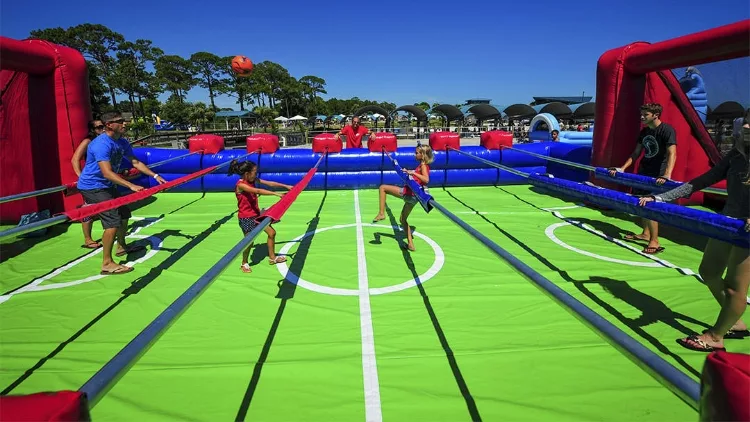
Human foosball is played on an inflatable or rope-divided field where players hold onto horizontal poles and can only slide left and right along their assigned row — exactly like the rods inside a real foosball table, except you are the player on the rod. You rely on timing, lateral coordination, and constant communication with your teammates rather than raw speed or strength, which makes the game remarkably inclusive across age groups and fitness levels. It belongs comfortably alongside the other active social games covered in the other games section of this site.
The rules are simple enough to explain in two minutes, but genuine coordination and smart positioning take several rounds to develop. This guide covers setup, core rules, team strategy, and how to run a match that keeps every participant energized from the opening kick to the final goal.
Contents
Getting Up to Speed: What Human Foosball Is and How the Field Works
The Life-Size Foosball Experience
Human foosball is a direct physical translation of table football into a full-body, outdoor-friendly activity. Instead of spinning plastic figures on metal rods, you get real people gripping or clipped to rope or PVC poles stretched across an inflatable arena or a clearly marked grass field. Each player slides only laterally — no stepping forward or backward, and no releasing the pole — while using their feet, chest, or head to advance the ball toward the opposing team's goal.
The setup typically uses two teams of six to ten players, though a compact four-on-four version works well for smaller groups or tighter spaces. Players arrange in rows that mirror the classic foosball table: goalkeepers at the back, defenders in front of them, midfielders in the center, and forwards closest to the opposing goal. The pole restriction is the defining mechanic — it creates the frantic lateral scrambling that makes every goal feel genuinely earned rather than simply athletic.
Field Setup and Equipment You'll Need
| Item | Standard Option | Budget Alternative |
|---|---|---|
| Playing field | Inflatable arena (40ft × 20ft) | Rope boundaries on flat grass |
| Poles | Foam-padded PVC pipe | Thick knotted rope at waist height |
| Ball | Soft foam ball or volleyball | Lightweight rubber kickball |
| Goals | Pop-up soccer goals | Cones or chalk-marked lines |
| Team size | 6–10 players per side | 4–6 players per side (smaller field) |
| Referee | 1 neutral official | Rotating honor system between rounds |
Inflatable arena rentals from local party suppliers typically include the poles, field markings, and setup instructions in a single package. For a DIY setup, stretch ropes at waist height across the field and space the rows far enough apart that players can maneuver without crowding the row in front of or behind them. Padding every hard pole with foam pipe insulation is non-negotiable — it costs almost nothing and prevents the kind of bruises that turn a fun afternoon into a complaint-filled evening.
How to Play Human Foosball: The Rules That Drive the Game
Core Rules Every Player Needs to Know
The rules for how to play human foosball stay close to the tabletop original, with straightforward adaptations for the physical format. Every player on the field keeps both hands on their pole at all times — releasing the grip, even briefly, earns the opposing team a free kick from that position. Players move only side to side, never stepping forward or backward, and they contact the ball using their feet (or chest and head, depending on the variation your group agrees on before the game).
- Kickoff: place the ball at center field and begin on the referee's signal or a three-count
- Out of bounds: return the ball to the nearest row and restart from that pole's position
- Fouls: releasing the pole, encroaching on an adjacent row's space, or deliberately blocking the ball with your torso instead of your foot all result in a free kick for the opposing side
- Goals: the ball must fully cross the goal line between the markers to count as a score
- Game length: most casual games run first to five or seven goals, or use two ten-minute halves
Pro tip: Keep a spare ball within arm's reach of the referee — soft foam balls travel surprisingly far during deflections, and stopping mid-game to chase one kills momentum instantly.
Scoring and Winning
Scoring works exactly as you'd expect: drive the ball past the goalkeeper and between the goal markers, and your team earns a point. The goalkeeper row often receives a small allowance in the rules — some variations permit the goalkeeper to use their hands for saves, which changes the defensive dynamic significantly and rewards a dedicated, focused player in that position. Settle this rule before the game starts and announce it to both teams, because mid-game rule changes breed arguments faster than any bad call from a referee.
Positioning and Tactics That Give Your Team the Edge
Communication Is Your Most Powerful Tool
Because every player is anchored to a pole, the ball travels between rows through deliberate passes and precisely timed lateral shifts, not individual runs. Teams that call out constantly — signaling for the ball, announcing a direction change, alerting the next row that the ball is incoming — consistently outperform teams with better individual athletes who stay silent throughout the match. Assign one vocal leader per row before the game starts, and task that person with coordinating lateral movement and calling passes.
This kind of team-based coordination mirrors the spatial thinking you find in well-designed competitive games, and it's worth cultivating for any group activity. If you're thinking about setting up a dedicated outdoor space for games like this, the guide on creating the perfect outdoor game room covers the layout planning and equipment selection decisions that make a real difference for regular use.
Row Roles and Lateral Positioning
- Forwards: hold center when the ball is deep in your half, then shift hard toward the ball's side as it enters your row's zone
- Midfielders: read the opposing team's pass patterns and shift to cut off passing lanes rather than tracking the ball reactively
- Defenders: maintain a deliberate offset from your goalkeeper so both players cover different width zones without overlapping
- Goalkeeper: track the ball's trajectory, not the kicker's body position — restricted players often show misleading footwork before contact
Rotating players between row positions across rounds also accelerates understanding of the full game — a midfielder who has spent time as a goalkeeper reads defensive angles immediately and becomes a significantly better passer as a result.
Running a Match Everyone Remembers for the Right Reasons
Organizing Teams and Managing Energy
Mixing ability levels deliberately — rather than letting friends self-select into groups — produces the most enjoyable matches at every type of event. When one team stacks all the athletic players, the game becomes a rout inside three minutes, and the losing side checks out emotionally long before the final goal. Shuffle teams between rounds, rotate row assignments so every player experiences a different position, and keep individual games short enough that energy and competitive intensity stay consistently high throughout the event.
For large events with eight or more teams, a round-robin format followed by a single-elimination bracket guarantees every group gets multiple games regardless of early results, which is especially important when you're hosting a corporate event or large birthday party where every guest should feel fully included in the competition.
Safety Rules That Keep the Game Fun
- Inspect the ground surface before play — wet grass creates slip hazards that sideline players, and hard concrete amplifies every fall
- Enforce a strict no-charging rule that prevents players from slamming their full body weight into the pole when another player is in contact with it
- Brief every participant on the rules before the first match, not mid-game when competitive adrenaline makes rule clarifications feel like personal attacks
- Use a neutral referee for every match at competitive or corporate events — the pole-release rule is the most commonly disputed call and needs consistent enforcement
For anyone who wants to pair human foosball with its tabletop counterpart at the same event, the basic foosball game rules of play article covers the original format in full detail and creates a natural thematic connection between the two versions that guests genuinely enjoy.
Frequently Asked Questions
What is human foosball?
Human foosball is a life-size version of the classic tabletop foosball game where real players grip or clip onto horizontal poles stretched across a field and can only move laterally, kicking a ball toward the opposing team's goal.
How many players do you need for human foosball?
The standard setup uses six to ten players per team, placing twelve to twenty people on the field simultaneously. A compact four-on-four version works well for smaller groups or tighter outdoor spaces.
Can you use your hands in human foosball?
Field players are restricted to feet, chest, and head contact in most rulesets. Goalkeepers are sometimes permitted to use their hands for saves — decide this rule before the game starts and communicate it clearly to both sides.
What equipment do you need to set up human foosball?
You need a defined field (inflatable arena or rope-marked grass), horizontal poles or ropes at waist height, a soft ball, and goal markers. Inflatable arena rentals typically bundle all components into a single package.
How long does a human foosball game last?
Most casual games run first to five or seven goals, or use two ten-minute halves. For multi-team events, keeping individual matches under fifteen minutes ensures strong pacing and maximum participation across all groups.
Is human foosball safe for all ages?
Human foosball is safe when poles are padded, ground surfaces are free of hazards, and a no-charging rule is enforced consistently. Adjusting pole heights and using a lighter ball makes the game comfortable and safe for younger players as well.
Do you need a referee for human foosball?
A neutral referee is strongly recommended for competitive or corporate events where the pole-release rule needs consistent enforcement. Casual backyard games can use a rotating honor system between rounds without significant issues.
Where can you rent human foosball equipment?
Local party rental companies, event entertainment suppliers, and inflatable game rental services typically carry complete human foosball setups. Searching for "inflatable game rentals" in your area returns the most relevant local providers.
Final Thoughts
Human foosball is one of those rare activities that works equally well as a structured competition and as pure, spontaneous fun — and now that you know how to play human foosball, you have everything you need to pull it off successfully. Book a rental, flatten your field, mix your teams with intention, and run your first match this weekend, because the fastest way to understand why this game builds such genuine enthusiasm is to be one of the players gripping that pole, shifting hard left, and connecting on the pass that leads to the winning goal.


About Mike Jones
Mike Jones grew up in the golden age of arcade and home gaming — a childhood shaped by Atari classics like Pitfall, Frogger, and Kaboom that gave him a lifelong appreciation for games of all kinds. These days he covers the full breadth of tabletop and family gaming: board games, card games, yard games, table games, and game room setup, with a particular focus on finding the games that bring different groups together. At GamingWeekender, he covers game reviews, buying guides, and recommendations for families, friends, and hobbyists who take their leisure seriously.
You can get FREE Gifts. Or latest Free phones here.
Disable Ad block to reveal all the info. Once done, hit a button below