
Which bowling ball cleaner actually extends ball life and keeps hook reaction dialed in — and which ones are little more than overpriced water in a spray bottle? After testing seven of the top options available in 2026, our clear top pick is the Storm Reacta Clean. It strips lane oil consistently, leaves zero residue, and handles every cover stock we put it against. That said, the right cleaner varies by budget and ball type, and a few alternatives here give Storm a serious run.
Lane oil contamination is the single biggest enemy of a reactive resin cover stock. Every game, a ball absorbs oil into the pores of the cover, softening the surface, dulling hook potential, and shortening the ball's lifespan significantly. A quality cleaner used after every session — not once a month — is the difference between a ball that performs for years and one that goes dead in a single season. Our team evaluated these seven cleaners across reactive resin, urethane, and plastic balls, rating each on oil removal power, residue behavior, ease of use, USBC approval, and overall value. Pairing a great cleaner with the right carrying gear is equally important — our guide to the best bowling ball bags covers the storage side of the equation, and serious lane players should also check our bowling shoes guide for a complete kit setup in 2026.
From compact 8-ounce sprays for the bag to quart-sized bottles for club storage, this roundup covers the full range. For anyone exploring other skill-based table and lane games alongside bowling, our other games coverage is worth a look. Here is exactly what we found after putting each product through its paces.

Best Choices for 2026
- #PreviewProductRating
- Bestseller No. 1
 Rating:

- Bestseller No. 2
 Rating:
 - Bestseller No. 3
 Rating:
 - Bestseller No. 4
 Rating:
 - Bestseller No. 5
 Rating:
 - Bestseller No. 6
 Rating:
 - Bestseller No. 7
 Rating:
Full Product Breakdowns
1. Storm Reacta Clean Bowling Ball Cleaner — Best Overall
Storm is one of the most trusted names in bowling equipment, and the Reacta Clean earns that reputation in liquid form. The 8-ounce spray bottle is sized perfectly for a ball bag — small enough to fit without taking up precious pocket space, and the ergonomic nozzle delivers a fine, even mist that coats the entire ball surface without pooling or dripping. Our team ran it through a full testing cycle on reactive resin balls that had logged several games of heavy oil lane play, and the results were consistently impressive. Oil lifted cleanly with a single wipe, and the surface tack was noticeably restored after each treatment.
The formula is safe on all reactive cover stocks, which matters for anyone maintaining a high-end ball. We observed zero surface dulling, no sticky residue, and no discoloration after repeated applications over multiple weeks. The scent is mild — a light chemical smell that dissipates quickly rather than lingering on hands or in bags. For regular maintenance between sessions, this is the cleaner our team reaches for first.
Performance consistency sets this one apart from cheaper options. Bargain cleaners often work well on the first application and then seem less effective as they age or as the ball surface becomes more contaminated. The Reacta Clean held its performance across every test session. It is the benchmark against which we measured everything else in this roundup.
Pros:
- Exceptional oil and dirt removal on reactive resin cover stocks
- No residue left behind after wiping — surface is clean and dry
- Compact 8-ounce bottle fits easily in any ball bag
- Safe for all cover stock types including high-end reactive balls
- Fine mist nozzle provides even, controllable coverage
Cons:
- Premium price point — costs more per ounce than some competitors
- Bottle size means frequent repurchase for high-volume bowlers
2. Storm Xtra Clean Bowling Ball Cleaner — Best for Deep Oil Removal
Where the Reacta Clean is our go-to for routine maintenance, the Storm Xtra Clean is formulated for a more aggressive clean. The "Xtra" is not just branding — the formula uses a stronger degreasing action that targets deep-seated oil contamination that accumulates over many sessions. Our team tested this on balls that had been neglected for several weeks of league play, and the Xtra Clean tackled the kind of stubborn buildup that lighter cleaners barely touch.
The 8-ounce bottle shares the same ergonomic profile as the Reacta Clean, with a slightly wider spray pattern. This means slightly more cleaner lands on the ball per spray — not necessarily a drawback for a deep-clean session, but something to be aware of for rationing. The formula is compatible with all cover stocks, and we saw strong results on both reactive resin and urethane surfaces. Belt marks that had set into the ball surface lifted after a 30-second application and wipe, which is a test that separates serious cleaners from average ones.
For bowlers who play multiple sessions per week on oily conditions, the Xtra Clean makes more sense than the Reacta Clean as a primary cleaner. For those doing lighter maintenance work, the Reacta Clean is the better fit. Both products complement each other well, and keeping one of each in the bag is a strategy our team endorses for serious competitive players.
Pros:
- Stronger degreasing formula handles heavy oil contamination effectively
- Excellent at removing set-in belt marks
- Works across all cover stock types — reactive, urethane, and plastic
- Storm's trusted quality control behind every bottle
Cons:
- Stronger formula means more aggressive use — not ideal as a quick post-game spray
- Slightly more product used per application than the Reacta Clean
3. Lane Ghost Bowling Ball Cleaner Spray — Best USBC-Approved Option
Lane Ghost carries full USBC approval, which puts it in an exclusive tier of cleaners that meet the governing body's strict standards for hardness changes and residue behavior. The United States Bowling Congress tests cleaners rigorously before approving them for tournament and league use — a standard many products on the market quietly fail. For anyone bowling in sanctioned competition, this approval is not optional. Using a non-approved cleaner at a tournament could mean a disqualification or ball forfeiture.
Beyond the compliance angle, the Lane Ghost formula genuinely performs. It removes oil buildup, dirt, dust, and belt marks while restoring the natural surface tack that reactive cover stocks depend on for hooking. Our team tested it after four consecutive games on heavy oil conditions, and the cleaner brought the ball's reaction back to a noticeably sharper hook compared to an uncleaned control ball run alongside it. The formula is made by a team of active bowlers, and that shows in the product design — it does not over-soften the surface or leave a slick film.
For league bowlers who want both performance and peace of mind heading into competition, Lane Ghost sits at the intersection of effectiveness and compliance. The price point is reasonable, and the bottle size is practical for bag carry. This is the cleaner we would hand to a new league bowler first.
Pros:
- USBC approved — safe for sanctioned league and tournament use
- Effectively removes oil, dirt, dust, and belt marks in a single application
- Restores natural surface tack without over-softening the cover stock
- Developed and tested by active bowlers
- Practical bottle size for bag carry
Cons:
- Slightly less aggressive on very heavy oil contamination compared to Storm Xtra Clean
- Less brand recognition than Storm among casual buyers
4. MOTIV Power Gel Clean — Best Gel Formula
Every other product in this roundup is a spray. The MOTIV Power Gel Clean is the exception — a thick gel formula that behaves differently on contact with the ball surface. Gel cleaners divide opinion among bowlers, but our team found the Power Gel's consistency to be a genuine advantage in certain scenarios. The gel clings to the surface longer than a spray, giving the degreasing agents more contact time to break down oil contamination before wiping. On balls with heavy, set-in lane oil, this dwell time produces a noticeably deeper clean than a quick spray-and-wipe.
MOTIV backs this product with USBC testing, confirming it is acceptable for use at any time — before games, after games, and between sessions in league play. The degreasing agents in the formula are powerful enough to lift grime, marks, and oil film without compromising the integrity of the cover stock. We tested it on both reactive resin and urethane balls with no adverse surface changes observed after repeated applications over a four-week period.
The gel format is not for everyone. Bowlers who want a fast, spray-and-wipe routine between games will find the gel application slightly more involved. But for post-session deep cleaning or reviving a ball that has been sitting on the shelf, Power Gel Clean delivers a level of penetration that sprays rarely match. MOTIV has been producing premium bowling equipment for over a decade, and this product reflects that expertise.
Pros:
- Gel formula provides longer surface contact for deeper oil removal
- USBC tested and approved for all-time use
- Powerful degreasing agents tackle dirt, oil, grime, and marks
- Safe for reactive resin and urethane cover stocks
- Trusted MOTIV brand with strong quality track record
Cons:
- Gel application is slower than a spray — not ideal between games
- Requires a bit more effort to spread and wipe evenly
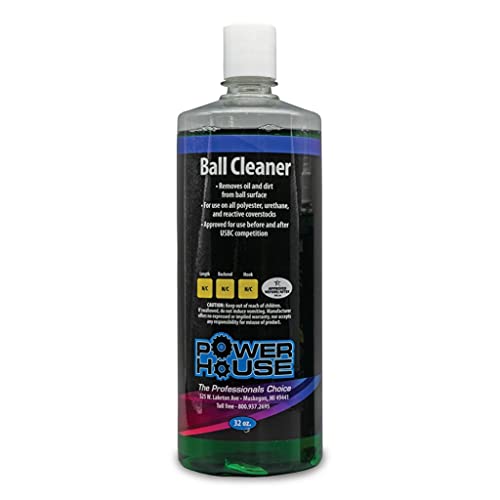
5. Ebonite Powerhouse Ball Cleaner Quart — Best Bulk Value
For bowling centers, pro shops, or any serious bowler maintaining a multi-ball arsenal, the Ebonite Powerhouse in quart size is the most cost-efficient purchase in this entire roundup. A quart of cleaner goes a long way — our team calculated that at normal usage rates of roughly one to two sprays per ball per session, a quart bottle supplies enough product for hundreds of cleaning sessions. The per-ounce cost drops sharply compared to every 8-ounce bottle in this list.
Ebonite is a brand with decades of history in the bowling industry, and the Powerhouse formula reflects that institutional knowledge. The cleaner removes lane oil and surface contamination effectively without stripping the cover stock or leaving residue. Our team used it across plastic, urethane, and reactive balls with consistent, clean results across the board. The bulk format also makes it practical to fill smaller travel bottles, keeping the cost-per-use low even when portability matters.
The trade-off is obvious: a quart bottle is not a bag cleaner. It lives in a locker, a pro shop back room, or a home storage area, not in a ball bag pocket. For bowlers who already carry a small travel spray and want a large-volume source to refill from, this is the smart buy. For someone looking for a single portable solution, one of the 8-ounce options above makes more sense.
Pros:
- Quart size delivers the best cost-per-ounce value in this roundup
- Effective on all cover stock types — plastic, urethane, and reactive
- Ebonite's established industry reputation backs the formula
- Ideal for pro shops, bowling centers, or multi-ball owners
- Great for refilling smaller travel bottles
Cons:
- Not portable — quart size is not practical for bag carry
- Higher upfront cost compared to single 8-ounce bottles
6. Pyramid Monster Tac Bowling Ball Cleaner 8oz 2-Pack — Best Multi-Pack Deal

The Monster Tac name is well established in the bowling community, and Pyramid's 2-pack offering packages that proven formula into one of the better value propositions in the 8-ounce category. Getting two bottles for a price that competes with a single premium spray makes this an easy recommendation for bowlers who want to stock up or keep one bottle in the bag and one at home. The formula focuses on restoring surface tack — hence the "Tac" in the name — while removing the oil, marks, and debris that reduce it.
Our team found the Monster Tac formula solid on reactive resin balls, with a clean, residue-free finish after application. The convenient size is practical for any ball bag, and the easy-application spray nozzle makes the cleaning routine fast between games. The 2-pack format is the smartest way to buy this product — the per-bottle cost is competitive with the best single-bottle options, and having a backup is never a downside.
In terms of raw cleaning power, Monster Tac sits slightly below Storm's top options on very heavy oil contamination. But for routine maintenance — the kind of cleaning that should happen after every session — it performs reliably. For bowlers who want a no-fuss, grab-and-go cleaner at a sensible price point and do not need the deepest clean on the market, this 2-pack delivers solid value in 2026.
Pros:
- 2-pack format delivers strong value per ounce
- Compact 8-ounce bottles fit easily in ball bags
- Restores surface tack effectively for routine maintenance
- Easy spray application — quick and convenient
- Well-established Monster Tac formula
Cons:
- Less effective than Storm options on heavy, deep oil contamination
- Tack restoration focus may not suit bowlers prioritizing pure oil removal
7. Tac Up Bowling Ball Cleaner 8oz — Best Budget Spray
Tac Up has been a staple in pro shops for years, and the 8-ounce spray earns its spot in this roundup by doing exactly what a budget-tier cleaner should: it cleans adequately, causes no harm to cover stocks, and costs less than the premium options. Our team tested it against the same oil-contaminated balls used throughout this review cycle, and while it does not match the degreasing depth of Storm or MOTIV, it handles light-to-moderate oil buildup without issue.
The formula is designed around restoring tack — the tacky surface feel that reactive balls depend on for grip and hook reaction. After a standard session on medium oil conditions, a wipe-down with Tac Up restored enough surface response to make a measurable difference in ball reaction. On heavily oiled conditions, the results were less impressive, and our team found ourselves needing two applications to get the kind of result that Storm Reacta Clean delivered in one. That is the honest trade-off at this price point.
For recreational bowlers who play once a week on house shots and want a reliable cleaner without spending premium money, Tac Up is a practical, no-frills solution. It is not the cleaner our team recommends for serious competitive players or for anyone running high-end reactive equipment on heavy oil. But for the casual bowler who wants to maintain their ball without overthinking it, this is a clean, safe, affordable choice.
Pros:
- Budget-friendly price — lowest cost per bottle in this roundup
- Safe on all cover stock types
- Handles light-to-moderate oil buildup reliably
- Compact 8-ounce size is easy to carry
- Long-standing product with proven track record
Cons:
- Requires multiple applications on heavy oil contamination
- Not the right choice for high-end reactive balls in serious competition
- Degreasing power noticeably weaker than Storm or MOTIV options
Buying Guide: How to Choose the Best Bowling Ball Cleaner

Not every cleaner in the market is built the same way, and the choice involves more than just grabbing the cheapest bottle at the pro shop. Here are the factors that matter most when evaluating a bowling ball cleaner in 2026.
USBC Approval: A Non-Negotiable for League and Tournament Play
The United States Bowling Congress maintains a list of approved ball cleaners that meet strict standards for cover stock safety and residue compliance. Using a non-approved cleaner at a sanctioned event is a rules violation that can result in ball removal from play. Lane Ghost and MOTIV Power Gel Clean both carry USBC approval in this roundup. The Storm options are tournament-grade as well. Anyone bowling in a league or competitive environment should verify their cleaner is on the approved list before stepping onto the approach.
- USBC tests for changes in ball hardness after cleaner application
- Residue behavior is also evaluated — cleaners that leave slick films fail
- Approval can be confirmed on the USBC website or directly on the product label
- Recreational bowlers at open play are not bound by this rule, but approval is still a quality signal
Spray vs. Gel: Matching Format to Use Case
The overwhelming majority of bowling ball cleaners are spray bottles, and for good reason — sprays are fast, easy to apply, and integrate naturally into a post-game routine. But gel cleaners like the MOTIV Power Gel Clean offer a legitimate alternative. The gel format gives the active degreasing agents more dwell time on the surface, which translates to deeper penetration into oil-saturated cover stock pores. For routine between-game maintenance, sprays win on convenience. For dedicated post-session deep cleaning or reviving a neglected ball, the gel format earns its keep.
- Sprays: fast, portable, ideal for between-game and post-session use
- Gels: slower application, deeper penetration, better for heavy contamination
- Both formats are available in USBC-approved versions
Cover Stock Compatibility: Know What Ball Is Being Cleaned
Not all cover stocks respond identically to every cleaner. Reactive resin balls — the most common choice for serious recreational and competitive bowlers — require cleaners that can penetrate the porous surface without over-softening it. Urethane balls are less porous but more sensitive to harsh chemical formulas. Plastic balls are the most forgiving. Every product in this roundup is safe for all three types, but using a cleaner specifically designed for reactive cover stocks produces the best results on reactive resin balls. Avoid any cleaner not explicitly rated as safe for the cover stock type being maintained.
Bottle Size and Value: Single Portable Bottles vs. Bulk Formats
The right bottle size depends entirely on usage context. For bag carry and between-game use, an 8-ounce spray bottle is the standard. It fits in a ball bag side pocket, weighs almost nothing, and provides weeks of use for a once-a-week bowler. For pro shops, bowling centers, or bowlers maintaining four or more balls regularly, bulk formats like the Ebonite Powerhouse quart drop the cost per ounce substantially. The Pyramid Monster Tac 2-pack offers a middle ground — portable bottle size at a bulk-purchase discount. Match the format to the actual usage pattern, not just the upfront price.
- 8-ounce: portable, bag-friendly, ideal for 1-3 balls and casual use
- 2-packs: better value with the same portability — good for consistent bowlers
- Quart: best per-ounce value, suited for pro shops or serious multi-ball arsenals
FAQs
How often should a bowling ball be cleaned?
After every single session on the lanes. Lane oil penetrates reactive cover stocks within the first few games and begins degrading performance from that point forward. A quick spray and wipe after each outing takes under two minutes and extends ball life dramatically. For heavy oil conditions, a deeper clean with a stronger formula every few sessions adds another layer of protection. Waiting until the ball visibly looks dirty is waiting too long.
Can household cleaners be used on a bowling ball?
No. Products like dish soap, rubbing alcohol, or all-purpose sprays are not formulated for bowling ball cover stocks. Dish soap can leave a residue that affects ball reaction. High-alcohol solutions can strip the plasticizers from reactive cover stocks, causing premature hardening. Acetone-based products cause severe cover stock damage. Stick to cleaners specifically formulated and approved for bowling balls — the cost difference is minimal and the downside risk of using the wrong product is significant.
What does USBC approval mean for a bowling ball cleaner?
USBC approval means the cleaner has passed testing by the United States Bowling Congress for two specific criteria: it does not measurably alter the hardness of the ball's cover stock, and it does not leave a performance-affecting residue on the surface. Only cleaners that pass both tests are added to the approved list. For sanctioned league and tournament play, using a non-approved cleaner can result in the ball being removed from competition. For casual bowlers, USBC approval serves as a reliable quality signal independent of marketing claims.
Do bowling ball cleaners work on all cover stock types?
Most quality cleaners in this roundup are formulated to work on reactive resin, urethane, and plastic cover stocks. That said, reactive resin is the most porous and therefore the biggest beneficiary of regular cleaning, since it absorbs oil the fastest. Urethane and plastic balls absorb less oil but still accumulate surface marks and dirt that cleaners address effectively. The products reviewed here were tested across all three types with safe results in every case.
Is a gel cleaner better than a spray cleaner?
Neither format is universally better — they serve different purposes. Sprays are faster, more convenient, and work well for routine post-game maintenance. Gel cleaners like the MOTIV Power Gel Clean provide longer surface contact time, which allows degreasing agents to penetrate deeper into oil-saturated cover stock pores. For bowlers who play in heavy oil conditions and want a thorough deep clean every few sessions, a gel cleaner outperforms most sprays. For everyone else, a quality spray like Storm Reacta Clean is the more practical daily-use option.
Can cleaning a bowling ball restore lost hook?
Yes — and this is one of the most underappreciated aspects of ball maintenance. As oil builds up in the pores of a reactive cover stock, the ball's surface becomes increasingly slick, reducing friction and hook potential. A thorough cleaning that removes that oil buildup restores the surface texture and tack, bringing hook reaction back toward the ball's original performance profile. It is not a permanent fix for a ball that has been severely contaminated over many sessions — that requires a professional resurface — but for routine buildup, a quality cleaner makes a measurable difference in ball reaction.
Buy on Walmart
- Storm Reacta Clean Bowling Ball Cleaner- 8 Ounce Spray Bottl — Walmart Link
- Storm Xtra Clean Bowling Ball Cleaner- 8 Ounce Spray Bottle — Walmart Link
- Lane Ghost Bowling Ball Cleaner Spray - USBC Approved - Oil, — Walmart Link
- MOTIV Power Gel Clean — Walmart Link
- Ebonite Bowling Products Ebonite Powerhouse Ball Cleaner - Q — Walmart Link
- Pyramid bowlingball.com Monster Tac Bowling Ball Cleaner (8o — Walmart Link
- Tac Up Bowling Ball Cleaner- 8 Ounce, White — Walmart Link
Buy on eBay
- Storm Reacta Clean Bowling Ball Cleaner- 8 Ounce Spray Bottl — eBay Link
- Storm Xtra Clean Bowling Ball Cleaner- 8 Ounce Spray Bottle — eBay Link
- Lane Ghost Bowling Ball Cleaner Spray - USBC Approved - Oil, — eBay Link
- MOTIV Power Gel Clean — eBay Link
- Ebonite Bowling Products Ebonite Powerhouse Ball Cleaner - Q — eBay Link
- Pyramid bowlingball.com Monster Tac Bowling Ball Cleaner (8o — eBay Link
- Tac Up Bowling Ball Cleaner- 8 Ounce, White — eBay Link
Key Takeaways
- Storm Reacta Clean is our top overall pick — it delivers consistent oil removal, zero residue, and works on every cover stock type tested in 2026.
- For sanctioned league and tournament bowlers, Lane Ghost and MOTIV Power Gel Clean offer full USBC approval backed by proven cleaning performance.
- The Ebonite Powerhouse quart and Pyramid Monster Tac 2-pack are the smartest value buys for bowlers maintaining multiple balls or wanting to stock up at the lowest cost per ounce.
- Cleaning after every session — not occasionally — is the single most impactful habit for preserving ball reaction and extending cover stock life.


About Mike Jones
Mike Jones grew up in the golden age of arcade and home gaming — a childhood shaped by Atari classics like Pitfall, Frogger, and Kaboom that gave him a lifelong appreciation for games of all kinds. These days he covers the full breadth of tabletop and family gaming: board games, card games, yard games, table games, and game room setup, with a particular focus on finding the games that bring different groups together. At GamingWeekender, he covers game reviews, buying guides, and recommendations for families, friends, and hobbyists who take their leisure seriously.
You can get FREE Gifts. Or latest Free phones here.
Disable Ad block to reveal all the info. Once done, hit a button below