Best Teen Murder Mystery Dinner Party Games Kit: Reviews, Buying Guide and FAQs 2026
by Mike Jones
According to a 2023 survey by the Toy Association, murder mystery games have grown over 40% in sales in the past three years — and it's easy to see why. There's something irresistible about sitting around a table with friends, sifting through fake crime scene photos and dramatic witness statements, trying to figure out who did it before anyone else does. For teens especially, these games hit a sweet spot: they're interactive, suspenseful, and feel genuinely grown-up without needing to be age-inappropriate. Whether you're planning a birthday party, a game night, or just want something that'll pull everyone away from their phones for a couple of hours, a murder mystery dinner party game kit is one of the best investments you can make in 2026.
The market has exploded with options ranging from immersive physical evidence games to full dinner party role-playing kits that seat 20 players. Some are best for solo sleuths curled up on the couch; others are built for a rowdy group of teenagers competing to crack the case first. The trick is knowing which format fits your crowd, your budget, and your tolerance for complexity. That's exactly what this guide is for. We've dug into the best teen murder mystery dinner party game kits available right now, breaking down who each one is really for and what makes it stand out — or fall short. If you're also looking for the best cooperative board games to round out your game shelf, that guide pairs perfectly with this one.

Below you'll find detailed reviews of seven top-rated products, a no-nonsense buying guide, and answers to the most common questions shoppers ask. According to Wikipedia's overview of murder mystery games, the genre stretches back to theatrical dinner events in the 1970s — but today's boxed versions have turned that experience into something anyone can host at home. Let's get into it.
Contents
- Best Choices for 2026
- Detailed Product Reviews
- Hunt A Killer: Lakeside Slaughter — Best Immersive Evidence Game
- Cryptic Killers: Murder of a Millionaire — Best Cold Case File Game
- Unsolved Case Files: Harmony Ashcroft — Best for Solo Play
- 16-Piece Crime Scene Decorations Kit — Best for Party Atmosphere
- 96 Pcs Mystery Party Decorations — Best Full Tableware Set
- Masters of Mystery: 1980s Edition — Best Group Dinner Party Game
- Awkward Guests 2: The Berwick Cases — Best Replayable Deduction Game
- Key Features to Consider When Choosing
- FAQs
- Key Takeaways
Best Choices for 2026
- #PreviewProductRating
- Bestseller No. 1
 Rating:

- Bestseller No. 2
 Rating:
 - Bestseller No. 3
 Rating:
 - Bestseller No. 4
 Rating:
 - Bestseller No. 5
 Rating:
 - Bestseller No. 6
 Rating:
 - Bestseller No. 7
 Rating:
Detailed Product Reviews
1. Hunt A Killer: Lakeside Slaughter — Best Immersive Evidence Game
Hunt A Killer has built a serious reputation in the mystery game world, and Lakeside Slaughter is one of their best standalone releases. You're dropped into the investigation of Monica's suspicious death at a lakeside vacation home, and from the moment you open the box, it feels like a real crime scene. You're handling physical letters, examining photographs, cross-referencing alibis — it's tactile in a way that most games just aren't. The attention to detail is impressive: the documents are printed to look genuinely worn and official, which sells the fiction completely.
Gameplay runs 90 to 120 minutes, which is ideal for a teen game night — long enough to feel substantial, short enough that nobody loses steam. It works solo or in a group, but it really shines with two to four players who can split up the evidence and argue their theories out loud. The narrative is compelling without being overly dark, which makes it suitable for ages 14 and up. If your teens are into true crime podcasts or shows like Unsolved Mysteries, this will feel like a custom-made experience. It also makes an excellent gift — the packaging is polished and presentation-worthy.
One thing to know: this is a one-and-done experience. Once you solve it (or look up the answer), the box has served its purpose. That's the nature of the format, and it's worth understanding before you buy. But for the price, the quality of the experience easily justifies a single-play product.
Pros:
- Exceptionally high-quality physical evidence components
- Compelling narrative that hooks players from the start
- Works solo or in groups — flexible for different occasions
- Appropriate tone and difficulty for teen players (14+)
Cons:
- Single-play only — can't be replayed once solved
- 90–120 min commitment may not suit casual players
2. Cryptic Killers: Murder of a Millionaire — Best Cold Case File Game
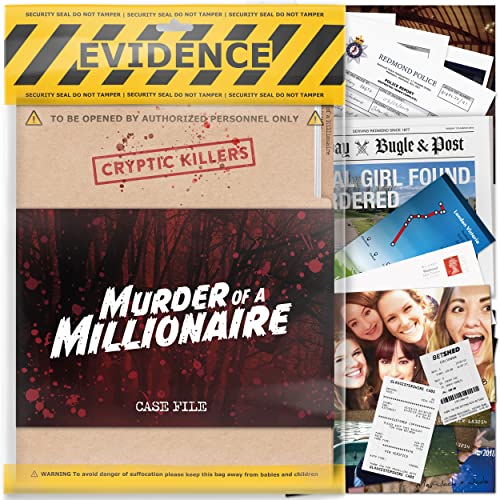
If you want a murder mystery game that feels authentically like a police investigation, Cryptic Killers' Murder of a Millionaire is the gold standard in 2026. The premise is gripping: lottery winner Chloe Whittle has been found stabbed to death in the UK town of Redmond, and you need to figure out who did it from a sprawling set of 29 physical evidence pieces. Those pieces include newspaper clippings, CCTV stills, betting slips, train schedules, coroner's reports, and witness statements — the kind of material that makes you feel like you're genuinely building a case board on your wall.
What really separates this one from the competition is the online police inbox component. Beyond the physical box, you need to log into a digital inbox and dig through additional information — but it's password-protected, and you'll need to use your investigative skills to get in. It's a clever integration of physical and digital that adds a whole extra layer of challenge without feeling gimmicky. For teens who are used to online interaction, this hybrid format feels natural and exciting. The difficulty level is appropriately challenging — this isn't a game you'll crack in 20 minutes, and that's the point.
It's equally strong for individuals, date nights, or small party groups, which makes it one of the most versatile picks on this list. The case is fictional but built with enough realistic detail that it consistently earns high marks for immersion. If your teen loves puzzle-heavy experiences, this is the one to grab.
Pros:
- 29 pieces of high-quality physical evidence
- Innovative online police inbox adds a digital investigation layer
- Great difficulty level — genuinely challenging without being unfair
- Versatile for solo, date night, or group play
Cons:
- Requires internet access for the online component
- One-time use — no replayability after solving
3. Unsolved Case Files: Harmony Ashcroft — Best for Solo Play
Set in 1998 and built around the cold case murder of Harmony Ashcroft, this game from Unsolved Case Files puts you in the position of a detective revisiting a wrongful conviction. The three-mystery structure is what makes this one genuinely special: you don't just identify the killer — you first prove the convicted man is innocent, then disprove a key suspect's alibi, then find the final piece of evidence that closes the case. That layered approach makes it feel far more like real detective work than a simple "who did it?" format.
The evidence pack is substantial — over 50 documents and photos, including fingerprint cards, legal documents, suspect interrogations, and a crime scene map. Everything is fictional, but the production quality makes it feel real enough to fully suspend your disbelief. It works well for solo players (check out our guide to the best solo board games for more single-player options) but also plays great with two or three people working together as a team. The 1998 setting adds a nostalgic twist that some players — and parents — will enjoy, while teens will appreciate the retro crime drama vibe.
For teens aged 14 and up, the difficulty is pitched just right: demanding enough to feel rewarding, but not so cryptic that it becomes frustrating. The cold case framing (where someone has already been wrongly convicted) adds genuine emotional stakes that most murder mystery games skip entirely. This is one of the most thoughtfully designed games on the list.
Pros:
- Unique three-mystery structure requires real detective thinking
- Over 50 pieces of physical evidence — excellent value
- Strong solo play experience — one of the best on this list
- Emotionally engaging cold case framing
Cons:
- Single-use once solved
- 1998 setting may feel dated for some younger teens
4. 16-Piece Halloween Crime Scene Decorations Kit — Best for Party Atmosphere
You've got the game — now you need the ambiance. This 16-piece decoration kit transforms any room into a convincing crime scene without requiring any special skills or a big budget. The centrepiece is a full-body silhouette measuring roughly 59 by 30 inches — big enough to lay on the floor and immediately set the mood. Add in the 65-foot bright yellow caution tape, 10 numbered evidence markers, and the bloody handprint and footprint window clings, and your party space suddenly looks like it was roped off by actual detectives.
Setup is genuinely easy. You lay down the silhouette, scatter the numbered markers around it, tape off the perimeter, and stick the window clings on glass surfaces for maximum spookiness. The whole setup takes maybe 15 minutes, even for a large room or garden space. The evidence markers are a particularly nice touch — numbered 0 through 10, they let you create your own "investigation scene" that players can explore before the game begins, which adds a fun pre-game ritual to the experience.
The materials are solid for the price point. The caution tape is vivid and holds its color well, the silhouette is a thick, durable paper-like material that lies flat without curling, and the stickers are reusable on smooth surfaces. This isn't a game on its own, but paired with any of the mystery games on this list, it's an easy and affordable way to make your party feel genuinely theatrical.
Pros:
- Full body silhouette (59" x 30") is a dramatic centrepiece
- 65 feet of caution tape covers large spaces generously
- Easy 15-minute setup — no tools or expertise needed
- Numbered evidence markers add interactive pre-game fun
Cons:
- Not a standalone game — decorations only
- Stickers may not adhere as well on textured walls
5. 96 Pcs Mystery Party Decorations Supplies — Best Full Tableware Set
If you're hosting a dinner party alongside your murder mystery game — and you should be, because the "dinner" part adds a lot to the vibe — this 96-piece tableware set is exactly what you need. It serves 24 guests with coordinated detective-themed plates, napkins, and forks, so you can seat a full house without mismatched table settings breaking the immersion. The set includes 24 nine-inch dinner plates, 24 seven-inch dessert plates, 24 printed clue napkins, and 24 gold plastic forks — everything you need to set a complete mystery dinner table.
The design leans into classic detective iconography: magnifying glasses, detective silhouettes, question marks, and bold black-and-white graphics that look sharp on a dinner table without being cheap-looking. The paper products use thick, fade-resistant materials — the kind that actually hold up through a whole dinner without going limp or bleeding color. The plastic forks are sturdy enough for a full meal, which matters more than you'd think when you're hosting 20+ teens and don't want utensils snapping mid-bite.
For the price-per-serving, this set offers excellent value. Buying individual theme plates, napkins, and forks separately would cost significantly more. If you're combining this with the crime scene decoration kit above, your party setup is basically done. It's also a clean, sophisticated choice compared to the generic "spooky Halloween" tableware alternatives — this looks like a planned event, not a last-minute costume party.
Pros:
- Serves 24 — ideal for large teen parties
- Coordinated detective theme looks polished and intentional
- Thick, sturdy plates and forks hold up through a full dinner
- Great value compared to buying components separately
Cons:
- Single-use disposable — not reusable after the party
- Gold forks may not suit every aesthetic preference
6. Masters of Mystery: 1980s Edition — Best Group Dinner Party Game
When you're hosting a large group and want everyone actively involved — not just watching a few people pore over documents — Masters of Mystery is the format you need. This 1980s-themed murder mystery dinner party game supports 4 to 20 players, which makes it one of the most scalable options on this list. The setting is a 1985 Hollywood movie set, complete with era-appropriate characters and a story that fully commits to the retro aesthetic. Think big hair, shoulder pads, and dramatic accusations over a dinner table.
Gameplay runs 1.5 to 3 hours depending on your group's pace, which is the right length for a dinner party format — you can pace it through courses. What makes this one particularly host-friendly is the special detective recordings feature: the host gets to participate in solving the mystery rather than just managing logistics. That's a detail most murder mystery dinner games get wrong — the host ends up stuck running the show instead of enjoying it. Here, you're in the game along with everyone else.
The roleplay element is stronger here than in the evidence-file games above. Players take on character roles and interact in character, which is perfect for a social teen crowd that's up for some theatrical fun. If your group enjoys games like Family Feud that thrive on group energy and audience participation, this murder mystery format will land extremely well. The 1980s theme is a crowd-pleaser across age groups, and the iconic characters make it easy for players to lean into their roles.
Pros:
- Scales from 4 to 20 players — handles large parties with ease
- Host participates as a detective, not just a referee
- 1980s theme is fun, distinct, and easy to costume around
- 1.5–3 hour runtime pairs naturally with a dinner
Cons:
- More roleplay-focused — less suitable for players who prefer pure deduction
- One-time play experience
7. Awkward Guests 2: The Berwick Cases — Best Replayable Deduction Game
Every other game on this list is a one-and-done experience. Awkward Guests 2 breaks that mold entirely. This board game generates thousands of unique murder scenarios from the same box, making it the most replay-friendly pick by a massive margin. The Berwick Cases system uses a modular card-and-deduction mechanic to set up a fresh crime each time you play — different victim, different suspects, different clues — so you can pull it out every game night and it'll feel new.
The deduction mechanics are genuinely clever. You're gathering clues, eliminating suspects, and piecing together a logical chain of evidence rather than relying on narrative hints alone. It rewards sharp logical thinking and works especially well for teens who enjoy strategic games. If you've got a group that gravitates toward puzzle games or logic-heavy board games, this will fit right into your rotation. It also pairs naturally with the kind of crowd who reads our cooperative board game guide — the deduction process here can be played cooperatively or competitively depending on your group's preference.
The production quality is excellent — clean graphic design, durable cards, and a rulebook that's actually well-written and easy to follow on first read. There's a learning curve on your first session, but by the second game, everything clicks and the pace picks up significantly. For any household or teen group that plays regularly, this is easily the best long-term value on this list. It's not a dinner party game in the traditional sense, but it slots naturally into any game night collection.
Pros:
- Thousands of unique case combinations — genuinely replayable
- Strong logical deduction mechanics reward strategic thinking
- High production quality — cards and components are built to last
- Can be played cooperatively or competitively
Cons:
- Learning curve on the first session — rulebook takes time to absorb
- Less narrative immersion than the evidence-file style games

Key Features to Consider When Choosing Teen Murder Mystery Dinner Party Games
Group Size and Format
The single most important variable to nail down before you buy is how many people will be playing. Evidence-file games like Hunt A Killer and Cryptic Killers are designed for small groups — one to four players is the sweet spot. Push that to eight or ten people and the experience breaks down because not everyone can engage with the physical evidence simultaneously. For larger groups of 8 to 20 players, roleplay-based dinner party games like Masters of Mystery are the right call. Always match the game format to your headcount, not just your budget. Also consider whether your group prefers working together (cooperative) or competing against each other to name the killer first — both formats exist, and teens tend to have strong opinions about which one they prefer.
Replayability vs. Narrative Depth
Here's the core trade-off in this product category: narrative-driven evidence games deliver a richer, more immersive experience but are one-time-use by design. Deduction board games like Awkward Guests 2 sacrifice some of that narrative depth but give you hundreds of plays from a single purchase. If you're buying for a one-time party, go deep on narrative. If you're buying for regular game nights, prioritize replayability. There's no wrong answer — just be honest with yourself about how you'll use it. A beautifully crafted cold case file game is a waste if it sits on a shelf after one play; a replayable deduction game is underwhelming if you only ever open it once.
Age-Appropriateness and Difficulty
Most of the games on this list are rated 14 and up, which is the right ballpark for teens. But difficulty varies significantly even within that age bracket. Evidence-file games like Cryptic Killers and Unsolved Case Files lean harder on logical deduction and can genuinely stump adults — they're not just "teen-easy." Meanwhile, dinner party roleplay games like Masters of Mystery depend more on social confidence and theatrical participation than puzzle-solving ability. Match the difficulty style to your group's strengths. A group of shy teens will struggle with roleplay-heavy formats; competitive puzzle-solvers will be bored by simple party games. Know your crowd.
Atmosphere and Decor
The game itself only sets part of the tone. If you want the full murder mystery experience in 2026, pairing your game with crime scene decorations makes a significant difference. The 16-piece decoration kit on this list is one of the easiest ways to transform a living room or backyard into something that actually feels like a crime scene before the game even begins. Similarly, the 96-piece tableware set turns a regular dinner into a themed event. These aren't necessary, but they elevate the occasion from "playing a board game" to "hosting an event." For birthdays and special occasions, the extra investment in atmosphere is absolutely worth it.
FAQs
What age group are teen murder mystery games designed for?
Most teen murder mystery games are rated for ages 14 and up, which reflects the complexity of the logic puzzles and the maturity of the themes involved. The crimes depicted are fictional and not graphic, but they do involve murder scenarios and investigative thinking that suits teenagers better than younger children. Some games, particularly the dinner party roleplay format, can work with younger teens (12–13) if an adult is facilitating, but the evidence-file games are genuinely better suited to 14+.
Can these games be played solo, or do you need a group?
Several of the evidence-file games on this list — including Hunt A Killer: Lakeside Slaughter, Cryptic Killers, and Unsolved Case Files: Harmony Ashcroft — work excellently as solo experiences. In fact, solo play is often where the immersion peaks because you're fully in charge of the investigation at your own pace. Dinner party roleplay games like Masters of Mystery require a group by design — you need multiple players to take on character roles. Awkward Guests 2 works best with two to four players but can also be played solo.
How long does a typical murder mystery game session take?
Runtime varies by format. Evidence-file games like Hunt A Killer and Cryptic Killers typically run 90 to 120 minutes for a focused session, though some groups stretch across two evenings. Dinner party roleplay games like Masters of Mystery run 1.5 to 3 hours, paced naturally through a meal. Deduction board games like Awkward Guests 2 can run 60 to 90 minutes per case. For parties, plan on the longer end of any estimate — teens will stop to debate, argue theories, and laugh, which is exactly the point.
Are murder mystery games replayable?
Most narrative evidence-file games are single-use — once you know the answer, the mystery is gone. This is a known limitation of the format and worth understanding before you buy. If replayability is a priority, Awkward Guests 2: The Berwick Cases is the clear standout, generating thousands of unique scenarios from the same box. Some publishers like Hunt A Killer also offer subscription boxes or expansion packs, so if your teen falls in love with the format, there are ways to keep the content fresh.
What's the difference between a cold case game and a dinner party murder mystery?
A cold case game (like Cryptic Killers or Unsolved Case Files) puts you in the role of a detective reviewing physical evidence — documents, photos, reports — to solve a fictional crime. It's quiet, focused, and puzzle-oriented. A dinner party murder mystery (like Masters of Mystery) is social and theatrical: players take on character roles, interact in character, and solve the mystery through roleplay and conversation. Cold case games work well in small, quiet settings; dinner party formats thrive with large groups who are comfortable being theatrical and improvisational.
Do I need to buy decorations separately, or do games come with them?
The games on this list — the evidence-file and roleplay formats — don't include party decorations. They're self-contained gameplay experiences. If you want crime scene tape, evidence markers, body silhouettes, and themed tableware for your party, those need to be purchased separately. The 16-piece crime scene decoration kit and the 96-piece tableware set on this list are both designed specifically to pair with murder mystery game nights, and together they cover everything you need for a full themed party setup.
Buy on Walmart
- Hunt A Killer: Lakeside Slaughter, Immersive Murder Mystery — Walmart Link
- Cryptic Killers Unsolved Murder Mystery Game - Cold Case Fil — Walmart Link
- Unsolved Case Files | Ashcroft, Harmony - Cold Case Murder M — Walmart Link
- 16 Pieces Halloween Crime Scene Decorations Kit Murder Myste — Walmart Link
- 96 Pcs Mystery Party Decorations Supplies – Detective Crime — Walmart Link
- Masters of Mystery 1980s / 80s Murder Mystery Dinner Party G — Walmart Link
- Awkward Guests 2: The Berwick Cases Board Game (English Edit — Walmart Link
Buy on eBay
- Hunt A Killer: Lakeside Slaughter, Immersive Murder Mystery — eBay Link
- Cryptic Killers Unsolved Murder Mystery Game - Cold Case Fil — eBay Link
- Unsolved Case Files | Ashcroft, Harmony - Cold Case Murder M — eBay Link
- 16 Pieces Halloween Crime Scene Decorations Kit Murder Myste — eBay Link
- 96 Pcs Mystery Party Decorations Supplies – Detective Crime — eBay Link
- Masters of Mystery 1980s / 80s Murder Mystery Dinner Party G — eBay Link
- Awkward Guests 2: The Berwick Cases Board Game (English Edit — eBay Link
Key Takeaways
- Hunt A Killer: Lakeside Slaughter is the top pick for immersive evidence-driven gameplay — ideal for teens aged 14+ who want a cinematic detective experience.
- Cryptic Killers: Murder of a Millionaire raises the bar with its hybrid physical-plus-digital police inbox mechanic, making it the most innovative cold case game in 2026.
- Masters of Mystery: 1980s Edition is the best choice for large dinner parties of up to 20 players, with a host-inclusive design that keeps everyone in the fun.
- Awkward Guests 2: The Berwick Cases is the smartest long-term investment for households that play regularly, delivering thousands of unique cases from a single box.


About Mike Jones
Mike Jones grew up in the golden age of arcade and home gaming — a childhood shaped by Atari classics like Pitfall, Frogger, and Kaboom that gave him a lifelong appreciation for games of all kinds. These days he covers the full breadth of tabletop and family gaming: board games, card games, yard games, table games, and game room setup, with a particular focus on finding the games that bring different groups together. At GamingWeekender, he covers game reviews, buying guides, and recommendations for families, friends, and hobbyists who take their leisure seriously.
You can get FREE Gifts. Or latest Free phones here.
Disable Ad block to reveal all the info. Once done, hit a button below