Which set of dominoes actually holds up for serious game nights — and which ones fall apart after a few sessions? We tested seven of the most popular options on Amazon in 2026, and the WE Games Mexican Train Dominoes Double Twelve set came out on top for most buyers. It delivers the right combination of durability, included accessories, and versatility at a price that makes sense. Keep reading for our full breakdown.
Dominoes have been a staple of family game nights and competitive play for centuries. According to Wikipedia's overview of dominoes, the game traces its origins to 13th-century China and has evolved into dozens of regional variants. Today, the options range from budget tin sets to handcrafted walnut cases built for tournament play. The category is broad enough that picking the wrong set is genuinely easy — a Double 6 set won't cut it for Mexican Train, and a Double 18 set is overkill for two players. We've done the sorting so most buyers don't have to.
Whether the priority is a premium gift, a compact travel tin, or a professional-grade tournament set, there's a strong option on this list. For anyone building out a dedicated game space, our guide on how to set up a family game room pairs well with this review. We've tested across tile material, case quality, pip clarity, and gameplay versatility. Here's what we found.

Contents
Editor's Recommendation: Top Picks of 2026
- #PreviewProductRating
- Bestseller No. 1
 Rating:

- Bestseller No. 2
 Rating:
 - Bestseller No. 3
 Rating:
 - Bestseller No. 4
 Rating:
 - Bestseller No. 5
 Rating:
 - Bestseller No. 6
 Rating:
 - Bestseller No. 7
 Rating:
Product Reviews
1. WE Games Mexican Train Dominoes, Double Twelve — Best Overall for Mexican Train
The WE Games Mexican Train set is our top pick for 2026, and it's not particularly close. The 91 ivory-colored, heavy-duty plastic dominoes are thick and satisfying to handle — each one measures 2.04 x 1.02 x 0.375 inches, which hits the sweet spot between legibility and comfortable shuffling. The assorted color dots make pip identification fast and reliable, even across the table under dim lighting. The included train and nine colorful train markers cover everything needed to run a full Mexican Train game for the family without sourcing extra pieces.
The vinyl carrying case with snap closure is a practical bonus. It keeps all 91 tiles, markers, and the train hub organized and protected between sessions. At 4.45 lbs total, this set has real heft — it doesn't feel like a cheap party favor. We've also confirmed it works cleanly for All Fives, Texas 42, and Fortress beyond Mexican Train, which broadens its value considerably. For households that want one domino set to handle multiple game formats, this is the one to buy.
The only real limitation is that newcomers to dominoes will need to look up rule books separately — no instructions are included. That's a minor knock on an otherwise well-executed package.
Pros:
- 91 double-twelve ivory tiles with color-coded dots for fast reading
- Includes 9 train markers, hub, and a sturdy vinyl snap-close case
- Supports multiple game variants — Mexican Train, All Fives, Texas 42, Fortress
- Solid 4.45 lb weight signals genuine build quality
Cons:
- No rule booklet included
- Vinyl case isn't as premium as wood or metal alternatives
2. Pressman Double 12 Color Dot Dominos in a Tin — Best Budget Pick
The Pressman Double 12 set covers the essentials without pushing into premium territory. The color dot system is the standout feature here — rich, vibrant pip colors make it genuinely easier to track high-count tiles during a Mexican Train game. The tin case is compact and clean, sliding shut securely enough to survive being tossed in a bag or stacked in a cabinet. For the price point, the build quality is respectable.
What Pressman delivers is a reliable, no-fuss entry into double-twelve gameplay. The tiles themselves are smooth and consistent in size, and the color coding prevents the number-fatigue that standard black pip sets cause during long sessions. This is the set we'd recommend for buyers who want to try Mexican Train before committing to a heavier-duty option. It also works well as a backup set for households that already own one set and need a second for larger gatherings.
The tin, while stylish, is smaller than the vinyl or wood cases on this list. Shuffling 91 tiles inside it requires patience. Still, for a budget-conscious purchase, Pressman over-delivers.
Pros:
- Vibrant color-coded dots improve gameplay speed and readability
- Compact tin case for easy storage and transport
- Solid value at its price point
Cons:
- Tin case is tight for shuffling all 91 tiles
- No train markers or hub included — must source separately for Mexican Train
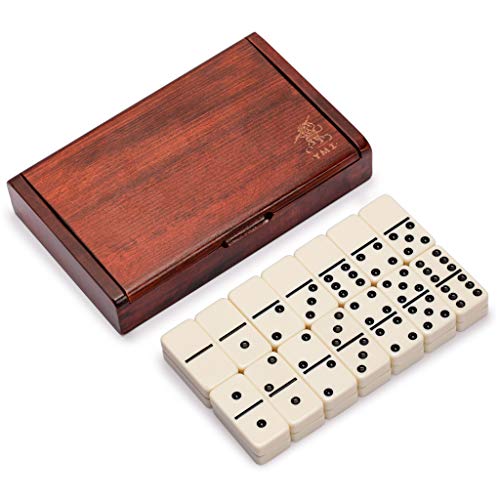
3. Yellow Mountain Imports 28 Tiles Double 6 Dominoes — Best Classic Set with Wood Case
Yellow Mountain Imports delivers a traditional Double 6 experience with a presentation that punches above its price. The 28 jumbo tournament-size tiles — each measuring 2.2 x 1.1 x 0.5 inches — are made from scratch-resistant melamine with etched and painted black pips. The etched pip construction means the dots won't rub off or fade over years of regular play, which is a real differentiator from injection-molded competitors. The tile surface has a smooth, professional feel.
The dark oak wood case is where this set earns its aesthetic reputation. At 8.6 x 5.31 x 1.57 inches, it houses the tiles snugly and looks good on a shelf. For anyone who cares about presentation — gifting this set, displaying it, or keeping it in a game room — the case elevates the whole package. The jumbo sizing is also easier on eyes and hands than standard-size tiles, making it a natural choice for older players or anyone who plays for extended sessions. Dominoes pairs naturally with other classic tile and card games — see our coverage of games like Gin Rummy for more ideas to complement a dedicated game night collection.
This is a pure Double 6 set, so it tops out at 28 tiles and isn't suited for Mexican Train or larger variant games. For classic Draw, Block, or All Fives with two to four players, it's excellent.
Pros:
- Scratch-resistant melamine tiles with etched pips that won't fade
- Jumbo tournament size — easier to read and handle
- Handsome dark oak wood case suitable for display or gifting
Cons:
- Only 28 tiles — limits game variant options
- Double 6 format won't support large groups or Mexican Train
4. Marion Domino Double 6 Black & White Two Tone Jumbo — Best Tournament Double 6
The Marion Domino set takes a serious approach to Double 6 gameplay. The tiles are crafted from high-density resin — a material that provides outstanding strength, stiffness, and color clarity. Each tile measures approximately 2 x 1 x 0.47 inches in the classic two-tone black and white format. The center spinner on every tile is the feature that serious players will appreciate most — it allows tiles to rotate during shuffling rather than dragging across the table, which protects the surface and extends tile life significantly.
The high-density resin construction feels immediately different from plastic competitors. These tiles have real rigidity and a smooth, cold surface that mimics the feel of professional-grade equipment. The velvet case, while elegant, is more of a soft pouch style — it provides good tile protection but doesn't have the structural rigidity of wood or metal cases. For players focused on the tiles themselves rather than display value, that's an acceptable trade-off.
This set is purpose-built for competitive Double 6 play. For casual game nights, the premium construction may be more than needed. For players who take their domino game seriously — and enjoy games like chess or other strategy-focused tabletop experiences — the Marion set matches that level of intentionality.
Pros:
- High-density resin tiles with exceptional rigidity and color clarity
- Center spinners on every tile protect surfaces during shuffling
- Jumbo tournament size with satisfying heft
- Elegant black velvet case for storage and presentation
Cons:
- Velvet case lacks structural rigidity compared to wood or metal alternatives
- Limited to Double 6 — no large-group variant support
5. Front Porch Classics Double 9 Colored Dot Dominoes Travel Tin — Best for Travel
Front Porch Classics hits the middle ground between the compact Double 6 sets and the expansive Double 12 options. The Double 9 format gives 55 tiles — enough for up to 8 players and a wider range of game styles than Double 6 without the bulk of a 91-tile set. The colored dot system makes this set genuinely more accessible for younger players — ages 8 and up is the official recommendation, and the color coding supports that claim. The travel tin is sized appropriately: protective, stackable, and carry-ready.
For families that bring games on road trips, to the cabin, or to relatives' houses, this set hits the right notes. The tiles are quality construction with vibrant pip colors that hold up under regular use. The 55-tile count supports more player flexibility than a Double 6 without requiring the full double-twelve investment. Anyone who wants a set that bridges casual and intermediate play will find this slot well-served.
The tin case is more robust than Pressman's in terms of internal organization, though shuffling 55 tiles requires spreading out on a table rather than mixing in the tin itself. The set includes no train hub or markers, so Mexican Train requires separate accessories.
Pros:
- Double 9 format supports 2 to 8 players across multiple game styles
- Colored dot pip system makes it accessible to players ages 8 and up
- Compact travel tin is durable and portable
- Good middle ground between small Double 6 and large Double 12 sets
Cons:
- No Mexican Train accessories included
- Tiles can feel slightly lightweight compared to premium options
6. Queensell Mexican Train Dominoes Set Double 18 — Best for Large Groups
The Queensell Double 18 set is the biggest domino set on this list, and it's built for situations where a Double 12 simply isn't enough. With 190 numbered tiles, a wooden hub, 12 plastic trains, a score pad, instructions, and an aluminum carrying case, this is the most complete package we reviewed in 2026. The numbered format — rather than traditional dot pips — is a deliberate choice that makes high-count tiles (like an 18-18 double) readable at a glance without counting dots.
Supporting 2 to 12 players, the Queensell set is the right call for large family gatherings, game nights with a big group, or events where the headcount is unpredictable. The aluminum case is genuinely impressive — it has the feel of professional equipment storage, and the snap closure keeps all 190 tiles and accessories secured during transport. Instructions are included, which addresses the learning curve for groups with mixed experience levels.
The numbers-instead-of-dots approach divides opinions. Purists who prefer traditional pip aesthetics will find it less appealing. For everyone else, the readability improvement on high-numbered tiles is a clear win. At this price and with this accessory count, the Queensell Double 18 is exceptional value for large-group buyers.
Pros:
- 190 numbered tiles support up to 12 players
- Complete set — includes wooden hub, 12 trains, score pad, and instructions
- Premium aluminum carrying case for transport and storage
- Numbered format improves readability on high-value tiles
Cons:
- Numbered tiles deviate from traditional domino aesthetics
- Large set — overkill for 2-4 player household use
7. Alex Cramer Le Club Luxury Domino Set — Best Luxury Gift
The Alex Cramer Le Club set sits in a different category than everything else on this list. It isn't primarily a game — it's a gift object that also functions as a serious domino set. The 28 ivory-look Double 6 tiles are official tournament size and weight: 2-1/8" x 1-1/8" x 7/16" at 0.055 lbs each. The tiles feature smoothly rounded corners and gleaming black dots on an ivory surface — the look and feel of professional competition equipment. The American-grown black walnut case, handcrafted in the USA, is the centerpiece. Polished brass closure, brass hinges, and brass accents give it the presence of heirloom furniture. The felt bottom protects the case and whatever surface it rests on.
The presentation box — black and gold with a gold ribbon — means this set ships ready to give. For anyone buying a gift for a dedicated domino player, a game room enthusiast, or someone who appreciates quality craftsmanship, the Le Club set is the correct choice. It arrives assembled and complete, and the walnut case is genuinely beautiful enough to display openly.
The limitation is scope: 28 tiles, Double 6 only. This isn't the set for Mexican Train with a group of eight. It's the set for two experienced players who want to enjoy the game on quality equipment — or for anyone who wants a centerpiece piece for their card and tile game collection.
Pros:
- Handcrafted American-grown black walnut case with brass hardware
- Official tournament size and weight tiles with rounded corners
- Ships in a premium gift box — ready to present without additional wrapping
- Assembled in the USA — supports domestic craftsmanship
Cons:
- Double 6 only — limits player count and game variety
- Premium price point reflects the luxury positioning

How to Pick the Best Dominoes Set
The domino market in 2026 is more varied than it looks at first glance. Getting the right set comes down to four key decisions. Here's how our team breaks it down.
Tile Count: Double 6, Double 9, Double 12, or Double 18?
The double number determines how many tiles are in the set and how many players it can support. This is the first decision, and it drives everything else.
- Double 6 (28 tiles): Classic. Works for 2–4 players. Supports Draw, Block, All Fives, and most traditional games. Limited for large groups.
- Double 9 (55 tiles): Intermediate. Handles 2–8 players. Good balance of accessibility and flexibility. Works for most casual households.
- Double 12 (91 tiles): The Mexican Train standard. Supports up to 8 players comfortably. Widest variant compatibility. Our overall recommendation for most buyers.
- Double 18 (190 tiles): For large gatherings of up to 12 players. Heavy, bulky, and requires serious table space. Best for dedicated game night enthusiasts.
Tile Material: Plastic, Resin, or Melamine?
Material affects durability, feel, and how the pips hold up over time. All three main materials have trade-offs.
- Heavy-duty plastic: Common, lightweight, affordable. Chips and scratches over time with heavy use. Fine for casual play.
- High-density resin: More rigid and durable than standard plastic. Better color clarity and resistance to warping. Preferred for tournament and serious play.
- Melamine: Scratch-resistant with excellent pip adhesion. Etched and painted pips won't rub off. The best long-term pip retention of any material we tested.
Pip Style: Dots vs. Numbers
Traditional dominoes use dots (pips). Numbered tiles are a newer format designed to improve readability on high-count tiles. Most buyers will prefer dots for aesthetic reasons — they're the classic look. For Double 12 and Double 18 sets where tiles reach counts of 144 or 171, numbers reduce miscounting errors significantly. For Double 6 and Double 9, dots are entirely readable and preferable for authenticity.
Case and Storage
The case matters more than most buyers expect. A poorly designed case turns every game session into a rummaging exercise.
- Vinyl snap-close cases: Lightweight, practical, protective. The standard for mid-range sets. Recommended for regular use.
- Metal/aluminum cases: Excellent protection and portability. Best for sets that travel frequently.
- Wood cases: Premium aesthetics, display-worthy. Best for sets that stay in one location or are purchased as gifts.
- Velvet pouches: Protect against scratching but offer no structural rigidity. Adequate for careful home use only.
Domino game nights fit naturally into a broader game room setup — for ideas on how to complement a set like these, our guide on backgammon fundamentals and strategy covers another classic tile-and-strategy game worth adding to the rotation.
What People Ask
What is the best dominoes set for Mexican Train?
The WE Games Mexican Train Dominoes Double Twelve is our top pick for Mexican Train play in 2026. It includes 91 double-twelve tiles, 9 train markers, and a hub — everything needed to run a full game. The color-coded dot system speeds up tile identification across the table. For large groups of 9 or more players, the Queensell Double 18 is the stronger option due to its 190-tile count and 12 included trains.
What's the difference between Double 6, Double 9, and Double 12 domino sets?
The number refers to the highest pip value on any single tile. A Double 6 set has 28 tiles and supports 2–4 players. A Double 9 set has 55 tiles and handles up to 8 players. A Double 12 set has 91 tiles and is the standard for Mexican Train with larger groups. Higher double numbers mean more tiles, more players supported, and more game variant compatibility.
Are numbered domino tiles better than traditional dot (pip) tiles?
It depends on the tile count. For Double 6 and Double 9 sets, traditional dot pips are fully readable and aesthetically preferred. For Double 12 and Double 18 sets, numbered tiles provide a meaningful readability advantage — counting 17 dots on a single tile end is error-prone. The Queensell Double 18 uses numbers for exactly this reason. Most buyers still prefer dots for sets up to Double 12 due to the classic visual appeal.
What material makes the most durable domino tiles?
Melamine is the most durable material for pip retention — etched and painted pips won't rub off or fade over years of play. High-density resin offers the best combination of rigidity, color clarity, and warp resistance for tile structure. Heavy-duty plastic is the most common and most affordable option but shows wear fastest under regular use. For long-term value, melamine or high-density resin tiles are the better investment.
How many players can play with a standard domino set?
A Double 6 set handles 2–4 players comfortably. A Double 9 set scales to 8 players. A Double 12 set supports 8 players in Mexican Train and similar games. A Double 18 set extends that to 12 players. For most home game nights, a Double 12 set covers all realistic scenarios without the bulk of a 190-tile Double 18 set.
What should buyers look for in a domino carrying case?
Structural rigidity and closure security are the two priorities. Snap-close vinyl cases are the practical standard — lightweight and fully protective. Aluminum cases offer the best combination of portability and protection for sets that travel frequently. Wood cases are display-grade and best for sets kept in a fixed game room location. Velvet pouches protect against surface scratches but won't survive being dropped or compressed in a bag.
Buy on Walmart
- WE Games Mexican Train Dominoes, Double Twelve - Premium Ivo — Walmart Link
- Pressman Double 12 Color Dot Dominos in A Tin, 5" — Walmart Link
- Yellow Mountain Imports 28 Tiles Double 6 Dominoes (Pips/Dot — Walmart Link
- Marion Domino Double 6 Black & White Two Tone Jumbo Tourname — Walmart Link
- Front Porch Classics, Double 9 Colored Dot Dominoes Travel T — Walmart Link
- Queensell Mexican Train Dominoes Set with Numbers - Double 1 — Walmart Link
- Alex Cramer Le Club' Luxury Domino Set with Handcrafted Waln — Walmart Link
Buy on eBay
- WE Games Mexican Train Dominoes, Double Twelve - Premium Ivo — eBay Link
- Pressman Double 12 Color Dot Dominos in A Tin, 5" — eBay Link
- Yellow Mountain Imports 28 Tiles Double 6 Dominoes (Pips/Dot — eBay Link
- Marion Domino Double 6 Black & White Two Tone Jumbo Tourname — eBay Link
- Front Porch Classics, Double 9 Colored Dot Dominoes Travel T — eBay Link
- Queensell Mexican Train Dominoes Set with Numbers - Double 1 — eBay Link
- Alex Cramer Le Club' Luxury Domino Set with Handcrafted Waln — eBay Link
Final Thoughts
For most buyers in 2026, the WE Games Mexican Train Dominoes Double Twelve is the right call — it's versatile, complete, and built to last. Anyone shopping for a premium gift should look at the Alex Cramer Le Club, and large-group hosts will find the Queensell Double 18 worth every penny. Pick the set that matches the actual use case, and this is a purchase that pays off for years of game nights.


About Mike Jones
Mike Jones grew up in the golden age of arcade and home gaming — a childhood shaped by Atari classics like Pitfall, Frogger, and Kaboom that gave him a lifelong appreciation for games of all kinds. These days he covers the full breadth of tabletop and family gaming: board games, card games, yard games, table games, and game room setup, with a particular focus on finding the games that bring different groups together. At GamingWeekender, he covers game reviews, buying guides, and recommendations for families, friends, and hobbyists who take their leisure seriously.
You can get FREE Gifts. Or latest Free phones here.
Disable Ad block to reveal all the info. Once done, hit a button below