Picture this: you've just set up a dartboard in your garage or basement, and now you're standing in front of your phone scrolling through dozens of dart sets, wondering what the difference really is between a $15 pack and a $80 tungsten set. It's overwhelming. You don't want to spend a fortune on something you might not stick with, but you also don't want to buy garbage that sends darts bouncing off the board every other throw. That's exactly why we put this guide together.
Darts is one of those games that sneaks up on you. You start tossing a few after dinner with friends, and before long you're watching the PDC World Championship at midnight and ordering your third set of flights. Whether you're brand new to the game or you've been playing casually for a year or two and want to level up your equipment, the darts you throw matter more than most people think. The right weight, grip, and tip type can genuinely make you more accurate and consistent — even before you've practiced a single hour.
In 2026, the market is loaded with options ranging from beginner-friendly value packs to professional-grade tungsten sets used by world-ranked players. We've narrowed it down to six of the best darts for home use, covering both soft tip (for electronic dartboards) and steel tip (for bristle boards), so you can find exactly what fits your setup and your budget. And if you're still exploring other backyard and rec room games beyond darts, check out our broader other games section for more ideas.
Contents
- Top Rated Picks of 2026
- Our Hands-On Reviews
- Fat Cat Soft Tip Dart Set (21-Pack) — Best Budget Soft Tip
- Fat Cat Steel Tip Dart Set (21-Pack) — Best Budget Steel Tip
- Harrows Fire Inferno 90% Tungsten Soft Tip — Best Intermediate Soft Tip
- Harrows Ryan Searle 90% Tungsten Steel Tip — Best Pro Value Steel Tip
- Unicorn Gary Anderson Phase 5 Noir 90% Tungsten — Best Signature Pro Set
- RED DRAGON Peter Wright Black Mamba 22g — Best Premium Steel Tip
- Key Features to Consider When Choosing
- FAQs
Top Rated Picks of 2026
- #PreviewProductRating
- Bestseller No. 1
 Rating:

- Bestseller No. 2
 Rating:
 - Bestseller No. 3
 Rating:
 - Bestseller No. 4
 Rating:
 - Bestseller No. 5
 Rating:
 - Bestseller No. 6
 Rating:
Our Hands-On Reviews
1. Fat Cat Soft Tip Dart Set (21-Pack), 17g — Best Budget Soft Tip
If you've just picked up an electronic dartboard and you need darts to go with it without spending serious money, the Fat Cat Soft Tip 21-Pack is the single best place to start. Twenty-one darts sounds like a lot, and it is — but trust us, you'll use them. Soft tips break. They wear down, they snap off in the board, and they go missing faster than TV remotes. Having 21 darts on hand means you're not stopping mid-game to dig plastic tips out of the carpet. Each dart weighs in at 17 grams, which puts them right in the sweet spot for beginners who haven't figured out their preferred weight yet. Light enough to throw consistently without fatigue, but heavy enough to fly straight.
The barrels are nickel silver-plated, which sounds fancy but really just means they're durable and look clean. Don't expect the slim, grippy profile of a $60 tungsten barrel — these are thicker and rounder in the hand. For a beginner, that actually helps. More surface area means you can hold them however feels natural while you develop your grip. The nylon shafts are sturdy enough for regular use, and the 2BA Tufflex Tips (the plastic points that go into the electronic board) are the industry standard connection size, so you can swap them out for any replacement tips you find at a sporting goods store. The plastic storage jar is genuinely useful — it keeps your spares organized and travels well if you're heading to a friend's place for a game night.
These are not precision instruments. You won't be grouping darts in the triple-20 with these from day one. The tolerances aren't tight enough for competitive play, and the flights are basic in shape and material. But that's not the point. The point is that you get a complete, functional, reliable set of soft tip darts at a price that won't make you wince if one snaps in half. For the purpose they serve — getting a beginner comfortable with the game on an electronic board — they nail it completely.
Pros:
- 21 darts gives you a massive supply of replacements, which matters a lot with soft tips
- 17g weight is a solid starting point for new players still developing their throw
- 2BA Tufflex Tips are the standard size, making replacements easy to find
- Storage jar keeps everything organized and travel-ready
Cons:
- Thicker nickel silver barrels lack the precision grip of tungsten — you'll feel the difference if you upgrade later
- Flights are basic and won't perform as consistently as premium options
2. Fat Cat Steel Tip Dart Set (21-Pack), 20g — Best Budget Steel Tip
Same concept as the soft tip version above, but built for a bristle dartboard. If you have a traditional sisal fiber board on the wall — the kind you see in every bar and pub — you need steel tips, and the Fat Cat 21-Pack Steel Tip set gives you everything you need to get started without overthinking it. The 20-gram weight is slightly heavier than the soft tip version, which is intentional. Steel tip darts traditionally run a touch heavier because the steel point itself adds negligible weight compared to a plastic tip, and players tend to prefer a slightly heavier dart for the firmer surface of a bristle board. Twenty grams is the single most popular weight in recreational steel tip play, which tells you something about how well it suits a wide range of throwing styles.
The construction mirrors the soft tip set: nickel silver-plated barrels, nylon shafts, and standard flights. Nothing revolutionary here. But the value equation is hard to argue with. You're getting 21 complete darts — shafts, flights, barrels, and steel points — for roughly the price of a six-pack of craft beer. If one dart bends on an errant throw or a flight tears, you're not scrambling. You just grab another one from the jar. For a beginner who isn't sure yet if steel tip or soft tip is the right setup for their home, buying one of each Fat Cat pack is honestly a smart move — it costs less than a single set of mid-range tungsten darts and covers both board types.
The steel points are fixed, not replaceable like soft tips, but that's true of virtually all darts at this price point. The barrel grip is smooth rather than knurled, which some players like and others don't. If you find your fingers slipping mid-throw, that's your signal to upgrade to a knurled or ringed barrel further down the line. For now, these do the job.
Pros:
- 20g is the most popular recreational weight — great starting point for new steel tip players
- 21-dart count means you'll never run out of spares mid-session
- Price is almost absurdly low for what you get
- Storage jar included keeps everything neat between uses
Cons:
- Smooth barrel offers minimal grip — finger slippage is a real issue for some players
- Not tungsten, so the barrels are thicker and harder to group tightly on the board
3. Harrows Fire Inferno 90% Tungsten Soft Tip Darts — Best Intermediate Soft Tip
This is where things get serious. The Harrows Fire Inferno is built with 90% tungsten (a dense, hard metal used in professional darts), which is the single biggest upgrade you can make when stepping up from a beginner nickel-silver set. Why does tungsten matter? Because tungsten is much denser than nickel silver, which means the barrel can be made significantly slimmer while keeping the same weight. Slimmer barrels mean your darts sit closer together in the board, which means you stop deflecting off your own darts when you're going for that treble-20. That's a genuine performance improvement, not marketing fluff.
The Fire Inferno comes in a 20g weight and is designed for electronic (soft tip) boards. Harrows is a brand with serious credibility in the darts world — they've been manufacturing professional darts for decades, and their quality control is a clear step above the budget brands. The barrel design on the Fire Inferno features aggressive grip texturing that gives your fingers something to anchor to on every throw. Once you get used to a proper gripped barrel, going back to a smooth nickel-silver barrel feels like throwing a wet bar of soap. The flights and shafts that come with it are functional, but honestly the first thing most intermediate players do is experiment with different flight shapes anyway.
If you've been playing for a few months on a Fat Cat or similar beginner set and you're consistently hitting the board but want more control and tighter groupings, this is your move. The jump in price from the Fat Cat is real, but so is the jump in performance. The 90% tungsten composition at this price point is hard to beat in the soft tip category. You get professional-grade materials without the professional-grade price tag of the signature pro sets lower on this list.
Pros:
- 90% tungsten barrels are slim, dense, and dramatically better than nickel-silver for grouping darts
- Textured grip gives you consistent finger placement every throw
- Harrows is a trusted professional brand with decades of manufacturing experience
- 20g is a versatile weight that suits most intermediate players
Cons:
- Steeper price jump from beginner sets — might feel risky if you're not sure how serious you are about the game
- Included flights and shafts are basic and you'll likely want to upgrade them separately
4. Harrows Ryan Searle 90% Tungsten Steel Tip Darts — Best Pro Value Steel Tip
Ryan Searle is a professional PDC darts player, and this is the dart he throws on the world stage. That alone tells you something. When a touring pro's name goes on a dart, the manufacturer isn't designing a watered-down version for the retail market — this is the same spec Searle uses in competition, available for you to throw in your living room in 2026. The set comes in a range of weights from 21g all the way up to 32g, which is genuinely unusual and massively useful. Most dart sets give you one weight and expect you to make it work. Harrows gives you the flexibility to actually find your weight.
The Carbon ST shafts included in this set are a significant upgrade over standard nylon. Carbon shafts are lighter, stiffer, and more resistant to breaking on deflection. If you've ever had a dart hit the shaft of a dart already in the board and snapped the shaft clean in half, carbon shafts reduce that problem considerably. The 100 Micron Heavy Metal flights are also noticeably more durable than standard-thickness flights — they hold their shape longer and maintain consistent flight paths, which matters when you're throwing 100 darts in a session.
The barrel itself has a strong, confident grip texture — not aggressive to the point of being uncomfortable, but firm enough that you know exactly where your fingers are on every throw. At 90% tungsten, the barrel profile is slim and allows tight groupings that would be physically impossible with a thicker budget barrel. This is the dart you buy when you're done experimenting and you want something that performs at a high level consistently. It's also the dart to buy if you play regularly with friends and want something that feels like a serious piece of equipment without crossing into the price territory of a full signature pro set. Among the steel tip options on this list, this is the one we'd personally reach for.
Pros:
- Multiple weight options (21g–32g) let you actually find what suits your throw
- Carbon ST shafts are more durable and consistent than standard nylon
- 100 Micron Heavy Metal flights hold shape and fly consistently over extended sessions
- Pro player design at a price that's accessible for serious recreational players
Cons:
- At the higher end of the weight range (30g+), these are for very specific throwing styles — beginners should start at 22g or below
- Not ideal for players who are still experimenting with fundamentals
5. Unicorn Gary Anderson Phase 5 Noir 90% Tungsten, 25g — Best Signature Pro Set
Gary Anderson is a two-time PDC World Champion. The Phase 5 Noir is what he's thrown in competition, and if you've watched him play, you know his release is one of the cleanest in professional darts. The Noir edition of his Phase 5 signature dart is coated in Black Titanium Nitride (TiN), which is not just a cosmetic choice. TiN coating adds a thin, extremely hard layer over the tungsten barrel that reduces wear, improves corrosion resistance, and — this matters more than it sounds — gives the barrel a slightly different tactile feel under your fingers. The surface has a subtle texture that many players describe as feeling more "grippy" without being aggressively knurled.
At 25g, this is the heaviest dart on this list, and that's very much a deliberate design choice for Gary Anderson's straight, powerful throw. If you have a smooth, fast release and you've been struggling with darts that feel too light and fly inconsistently, 25g might be exactly what you need. Heavier darts travel on a flatter arc, which means less compensation for gravity in your aim. For players who naturally throw hard, they just feel right in a way that a 17g or 20g dart never will.
The Phase 5 Noir comes in a presentation box with a protective sleeve, which is a nice touch if you're giving these as a gift or you want to store them properly between sessions. Unicorn is one of the top three dart manufacturers in the world alongside Harrows and Target, and their quality at this price tier is immaculate. Every component — barrel, shaft, flight — is manufactured to tight specifications. The presentation box also comes with a sleeve that slides over to protect the darts during storage, a feature that sounds small until you've had a stored set of darts clink against each other and chip. This is a complete, premium product. It just requires you to be honest about whether your game is at a level where you'll appreciate the difference.
Pros:
- Black Titanium Nitride coating adds durability and a distinct grip feel beyond standard tungsten
- Championship-winning player's exact specification — this is what Gary Anderson uses in PDC competition
- Presentation box and protective sleeve make this ideal as a gift or for careful storage
- Unicorn's build quality is among the best in the industry
Cons:
- 25g is a specific weight that suits certain throwing styles — not universally right for intermediate players
- Premium price tag means this is a harder buy if you're still figuring out your preferences
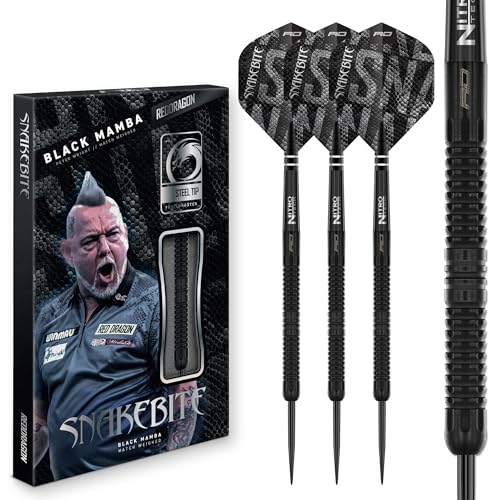
6. RED DRAGON Peter Wright 'Snakebite' Black Mamba 22g — Best Premium Steel Tip
Peter Wright, known as "Snakebite" on the PDC tour, is one of the most recognizable players in professional darts — his mohawk and face paint are hard to miss. But beyond the spectacle, he's a two-time World Champion, and the Black Mamba series is built around his throwing preferences. RED DRAGON is a respected manufacturer known for attention to detail in their professional signature lines, and the Black Mamba is no exception. At 22g, it sits in a comfortable middle weight that's genuinely versatile — heavier than the absolute beginner range but not as demanding as a 25g+ dart.
The 90% tungsten barrel is slim and aerodynamically clean. RED DRAGON calls their barrel treatment "Nitro Tech" on the shaft side, which refers to the integrated shaft and flight design that reduces drag on the dart's journey to the board. Less drag means a more consistent flight path, and a more consistent flight path means your muscle memory can actually build into repeatable accuracy. The Snake Skin flights are a distinctive design element that performs well aerodynamically — they're not just cosmetic, they have a specific profile that stabilizes the dart quickly off the release point.
One thing RED DRAGON does well that competitors at this tier sometimes skip: the Black Mamba series is offered in multiple tip configurations. You can get the 22g and 24g versions in steel tip, and an 18g soft tip version, which means if your home setup changes — say you add a bristle board to complement your electronic board — there's a matching dart in the same family. That continuity of feel across tip types is underrated. The darts come with the Nitro Tech shafts and Snake Skin flights included, which are both upgrades over what you'd get in a generic set, so you're not spending extra to get a workable configuration out of the box. If you want one set of premium steel tip darts that looks impressive, throws well, and holds its value as your game improves, this is it. We'd also recommend checking out our best magnetic dartboard guide and our pool table buying guide if you're building out a full rec room setup around your new darts.
Pros:
- 22g is an ideal all-around weight for intermediate steel tip players
- Nitro Tech shafts and Snake Skin flights included — ready to perform out of the box
- Available in matching soft tip weight for players with both board types
- Peter Wright's proven competition specification at a reachable price
Cons:
- The signature design aesthetic (Black Mamba branding) is bold — not everyone wants their darts to make a statement
- At this price point, you're paying partly for the pro license; alternatives like the Harrows Ryan Searle offer comparable performance at less cost
Key Features to Consider When Choosing Darts for Home Use
Soft Tip vs. Steel Tip: Start With Your Board
Before you even look at a dart, figure out what kind of board you have — or plan to get. Darts splits cleanly into two categories: soft tip for electronic (plastic) boards, and steel tip for traditional bristle (sisal fiber) boards. You cannot use steel tip darts on an electronic board — you'll break the scoring sensors. You can technically use soft tip darts on a bristle board, but they won't stick reliably and will frustrate you quickly. Match the dart to the board. If you already have an electronic board and want to add a bristle board later, just buy both types — a set of each from the beginner Fat Cat options on this list won't break the bank.
Weight: The Most Personal Choice in Darts
Dart weight is measured in grams, and the range you'll find in recreational and professional sets runs from about 16g to 32g. Most beginners do well starting between 17g and 22g. Lighter darts require more force and more arc in the throw; heavier darts travel flatter but require a more controlled, deliberate release. There's no universally correct weight — it's entirely about your natural throwing motion. The standard advice is to start in the middle range (around 20g–22g), see how it feels, and adjust from there. If your darts consistently land above where you're aiming, try going lighter. If they drop low, try going heavier. Weight is the most impactful variable you can control after practice.
Barrel Material: Nickel Silver vs. Tungsten
This is the biggest performance differentiator between budget and mid-range darts. Nickel silver barrels (used in the Fat Cat sets) are affordable and durable, but they're relatively thick. Tungsten barrels — especially at 90% purity like the Harrows, Unicorn, and RED DRAGON sets on this list — are far denser, which means the barrel can be made much slimmer while maintaining the same weight. Slim barrels mean your darts can physically sit closer together in the scoring zones, which reduces deflections and allows tighter groupings. If you're playing seriously or you're already consistent enough to aim at specific segments, tungsten is a meaningful upgrade. If you're still working on hitting the board reliably, nickel silver is perfectly fine.
Grip, Shafts, and Flights: The Supporting Cast
Once you have weight and material sorted, the details of grip texture, shaft length, and flight shape all contribute to fine-tuning your throw. Barrel grip can be smooth, ringed, or knurled (deeply textured). Smooth is comfortable but slippery; knurled gives you maximum finger lock. Shafts come in short, medium, and long lengths — shorter shafts make the dart fly nose-forward and flatter; longer shafts give more rear stability. Flights come in standard (large, more stability) or slim (less drag, faster) profiles. Beginners should start with whatever the set includes and experiment from there. Carbon shafts, like those in the Harrows Ryan Searle set, are worth seeking out once you know your preferences — they outlast nylon shafts by a significant margin under regular play.
FAQs
What weight darts should a beginner start with?
For most beginners, 18g to 22g is the sweet spot. It gives you enough mass for a controlled throw without requiring the precise release technique that heavier darts demand. The Fat Cat sets on this list at 17g and 20g are both solid starting points. Once you've thrown a few hundred games and feel like something isn't quite right, then experiment with weight adjustments.
What's the difference between soft tip and steel tip darts?
Soft tip darts have plastic points and are designed for electronic dartboards that detect scoring via sensors. Steel tip darts have metal points and are used on traditional bristle (sisal fiber) boards. You need to match the dart type to your board — using the wrong type will either damage the board or simply not work properly.
Are tungsten darts worth the extra cost for home use?
If you're playing more than a few times per month and you're past the absolute beginner stage, yes — tungsten darts are worth it. The slim barrel profile that tungsten allows reduces deflections, improves grouping, and gives you a more consistent grip experience. The Harrows Fire Inferno is a great entry point into 90% tungsten without spending pro-level money.
How many darts do I need for a game?
Standard darts is played with three darts per turn, so technically you need a minimum of three. But having spares matters — especially with soft tip darts, where the plastic tips break frequently. A set of six to nine gives you room to rotate. That's why the Fat Cat 21-packs are so popular for beginners: you'll never run out mid-session.
Can I use soft tip darts on a bristle board?
Technically yes, but it's a bad idea in practice. Soft tips aren't designed to pierce and grip sisal fibers — they'll bounce out or bend on impact. Stick to steel tips for bristle boards. If you have both board types, just get one set of each. Entry-level sets for both are cheap enough that buying both isn't a big commitment.
What's the best dartboard to pair with these darts in 2026?
For soft tip darts, an electronic board with a large scoring surface and bounce-out reduction technology is ideal — check our best electronic dart board guide for specific recommendations. For steel tip darts, a quality sisal bristle board is the standard. If you want something safer for a home with kids or limited space, our best magnetic dartboard roundup covers soft-play alternatives worth considering.
Buy on Walmart
- Fat Cat Soft Tip Dart Set (21-Pack), 17-Gram Darts with Plas — Walmart Link
- Fat Cat Steel Tip Dart Set (21-Pack), 20-Gram Darts with Pla — Walmart Link
- Harrows Fire Inferno 90% Tungsten Soft Tip Darts (20) — Walmart Link
- Harrows Ryan Searle Darts 90% Tungsten | Pro Player Steel Ti — Walmart Link
- Unicorn Dart Set, Gary Anderson, Phase 5, Noir, 90% Tungsten — Walmart Link
- RED DRAGON Darts - Professional Player - Peter Wright 'Snake — Walmart Link
Buy on eBay
- Fat Cat Soft Tip Dart Set (21-Pack), 17-Gram Darts with Plas — eBay Link
- Fat Cat Steel Tip Dart Set (21-Pack), 20-Gram Darts with Pla — eBay Link
- Harrows Fire Inferno 90% Tungsten Soft Tip Darts (20) — eBay Link
- Harrows Ryan Searle Darts 90% Tungsten | Pro Player Steel Ti — eBay Link
- Unicorn Dart Set, Gary Anderson, Phase 5, Noir, 90% Tungsten — eBay Link
- RED DRAGON Darts - Professional Player - Peter Wright 'Snake — eBay Link
Buy the dart that matches where you are right now — not the one you hope to grow into someday.


About Mike Jones
Mike Jones grew up in the golden age of arcade and home gaming — a childhood shaped by Atari classics like Pitfall, Frogger, and Kaboom that gave him a lifelong appreciation for games of all kinds. These days he covers the full breadth of tabletop and family gaming: board games, card games, yard games, table games, and game room setup, with a particular focus on finding the games that bring different groups together. At GamingWeekender, he covers game reviews, buying guides, and recommendations for families, friends, and hobbyists who take their leisure seriously.
You can get FREE Gifts. Or latest Free phones here.
Disable Ad block to reveal all the info. Once done, hit a button below