Ever stared at your backyard trampoline and thought, "there has to be more to this"? There is. The best games to play on a trampoline transform a simple bounce session into something competitive, creative, and genuinely hard to walk away from. From neighborhood classics like Crack the Egg to fast-paced elimination rounds that work for every age group, there are far more options than most people realize. If you already enjoy fun games to play with a ball, you'll find that many of those same instincts — timing, awareness, reading the other players — translate perfectly onto the trampoline surface.
Trampoline games are one of the most underrated forms of active play going. They build coordination, burn serious energy, and create the kind of chaotic, memorable fun that kids still talk about weeks later. What surprises most adults is how quickly they get hooked too. Once you try a few rounds of Poison Ball or a competitive seat-drop challenge, the session stops being about just bouncing and starts being about winning. The trampoline becomes a game board — and everyone on it has something to lose.
This guide covers the top trampoline games, the gear that makes them better, how to keep everyone safe, and a few persistent myths worth clearing up. Whether you're organizing a birthday party, planning a family afternoon, or just tired of everyone drifting back to their phones, this list gives you everything you need to make your trampoline the centerpiece of a genuinely great time. For even more ideas beyond the mat, browse the other games category — there's no shortage of ways to play.
Contents
The Best Trampoline Games: A Quick Comparison
Before you run outside and start shouting rules at confused kids, take thirty seconds to pick the right game for your group. Not every trampoline game fits every situation. Some work best with two players, others shine with six. This table gives you a snapshot so you can choose based on who's playing and what you're working with.
| Game | Players | Min. Age | Skill Level | Equipment Needed |
|---|---|---|---|---|
| Crack the Egg | 3–6 | 5+ | Easy | None |
| Poison Ball | 2–8 | 6+ | Easy | 2–3 soft foam balls |
| Dead Man's Drop | 2–5 | 8+ | Medium | None |
| Add a Trick | 2–6 | 8+ | Medium | None |
| Bounce Battle | 2–4 | 10+ | Medium | None |
| Trampoline Dodgeball | 4–8 | 8+ | Medium | 2–4 foam balls |
What Makes a Good Trampoline Game
The best trampoline games share a few common traits: clear rules that take under a minute to explain, a definite winner, and enough unpredictability to keep every round feeling different. Games that rely purely on who can jump highest are fun for about three minutes. Games with strategy, elimination mechanics, or physical challenges last far longer and hold attention from round one to the final bounce. The moment someone almost wins and then doesn't is the moment everyone wants to play again.
Solo Games vs. Group Games
Solo trampoline games focus on personal challenges — how many consecutive seat drops you can land, how long you can hold a specific shape mid-air, or nailing a move you've been working on. Group games add competition and unpredictability. Both are worth knowing. Some days you're out there practicing alone; other days you've got five people all wanting to win something right now.
Easy Games You Can Start Playing Right Now
You don't need to overthink this. Some of the most beloved games to play on a trampoline have been passed down through neighborhoods for decades, and they work just as well today. Here are the ones you can teach in under two minutes flat.
Crack the Egg
One player sits in the center of the trampoline and hugs their knees as tightly as possible — that's the "egg." Everyone else bounces around them, trying to break the egg by making the sitting player lose their grip on their knees. The egg player wins by holding the position through the whole round. It's simple, it's physical, and it almost always ends in genuine laughter. This game works best with three to six players on a standard backyard trampoline, and younger kids can join in without needing any special athletic ability.
Poison Ball
Toss two or three soft foam balls onto the trampoline mat. Every player has to keep bouncing while avoiding any contact with the balls. Touch a ball, you're out. Last player standing wins. It sounds manageable until the balls start careening off the springs and rolling in four directions at once while you're in the air. Poison Ball scales easily for bigger groups — just add more balls to increase the chaos. It's one of those games where the rules are simple but the actual experience is anything but.
Dead Man's Drop
Stand still on the trampoline surface, fall backward like a board — no bending at the hips — and spring back to your feet as cleanly as possible. Other players vote on who nailed the flattest drop and the cleanest recovery. It sounds straightforward but demands real body control and a certain amount of nerve on your first attempt. First-timers almost always over-bend at the waist. With a few rounds of practice, you get that satisfying full-body spring that looks completely effortless from the outside.
Gear That Raises Your Game
You don't need a lot to run most trampoline games, but the right setup genuinely changes the experience. A safety enclosure net is the single most important piece of equipment you can have. It removes the biggest physical risk — someone bouncing off the edge mid-game — and opens up games you simply can't play safely without a boundary in place.
Balls and Props
Soft foam balls or lightweight rubber balls work best for games like Poison Ball and Trampoline Dodgeball. Standard playground balls are fine. Avoid anything hard or weighted — the bounce surface amplifies impact, and a fast-moving rubber ball at ankle height during a landing can cause falls that wouldn't happen on flat ground. Keep any props simple, soft, and easy to spot against the dark mat surface so players can react quickly.
Padding and Enclosure Nets
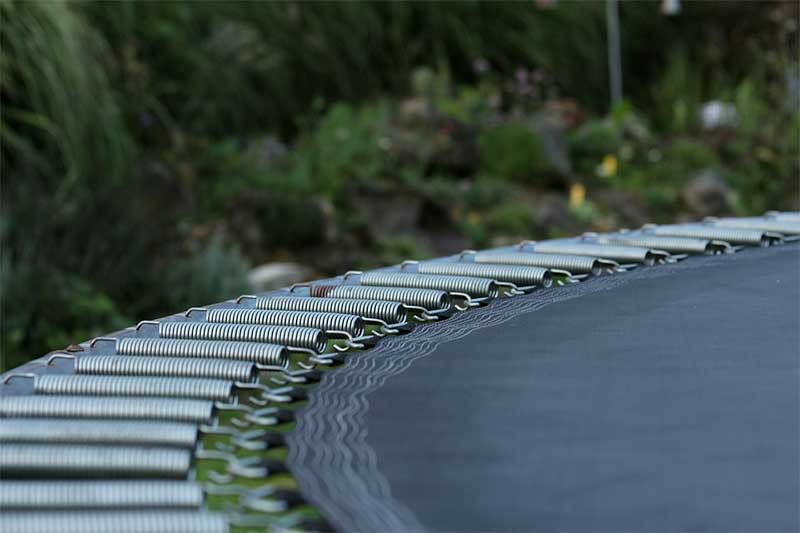
Spring pads — the thick foam covers that wrap around the trampoline's metal frame and spring hooks — are essential the moment you introduce multi-player games. When players move fast and unpredictably, landing near the edge happens. Replace worn or split pads before running any elimination game. Enclosure nets should be inspected every session for small tears, as a two-inch gap near the bottom is easy to miss and easy for a foot to catch.
Pro tip: Check your spring pad and enclosure net before every game session — a small tear or a shifted pad is easy to overlook but can turn a great afternoon into an urgent care visit.
Trampoline Game Myths Worth Busting
A handful of stubborn myths keep people from getting the full value out of their trampoline. Here's what the evidence actually says.
Myth: These Games Are Only for Young Kids
This one is completely wrong. Adults play competitive trampoline games at a level most kids simply can't match, because coordination, timing, and strategic awareness all improve with age. Games like Bounce Battle and competitive seat-drop challenges actually favor adults because they demand precise body control rather than raw energy. Trampoline parks built their entire business model around adults paying for exactly this experience. Just like how fun darts games aren't exclusively a bar crowd activity, trampoline games don't belong only to the under-twelve set.
Myth: You Need a Huge Trampoline for Group Games
A standard 14-foot round trampoline holds three to four players comfortably for the majority of games. Some games — Crack the Egg in particular — actually become harder and more entertaining on a tighter surface. What matters far more than diameter is the weight capacity and the quality of the enclosure system. Check your manufacturer's posted capacity before running multi-player sessions. Overloading the frame is the most common safety mistake families make, and it's entirely avoidable.
Myth: Trampolines Are Too Dangerous for Structured Games
According to the CDC's injury prevention resources, the vast majority of trampoline injuries come from falls off the equipment or collisions between multiple jumpers — both of which are preventable with proper equipment and enforced rules. Trampolines with enclosures and clear turn-taking expectations are dramatically safer than those without. The danger comes from ignoring the setup requirements, not from playing games themselves. Structure actually makes trampolines safer, not riskier.
How to Make Any Trampoline Game Better
The difference between a game that fizzles after five minutes and one that goes for an hour usually comes down to small, deliberate tweaks. Here's what consistently works.
Add a Challenge Round
After a standard game ends, run one more round with a single constraint added — no seat drops allowed, or both hands must stay touching your head the whole time. Constraints force creative movement and make completely familiar games feel like something new. This approach works especially well for groups who've played the same game so many times that the outcome feels predictable. Just like how cornhole has evolved with new rules and formats over the years, trampoline games grow with the people playing them.
Keep a Running Score
Track wins across multiple sessions — a whiteboard on the fence, a note on your phone, whatever works. When players know there's an ongoing championship with actual history behind it, even a quick fifteen-minute bounce session carries real weight. Sustained competition over time is what turns casual games into something people genuinely look forward to. Kids who know they're two wins away from the weekly title show up with a completely different level of focus.
Mix Age Groups Intentionally
Pair younger players with older ones for team-based games. This levels out the raw athleticism gap and teaches younger kids strategy faster than playing exclusively with peers would. Team Poison Ball — two versus two, with partners calling out ball positions for each other — creates real communication and game awareness even among young players. The older player gets a challenge; the younger player gets a mentor. Both leave wanting another round. On rainy days when the trampoline's off the table, there are always fun games to play over text to keep the competitive streak going.
How Real Families Make Trampoline Time Count
The families who consistently get the most out of trampoline games share one straightforward habit: they show up with a plan. Instead of saying "go bounce," they arrive at the trampoline with two or three specific games already chosen and a rough rotation in mind. That removes the "what do we play now" pause that kills momentum between rounds and turns a half-hour session into a full afternoon.
Birthday Parties
Trampoline games are a natural anchor for backyard birthday parties because they require zero setup beyond what you already own. Crack the Egg, Poison Ball, and a Highest Jump contest keep a group of eight to ten kids actively engaged for a full hour without a single screen in sight. Elimination-format games keep things moving — nobody waits long for their next turn, which means no one drifts off to find something else to do. Knowing the rules cold before the party starts prevents the arguments that derail the fun. The same principle applies whether you're managing air hockey rules in a game room or trampoline rules in the backyard — clarity upfront pays off the whole session.
Family Fitness Routines
Some families build trampoline games into their weekly routine specifically because it doesn't feel like exercise to anyone involved. Kids who push back on a twenty-minute jog will happily play Crack the Egg for forty-five minutes without once noticing they're getting a genuine cardiovascular workout. Trampoline games deliver real physical benefit wrapped entirely in competition and play. That combination is rare. Most structured fitness activities require buy-in that kids resist; trampoline games get it for free because the fun is the point, and fitness is just what happens.
Safety Rules That Keep the Fun Going
Every great game runs on clear rules. Safety on a trampoline is no different — and clear boundaries prevent both injuries and arguments at the same time. Set these expectations before the first person steps on the mat, and they become second nature within a session or two.
The One-at-a-Time Rule for Tricks
When one player is attempting any skill move — a backflip, a front drop, a specific trick sequence — everyone else on the trampoline stops bouncing completely. The mat is a shared system, and an unexpected bounce from another player at the wrong moment throws off timing in ways that cause falls. For standard competitive games like Poison Ball this pause isn't necessary. For any round involving intentional tricks, enforce this rule with no exceptions, every single time.
Age and Weight Guidelines
Most residential trampolines are rated for a specific number of simultaneous jumpers and a maximum combined weight per session. These numbers are engineering limits, not suggestions. Running four-player elimination games on a frame rated for two jumpers is how springs fail and nets give way mid-bounce. Find the label on your frame — it's usually on a leg or the enclosure pole — and enforce it. No game is worth a broken frame or a trip to the emergency room.
The No Shoes Rule
This one gets forgotten constantly. Shoes add impact force to every landing and can catch on the mat weave in ways that bare feet simply don't. If cold weather makes bare feet uncomfortable, jump socks — thin grip socks designed specifically for bounce surfaces — are a solid middle ground. Many trampoline parks sell them at the front desk, and there's a reason: they work. Make it a rule before the games start, not a conversation after someone's ankle turns.
The trampoline in your backyard is already the best game you own — you just need the right rules to prove it.


About Mike Jones
Mike Jones grew up in the golden age of arcade and home gaming — a childhood shaped by Atari classics like Pitfall, Frogger, and Kaboom that gave him a lifelong appreciation for games of all kinds. These days he covers the full breadth of tabletop and family gaming: board games, card games, yard games, table games, and game room setup, with a particular focus on finding the games that bring different groups together. At GamingWeekender, he covers game reviews, buying guides, and recommendations for families, friends, and hobbyists who take their leisure seriously.
You can get FREE Gifts. Or latest Free phones here.
Disable Ad block to reveal all the info. Once done, hit a button below