A 2024 study found that even a 50ms spike in network latency can reduce a competitive gamer's in-game reaction accuracy by up to 24% — yet most households are still running the same all-purpose router that came free from their ISP, a device that was never engineered to prioritize gaming traffic over your roommate's 4K Netflix stream. If you've ever felt that gut-punch moment when a lag spike costs you a ranked match you were clearly winning, the problem almost certainly isn't your internet plan — it's the hardware managing your connection. In 2026, gaming routers have evolved far beyond simple bandwidth boosters, offering dedicated game acceleration engines, advanced QoS systems that surgically prioritize your packets, and multi-gigabit wired ports that deliver the kind of stability your competitive play actually demands.

Choosing the right gaming router isn't as simple as picking whichever box has the most antennas or the most aggressive-looking chassis — and trust me, some of these things look like alien spacecraft that landed on your desk. What you're really evaluating is a combination of WiFi standard, QoS sophistication, physical port configuration, and whether the router's firmware gives you actual control over your gaming experience or just a flashy dashboard with limited utility. Whether you're deep into competitive first-person shooters where every millisecond counts, or you're managing a household where multiple people game and stream simultaneously, the right router makes a tangible difference that you'll feel within the first gaming session. If you're also building out the rest of your setup, don't miss our guide to the best gaming desks for PC gaming sessions — a solid workstation environment complements everything discussed here.
We've evaluated seven of the top gaming routers available right now, ranging from budget-friendly AC2600 options that still outperform standard consumer routers, all the way to cutting-edge WiFi 7 quad-band powerhouses pushing theoretical speeds of 30 Gbps. Each router has been assessed for real-world gaming performance, not just spec-sheet numbers, and we'll walk you through exactly who each one is best suited for. You can also explore the full range of video games content on our site to round out your gaming knowledge alongside this hardware deep-dive.
Contents
- Our Top Picks for 2026
- Our Hands-On Reviews
- ASUS ROG Rapture GT-AX11000 Pro — Best for Hardcore WiFi 6 Gamers
- ASUS ROG Rapture GT-BE98 PRO — Best Premium WiFi 7 Gaming Router
- NETGEAR Nighthawk Pro XR1000 — Best for Lag Reduction & Ping Optimization
- TP-Link Archer GE800 — Best Future-Proof WiFi 7 Value
- ASUS ROG Rapture GT-AX6000 — Best Dual-Band WiFi 6 Mid-Range Pick
- NETGEAR Nighthawk Pro XR500 — Best Budget Gaming Router
- NETGEAR Nighthawk Pro XR700 — Best for Wired-First Power Users
- Buying Guide
- What People Ask
Our Top Picks for 2026
- #PreviewProductRating
- Bestseller No. 1
 Rating:

- Bestseller No. 2
 Rating:
 - Bestseller No. 3
 Rating:
 - Bestseller No. 4
 Rating:
 - Bestseller No. 5
 Rating:
 - Bestseller No. 6
 Rating:
 - Bestseller No. 7
 Rating:
Our Hands-On Reviews
1. ASUS ROG Rapture GT-AX11000 Pro Tri-Band WiFi 6 — Best for Hardcore WiFi 6 Gamers
The GT-AX11000 Pro is ASUS's flagship WiFi 6 gaming router, and it delivers the kind of tri-band performance that transforms a chaotic household network into something approaching a dedicated gaming environment. Combined theoretical speeds of up to 11,000 Mbps across three bands give you a genuinely uncongested wireless experience, especially when you pair 160 MHz channel support with the ASUS RangeBoost Plus technology that actively improves signal propagation throughout your home. Where this router really distinguishes itself from previous ASUS ROG models is the flexible port configuration — you get both a 2.5G port and a 10G port, and crucially, either of them can be configured for WAN or LAN operation depending on your ISP's physical setup, which makes it compatible with multi-gig internet plans that are becoming increasingly common in 2026.
The Triple-Level Game Acceleration system works at the device level, the router level, and the server level simultaneously, routing your gaming packets through the most optimal path rather than simply blasting them out at maximum power and hoping for the best. ASUS's subscription-free network security — powered by AiProtect — scans all traffic without requiring a recurring payment, which is a meaningful advantage over competitors who charge you annually for the same protection. AiMesh compatibility means you can combine this router with other ASUS nodes to build a whole-home mesh network without sacrificing the gaming-grade QoS that makes the GT-AX11000 Pro worth buying in the first place. If you're running a gaming PC and want your entire peripheral ecosystem at the same level as this router, our guide to the best gaming keyboards for pro-level play is worth a read alongside this one.
Build quality is exactly what you'd expect from the ROG lineup — heavy, purposeful, and aggressively styled with a design that signals serious intent. The eight external antennas create a rather dramatic presence on any desk or shelf, and the router does run warm under sustained load, so placement with adequate ventilation is something you'll want to think through carefully before installation.
Pros:
- Flexible 2.5G + 10G ports configurable as WAN or LAN for multi-gig ISP compatibility
- ASUS RangeBoost Plus delivers noticeably stronger real-world coverage than standard beamforming alone
- Subscription-free AiProtect network security with no annual fee required
- AiMesh support enables seamless expansion into a full mesh network
Cons:
- Premium price point may be difficult to justify if your ISP plan tops out below 1 Gbps
- Large physical footprint requires thoughtful placement with good airflow around the unit
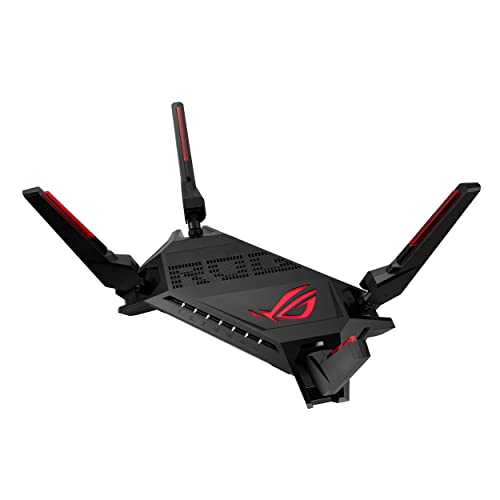
2. ASUS ROG Rapture GT-BE98 PRO Quad-Band WiFi 7 — Best Premium WiFi 7 Gaming Router
The GT-BE98 PRO represents the absolute cutting edge of consumer networking hardware in 2026, bringing WiFi 7's full 802.11be feature set to a gaming-optimized platform that pushes theoretical speeds to a staggering 30 Gbps. The 320MHz channels in the 6 GHz band alone represent a doubling of channel width compared to WiFi 6E's already-impressive 160MHz, and when you combine that with 4096-QAM modulation, the result is a meaningful increase in real-world throughput that you'll notice even if your devices can't saturate those upper limits. The first quad-band configuration in ASUS's lineup means this router can simultaneously serve dedicated gaming, streaming, IoT, and backhaul traffic across four completely separate radio chains, eliminating the band-sharing compromises that all previous routers required you to accept.
Multi-Link Operation is arguably WiFi 7's most important gaming feature, and the GT-BE98 PRO implements it fully — your compatible devices can maintain simultaneous connections to multiple frequency bands, so if one band experiences interference or congestion, traffic seamlessly flows through the others without the momentary dropout you'd experience on older hardware. The dual-feeding external antenna design takes a fundamentally different approach to signal propagation than standard dipole antennas, providing more uniform coverage across a wider range of angles rather than concentrating gain in a single direction. Dual 10G ports ensure that your wired backbone can actually keep pace with the wireless performance, which matters enormously if you're connecting a NAS, a gaming PC, or a network switch into this router's ecosystem.
The firmware experience is ASUS's most mature ROG gaming interface yet, with Triple-Level Game Acceleration inherited from the AX11000 Pro and a mobile game mode that detects and prioritizes handheld device traffic automatically. At this price tier, you're buying significant future-proofing — WiFi 7 client adoption is accelerating rapidly, and this router will handle whatever 2026 and beyond throws at your home network without requiring an upgrade cycle.
Pros:
- WiFi 7's Multi-Link Operation provides the most stable wireless gaming connection currently available in a consumer router
- Quad-band architecture eliminates band congestion that plagues tri-band and dual-band routers in busy homes
- Dual 10G ports support multi-gig wired backbones for NAS and high-performance gaming PCs
- Future-proof 320MHz channels in the 6 GHz band deliver headroom for next-generation client devices
Cons:
- Premium pricing places this significantly above what most gamers need if their home has fewer than six connected devices
- Full WiFi 7 benefit requires WiFi 7-capable client devices, which remain relatively uncommon in 2026
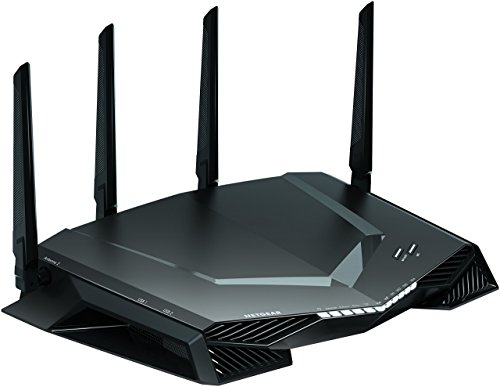
3. NETGEAR Nighthawk Pro Gaming XR1000 — Best for Lag Reduction & Ping Optimization
If raw speed specs don't matter as much to you as actual measurable ping reduction, the XR1000 is the router that deserves your serious attention. DumaOS 3.0 is genuinely the best gaming-specific router operating system currently available, giving you tools like Geo-Filter — which lets you draw a literal circle on a world map and force your game to only connect to servers within that region — alongside Ping Heatmaps that visualize your connection quality to specific game servers over time. NETGEAR's own testing demonstrates ping rate reductions of up to 93% compared to standard routers under congested conditions, which translates to the kind of consistent, predictable connection that separates a good gaming session from a frustrating one. The AX5400 dual-band WiFi 6 platform provides solid real-world throughput with up to four times the device capacity of older AC routers, making it an excellent choice for households where the gaming router is also the household router.
The four 1G Ethernet ports keep this router firmly in wired-gaming territory for traditional setups, which is honestly where most competitive gamers operate anyway — Ethernet will always beat wireless for consistency even if it can't match WiFi 7 for raw bandwidth in ideal conditions. Built-in security features including automatic firmware updates and NETGEAR's Armor protection activate out of the box without requiring manual configuration, which is a genuinely practical advantage if you're not the type to spend an evening in a router admin panel tuning security settings. The QoS system in DumaOS 3.0 goes far beyond basic traffic prioritization, offering device-level bandwidth allocation that lets you guarantee your gaming PC gets first access to upstream and downstream capacity even when every other device in your home is competing for bandwidth simultaneously.
The physical design is more understated than ASUS's ROG aesthetic, which some people will appreciate — this looks like a high-performance router rather than a prop from a science fiction film, and it runs noticeably cooler under sustained load than the larger ASUS units. If you're building a comprehensive gaming setup and are looking at other peripherals alongside this router, check out our roundup of the best headphone stands for your gaming headset to keep your whole station organized.
Pros:
- DumaOS 3.0 provides the most sophisticated gaming-specific ping management of any router in this roundup
- Geo-Filter technology actively prevents connection to high-latency distant servers in supported titles
- Automatic security updates and built-in Armor protection require zero manual configuration
- More compact and cooler-running than the larger ASUS ROG units
Cons:
- Four 1G Ethernet ports feel limiting for power users who want multi-gig wired connectivity
- AX5400 dual-band spec is less future-proof than the tri-band WiFi 7 options in this guide
4. TP-Link Archer GE800 Tri-Band BE19000 WiFi 7 — Best Future-Proof WiFi 7 Value
The Archer GE800 is TP-Link's boldest gaming router statement to date, packing WiFi 7 tri-band performance at 19 Gbps theoretical throughput alongside a port configuration that would have seemed outrageous on a consumer router just two years ago. Two 10G ports and four 2.5G ports give you an eight-port total that can handle a full gaming PC setup, a NAS, a network switch, and several consoles without any port becoming a bottleneck — this is the wired connectivity story that ASUS and NETGEAR's other options simply can't match at a comparable price point. The 12-stream architecture across 8 optimally positioned antennas distributes bandwidth more granularly than 8-stream or 4-stream designs, which pays real dividends in scenarios where you have many high-demand devices operating simultaneously in the same band.
WiFi 7's 320MHz channel support in the 6 GHz band, combined with Multi-Link Operation, means your compatible wireless devices can maintain the kind of latency consistency that was previously only achievable through a wired connection — though your gaming rig should still use Ethernet whenever possible, the difference for wireless-only devices like gaming laptops and handheld consoles is genuinely meaningful. TP-Link's Turbo Game Acceleration directs a dedicated processing queue to gaming traffic, and the quad-core processor paired with 2GB of RAM ensures this prioritization system operates without introducing its own processing latency — a real concern with underpowered gaming routers that throttle under load. The dedicated gaming panel on the hardware itself gives you one-touch access to key gaming settings without navigating through web admin panels, which is a small quality-of-life feature that you'll appreciate more than you expect after using it consistently.
HomeShield provides layered security including parental controls, IoT device protection, and intrusion prevention, with a free tier that covers the essential gaming-relevant features without requiring a subscription. The RGB lighting is tasteful by gaming peripheral standards and fully controllable through the Tether app — it's there if you want it and completely dismissible if you find it distracting. The Archer GE800 represents an extremely compelling combination of WiFi 7 performance, multi-gig port density, and gaming-specific software that undercuts the premium ASUS ROG WiFi 7 pricing noticeably.
Pros:
- Two 10G + four 2.5G ports provide the most wired connection flexibility of any router in this guide
- 19 Gbps tri-band WiFi 7 with 320MHz channels and Multi-Link Operation delivers genuine wireless gaming stability
- Quad-core processor + 2GB RAM prevents processing bottlenecks under heavy multi-device load
- Dedicated hardware gaming panel offers quick access to key settings without admin panel navigation
Cons:
- HomeShield advanced features require a subscription for the full feature set beyond the free tier
- Large and heavy chassis requires robust placement — not a router you'll tuck behind a TV easily
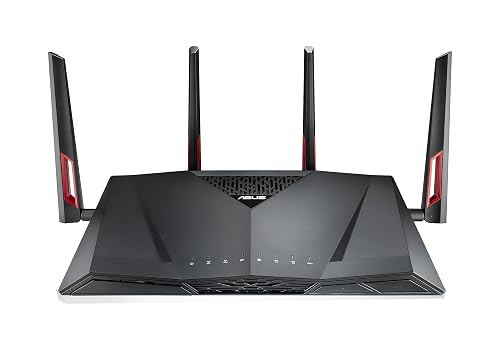
5. ASUS ROG Rapture GT-AX6000 Dual-Band WiFi 6 — Best Mid-Range WiFi 6 Pick
The GT-AX6000 occupies a sensible middle ground in ASUS's ROG gaming router lineup, delivering a 6000 Mbps dual-band WiFi 6 platform built around a 2.0 GHz quad-core processor that provides significantly more raw computational headroom than the processors found in budget gaming routers. The 160 MHz channel support ensures you're extracting maximum throughput efficiency from your WiFi 6 environment, and the dual 2.5G ports — which ASUS configures to give gaming and high-priority traffic precedence over standard data — provide wired connectivity that keeps pace with current multi-gig ISP offerings without requiring the 10G infrastructure that the flagship models demand. WAN aggregation support lets you bond two internet connections simultaneously if your ISP allows it, which is a genuinely useful feature for streamers or content creators who need maximum upstream reliability alongside gaming performance.
The 2.0 GHz quad-core CPU is a meaningful differentiator at this price point — where budget routers struggle to process advanced QoS rules without introducing their own processing latency, the GT-AX6000's processor handles simultaneous gaming traffic prioritization, security scanning, and VPN encryption without measurable degradation to your gaming connection. ASUS Instant Guard provides a one-tap personal VPN that routes your connection through this router's IP address when you're gaming on public networks, which is a legitimately useful security feature for LAN event attendees and coffee shop gaming sessions. Aura RGB sync ties the router's lighting into your broader ASUS ecosystem if you're running an Aura-compatible setup, though it's entirely optional and doesn't affect performance in any direction.
Lifetime internet security through ASUS AiProtect means no subscription costs eating into the value equation over the router's lifespan, which is a particularly compelling advantage when you compare it against NETGEAR's Armor subscription model. For most single-family gaming households running three to ten devices, the GT-AX6000 delivers everything you actually need from a gaming router without requiring you to invest in the full GT-BE98 PRO experience.
Pros:
- 2.0 GHz quad-core CPU handles gaming QoS, security, and VPN simultaneously without performance hits
- Dual 2.5G ports with traffic priority configured specifically for gaming and high-demand applications
- Lifetime AiProtect security eliminates subscription costs over the router's full lifespan
- WAN aggregation support for dual-ISP bonding in supported configurations
Cons:
- Dual-band architecture means no dedicated wireless backhaul band if you want to extend into a mesh network
- 2.5G ports rather than 10G limits future-proofing compared to flagship models
6. NETGEAR Nighthawk Pro Gaming XR500 — Best Budget Gaming Router
Not every gaming household needs to be running WiFi 7 with 10G ports, and the XR500 is the honest proof of that statement — it's a router that prioritizes intelligent traffic management over raw speed specifications, and the result is a gaming experience that can genuinely outperform more expensive routers that lack dedicated gaming firmware. The 1.7 GHz dual-core processor keeps packet processing efficient without the fan noise or heat output of larger units, and the four 1G Ethernet ports cover the realistic wired gaming needs of most households running one or two gaming PCs alongside a console. DumaOS on the XR500 — an earlier version than the XR1000's 3.0 implementation, but still meaningfully capable — provides Geo-Filter, bandwidth allocation, and ping monitoring tools that standard consumer routers simply don't offer at any price point.
AC2600 dual-band WiFi delivers speeds up to 2.6 Gbps in combined theoretical throughput, which is more than sufficient for any gaming application when your internet plan tops out below 1 Gbps — and in 2026, a huge proportion of residential internet plans still fall into that category despite multi-gig availability expanding. The advanced QoS system creates a dedicated gaming express lane that bypasses general household traffic even during peak usage hours, which means your ping stays consistent whether your kids are watching YouTube in 4K or your partner is video conferencing in the next room. Implicit and explicit beamforming ensure your wireless gaming devices maintain strong directional signal strength without requiring manual antenna adjustment.
The XR500 is the honest answer when someone asks what the minimum viable gaming router looks like in 2026 — it's not going to impress anyone with spec sheets, but it'll deliver noticeably better gaming sessions than any router that's treating your gaming traffic the same way it treats your smart refrigerator's firmware updates. It's also small enough to tuck into a cabinet or mount on a wall without the router becoming an architectural statement in your gaming space.
Pros:
- DumaOS gaming firmware delivers sophisticated QoS and Geo-Filter at the most accessible price in this roundup
- Compact, quiet operation with no fan noise under normal gaming loads
- Dedicated gaming traffic express lane keeps ping stable during simultaneous household internet usage
Cons:
- AC2600 WiFi standard is three generations behind current WiFi 7 hardware
- Four 1G Ethernet ports limit options for users with multi-gig ISP plans or NAS connectivity needs
- DumaOS version lacks some of the refined features found in the XR1000's 3.0 implementation
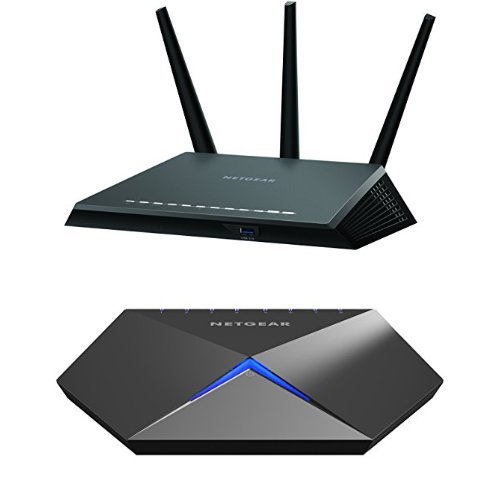
7. NETGEAR Nighthawk Pro Gaming XR700 — Best for Wired-First Power Users
The XR700 is the most unusual router in this roundup — an AD7200 quad-stream unit that pairs 60 GHz WiGig wireless performance with six 1G Ethernet ports and a 1.7 GHz quad-core processor, all wrapped in a chassis that prioritizes wired connectivity density over modern WiFi band configuration. At 7.2 Gbps combined theoretical wireless throughput, the XR700's speed numbers remain impressive even by 2026 standards, though the WiGig band's extremely limited range means its real-world application is primarily as a point-to-point high-throughput link between devices in the same room rather than as a whole-home wireless solution. Where this router genuinely excels is in wired gaming environments — six Gigabit Ethernet ports means you can connect every gaming device in your setup directly without needing an additional switch, which simplifies cable management and eliminates a potential network latency bottleneck.
DumaOS powers the XR700's gaming optimization layer, providing the same Geo-Filter and bandwidth allocation tools that made the XR1000 compelling, but with the additional port density that LAN party hosts and multi-console gaming dens genuinely require. The advanced Quality of Service system prioritizes gaming traffic across all six wired ports simultaneously, so your ping stays consistent whether you're running two gaming PCs, a streaming rig, and two consoles at the same time — a scenario that would overwhelm a standard four-port router's QoS capabilities. The 1.7 GHz quad-core processor provides enough headroom to manage this multi-device load without the packet-processing delays that plague dual-core budget units under heavy concurrent gaming sessions.
The XR700's value proposition in 2026 is somewhat more nuanced than it was at launch — the WiFi 7 routers in this roundup offer more modern wireless performance at comparable or lower prices. But if your gaming environment is primarily wired, if you need six Ethernet ports without adding a switch, and if DumaOS's gaming firmware is important to you, the XR700 remains a legitimately purposeful choice that hasn't been made obsolete by newer hardware in the way that its wireless specs alone might suggest. It's also worth noting that QoS (Quality of Service) technology like what DumaOS implements is fundamentally about traffic management intelligence, not just raw throughput — a distinction the XR700 still demonstrates effectively.
Pros:
- Six 1G Ethernet ports eliminate the need for an external switch in multi-device wired gaming setups
- DumaOS gaming firmware manages QoS across all wired ports simultaneously without degradation
- Quad-core processor handles heavy multi-device loads without packet-processing delays
Cons:
- WiGig (60 GHz) band has extremely limited range, making its high-speed wireless capability situational at best
- AD7200 wireless spec is significantly behind WiFi 6 and WiFi 7 in modern device compatibility and real-world throughput
- Six 1G wired ports rather than multi-gig ports limits future-proofing for faster-than-gigabit ISP plans
Buying Guide: How to Choose the Best Gaming Router
Picking a gaming router involves balancing several overlapping technical considerations that all interact with each other in ways that aren't immediately obvious from a spec sheet. The framework below covers the four decisions that will most directly affect your gaming experience, in roughly descending order of importance based on what actually matters in day-to-day competitive play.
WiFi Standard: WiFi 6, WiFi 6E, or WiFi 7?
The WiFi standard running in your router determines both the theoretical ceiling of your wireless performance and the feature set available to connected devices. WiFi 6 (802.11ax) remains the practical sweet spot for most gaming households in 2026 — it's well-supported by virtually every gaming device released in the last three years, it provides genuine real-world improvements in network efficiency over older standards in multi-device environments, and the routers implementing it are now available at competitive price points. WiFi 7 (802.11be) delivers meaningful advances in the form of Multi-Link Operation, 320MHz channels, and 4096-QAM modulation, but you'll only capture those improvements if your gaming devices also support WiFi 7 — a consideration worth checking against your current hardware before investing in a WiFi 7 router. For gaming specifically, Multi-Link Operation is the WiFi 7 feature that matters most, as it allows simultaneous multi-band connections that dramatically reduce the odds of a momentary band-switch dropout during a critical gaming moment. Older AC-series routers (WiFi 5) are still functional but lack the MU-MIMO efficiency and OFDMA scheduling improvements that make WiFi 6 noticeably better in real gaming environments with multiple connected devices.
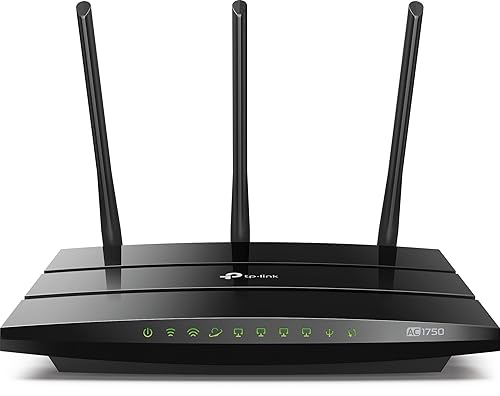
QoS and Traffic Prioritization: The Feature That Actually Reduces Ping
Quality of Service implementation is arguably more important for your gaming experience than the WiFi standard, because QoS determines how your router handles traffic competition between your gaming packets and everything else on your network. Basic routers implement simple priority queuing — gaming traffic gets a higher number and moves to the front of the line over general browsing. Gaming-grade QoS systems like DumaOS go substantially further: they can identify gaming traffic by game type, route it to geographically optimal servers, allocate precise bandwidth amounts to specific devices, and monitor ping performance to individual servers over time through visual heatmaps. When evaluating routers at similar price points, the sophistication of the QoS system is frequently the deciding factor in which delivers better real-world gaming performance, even if the spec-sheet WiFi numbers favor one direction. You should prioritize routers with dedicated gaming firmware over those that only offer basic QoS controls through a standard consumer interface, particularly if your household has multiple high-demand users competing for bandwidth simultaneously.
Wired Port Configuration: Multi-Gig vs. Gigabit
Your gaming PC or console absolutely should connect to your router via Ethernet whenever the cable run is physically feasible — wireless gaming introduces timing jitter and occasional packet retransmission delays that Ethernet's deterministic delivery model eliminates entirely. The question is which Ethernet speeds your setup actually requires. Standard 1G ports support any internet plan up to 1 Gbps and handle gaming traffic without any bottleneck whatsoever — if your ISP plan is 500 Mbps or 1 Gbps, four 1G ports are genuinely sufficient for your entire gaming setup today. Multi-gig ports (2.5G or 10G) become relevant when your internet plan exceeds 1 Gbps, when you're connecting a NAS or network storage device that moves large files, or when you want LAN transfer speeds between your gaming PC and other home servers to exceed the 1 Gbps ceiling. The 10G ports on the ASUS GT-BE98 PRO and TP-Link GE800 are genuinely future-proof investments if your ISP currently offers or plans to offer multi-gig service in your area — but if you're on a 500 Mbps plan with no near-term upgrade path, paying a premium for 10G port hardware you won't utilize is money better redirected toward a stronger QoS firmware platform.
Security, Mesh Support, and Long-Term Value
Gaming router security deserves more attention than most buyers give it, because a compromised router affects every device on your network, including gaming accounts, payment credentials stored in game clients, and any smart home devices sharing your connection. Routers with subscription-free security scanning (ASUS AiProtect) deliver a meaningfully better long-term value than those requiring an annual subscription to maintain the same protection level — factor those ongoing costs into your total cost of ownership calculation before making a final decision. Mesh compatibility is worth considering even if you don't need it today: AiMesh-compatible ASUS routers can be expanded into a whole-home mesh network by adding nodes rather than replacing the entire system, which makes the initial hardware investment more durable as your living situation changes. If you want to explore how a great gaming router fits into a complete gaming workspace, our guide to the best gaming desks for PC gaming sessions covers the physical setup considerations that complement your networking hardware choices.
What People Ask
Does a gaming router actually make a difference compared to a regular router?
Yes, but the improvement is most noticeable in specific situations rather than across-the-board speed gains. Gaming routers primarily help by prioritizing your game's network packets over competing household traffic through advanced QoS systems, reducing the latency spikes that occur when multiple devices compete for bandwidth simultaneously. If you live alone with a dedicated internet connection, the improvement will be minimal — but in shared households with multiple concurrent users, a gaming router with proper QoS can meaningfully stabilize your ping and reduce lag spikes during peak usage hours.
What's the difference between WiFi 6 and WiFi 7 for gaming in 2026?
WiFi 7's most important gaming advancement is Multi-Link Operation (MLO), which allows a device to maintain active connections to multiple frequency bands simultaneously — this eliminates the brief connection dropout that occurs when WiFi 6 devices switch bands due to interference or congestion. WiFi 7 also introduces 320MHz channels in the 6 GHz band and 4096-QAM modulation for higher throughput capacity. However, you only benefit from WiFi 7 features if your gaming devices also support it, so check your hardware compatibility before investing in a WiFi 7 router specifically for gaming performance improvements.
Should I use wired Ethernet or WiFi for gaming?
Wired Ethernet is always preferable for competitive gaming when a cable run is physically feasible. Ethernet delivers deterministic latency without the timing jitter, packet retransmission, and occasional band-switching dropouts that affect wireless connections even on the best gaming routers. WiFi 7's Multi-Link Operation significantly closes this gap compared to older wireless standards, but a well-run Ethernet cable to your gaming PC or console will still provide more consistent latency performance than even the best wireless connection in a real-world environment with walls, interference, and competing devices.
How much should I spend on a gaming router in 2026?
Your budget should align with your actual usage scenario rather than chasing the highest spec numbers available. For a single-user gaming setup on an internet plan under 500 Mbps, a quality WiFi 6 router with solid QoS firmware in the mid-range price tier delivers everything you practically need. Multi-user households with several concurrent high-demand devices benefit more significantly from the premium tri-band or WiFi 7 options, as the additional bands and more sophisticated QoS prevent congestion that a dual-band budget router can't manage gracefully. If your internet plan exceeds 1 Gbps, a router with at least one 2.5G or 10G port becomes necessary to avoid the router itself being the bottleneck in your network.
What is QoS and why does it matter specifically for gaming?
Quality of Service (QoS) is the system that determines how your router allocates bandwidth and prioritizes different types of network traffic when demand exceeds available capacity. For gaming, QoS matters because your game's networking packets are latency-sensitive — a 20ms delay caused by a router deprioritizing game traffic while processing a large download creates a lag spike that's far more disruptive to your gaming session than simply having less total bandwidth available. Gaming-grade QoS systems can identify and prioritize your game's traffic automatically, allocate guaranteed bandwidth allocations to specific devices, and in advanced implementations like DumaOS, geographically restrict server connections to minimize baseline latency before packet prioritization even becomes relevant.
Is a tri-band router worth it for gaming compared to dual-band?
Tri-band routers add a dedicated third radio band, which provides two key benefits for gaming households. First, the additional band gives you a dedicated wireless channel for your highest-priority gaming devices, keeping them separated from the general household traffic that occupies the other bands. Second, in mesh configurations, the third band can serve as a dedicated wireless backhaul between router nodes, which prevents mesh traffic from competing with your gaming device's data on the same radio. For single-device gaming on a simple network, the third band provides minimal benefit — but in households with five or more concurrent users, the congestion relief from the additional radio capacity is tangible and measurable in your ping performance.
Buy on Walmart
- ASUS ROG Rapture GT-AX11000 Pro Tri-Band WiFi 6 Extendable G — Walmart Link
- ASUS ROG Rapture GT-BE98 PRO First Quad-Band WiFi 7 Gaming R — Walmart Link
- NETGEAR Nighthawk Pro Gaming 6-Stream WiFi 6 Router (XR1000) — Walmart Link
- TP-Link Tri-Band BE19000 Wi-Fi 7 Gaming Router Archer GE800 — Walmart Link
- ASUS ROG Rapture WiFi 6 AX Gaming Router (GT-AX6000) Dual 2. — Walmart Link
- NETGEAR Nighthawk Pro Gaming XR500 Wi-Fi Router with 4 Ether — Walmart Link
- NETGEAR Nighthawk Pro Gaming XR700 WiFi Router with 6 Ethern — Walmart Link
Buy on eBay
- ASUS ROG Rapture GT-AX11000 Pro Tri-Band WiFi 6 Extendable G — eBay Link
- ASUS ROG Rapture GT-BE98 PRO First Quad-Band WiFi 7 Gaming R — eBay Link
- NETGEAR Nighthawk Pro Gaming 6-Stream WiFi 6 Router (XR1000) — eBay Link
- TP-Link Tri-Band BE19000 Wi-Fi 7 Gaming Router Archer GE800 — eBay Link
- ASUS ROG Rapture WiFi 6 AX Gaming Router (GT-AX6000) Dual 2. — eBay Link
- NETGEAR Nighthawk Pro Gaming XR500 Wi-Fi Router with 4 Ether — eBay Link
- NETGEAR Nighthawk Pro Gaming XR700 WiFi Router with 6 Ethern — eBay Link
The router that wins your next match isn't the one with the most impressive spec sheet — it's the one that keeps your ping stable when every other device in your home is fighting for the same connection at the same time.


About Mike Jones
Mike Jones grew up in the golden age of arcade and home gaming — a childhood shaped by Atari classics like Pitfall, Frogger, and Kaboom that gave him a lifelong appreciation for games of all kinds. These days he covers the full breadth of tabletop and family gaming: board games, card games, yard games, table games, and game room setup, with a particular focus on finding the games that bring different groups together. At GamingWeekender, he covers game reviews, buying guides, and recommendations for families, friends, and hobbyists who take their leisure seriously.
You can get FREE Gifts. Or latest Free phones here.
Disable Ad block to reveal all the info. Once done, hit a button below