The global board game market surpassed $13 billion in 2024, and two-player games built specifically for couples have emerged as its single fastest-growing segment — a trend that shows no sign of slowing heading into 2026. After years of testing games across different styles, skill levels, and moods, our team has a clear picture of what actually works for two people sitting across a table from each other versus what sounds good on the box.
The challenge with two-player games is real. Too many games designed for larger groups feel hollow with just two. Too many "2-player exclusive" titles lean so heavily into cutthroat competition that game night turns tense in the wrong way. What most couples actually want is a mix: a handful of cooperative options, a few competitive titles that stay fun even when one side is winning big, and at least one fast game that fits into a Wednesday evening. We've narrowed this list to the seven games that consistently hit all those marks. For anyone building out a broader collection, our board games hub covers the full landscape, and our guide to best board games for family game night is worth checking when the household expands.
Every game on this list has been played multiple times in multiple moods. We've logged wins, losses, frustrating draws, and that particular kind of competitive silence that either makes or breaks an evening. The rankings below reflect actual play experience, not just spec sheets — and we have strong opinions about which game belongs at the top.

Contents
Editor's Recommendation: Top Picks of 2026
- #PreviewProductRating
- Bestseller No. 1
 Rating:

- Bestseller No. 2
 Rating:
 - Bestseller No. 3
 Rating:
 - Bestseller No. 4
 Rating:
 - Bestseller No. 5
 Rating:
 - Bestseller No. 6
 Rating:
 - Bestseller No. 7
 Rating:
Our Hands-On Reviews
1. CGE Codenames: Duet (2nd Edition) — Best Cooperative Game
Codenames: Duet is the cooperative version of the beloved Codenames franchise, rebuilt from the ground up for two players. The 2nd Edition refines the component quality and tweaks a few edge-case rules that occasionally confused players in the original release. The core loop remains elegant: both players share a 5×5 grid of words, each sees a different portion of the key card, and together they must uncover 15 secret agents using single-word clues while avoiding assassins. The asymmetric information is the engine here — one player knows which words are safe for the other to guess, but not which ones are dangerous from their own key. It forces genuine communication and creative lateral thinking without descending into one player simply solving everything alone.
In our testing, Codenames: Duet consistently produced the most natural back-and-forth conversation of anything on this list. The 15-agent target is deliberately difficult, creating real pressure without making the game feel impossible. The 2nd Edition also includes a campaign mode with a map board and mission objectives, which adds meaningful long-term progression. Clue quality matters enormously here — stronger vocabulary and broader lateral thinking directly translate to better results. According to Wikipedia, the original Codenames won the prestigious Spiel des Jahres in 2016, and the Duet adaptation has earned near-universal praise for preserving what made it great. This is our top cooperative pick for 2026 without question.
The difficulty can be adjusted via the time token system, which is a smart inclusion. Casual players can give themselves more turns; experienced duos can tighten the challenge. Setup takes under two minutes and a full game runs 20–30 minutes, making it realistic for a weeknight.
Pros:
- Genuinely cooperative — no alpha-player problem
- Campaign mode adds replay depth
- Adjustable difficulty suits both casual and experienced players
- Fast setup and consistent 20–30 minute playtime
Cons:
- Vocabulary-dependent — mismatched word knowledge can create frustration
- Limited variety after many plays without expansion packs
2. Lookout Games Patchwork (Revised Edition) — Best Strategic Puzzle
Patchwork is a masterclass in doing a lot with very little. Two players compete to build the most efficient patchwork quilt on personal 9×9 boards, acquiring oddly-shaped Tetris-like tiles from a circular market using buttons as currency. The Revised Edition tightens the component quality — the tiles feel more substantial and the board presentation is cleaner — while keeping the core rules completely intact. The genius of Patchwork is the time track: each tile costs both buttons and time, and the player furthest back on the time track always moves next, creating a constant tension between taking expensive efficient tiles and cheap but time-consuming ones.
Our team finds this game incredibly satisfying to analyze mid-game. Watching the circular market shift as both players pick creates a layer of indirect competition that keeps the game interesting even though players never directly interact. The 7×7 bonus tile adds a secondary objective that rewards clean, gapless quilts. Scoring can swing dramatically based on late-game button income versus button debt for empty spaces, which means the game stays competitive even when one player appears far ahead.
At 30 minutes average playtime and with rules that can be taught in under five minutes, Patchwork earns a permanent spot in any two-player collection. The Revised Edition specifically addresses some feedback about component clarity — icons are crisper and the time track markers are more distinct. This is the game we reach for when time is limited and both players want something substantive but not exhausting.

Pros:
- Exceptionally easy to learn, difficult to master
- Strong strategic depth from minimal rules overhead
- Revised Edition improves component clarity
- Consistent 30-minute playtime — reliable for busy schedules
Cons:
- Purely competitive — no cooperative option
- Abstract theme won't resonate with every player
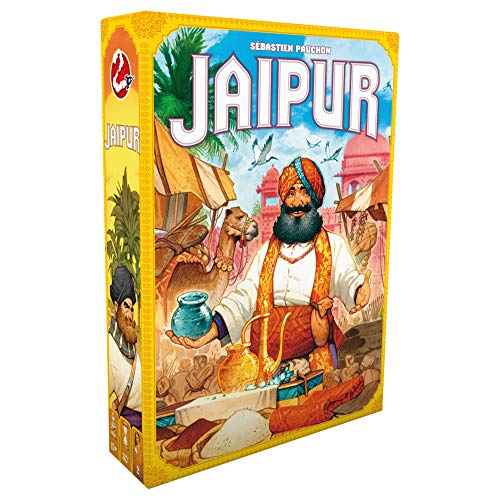
3. Asmodee Jaipur (New Edition) — Best Trading Card Game
Jaipur is a fast-playing two-player card game set in the bazaars of Rajasthan, and it remains one of the most elegantly designed competitive games available in 2026. Players act as rival merchants, collecting and selling goods — spices, leather, cloth, gems, gold, and silver — while managing a hand of cards and a herd of camels. The New Edition is particularly notable for Vincent Dutrait's revised artwork, which transforms what was already an attractive game into something genuinely beautiful. The decision space is deceptively rich for a game that teaches in about three minutes: do most buyers sell quickly for guaranteed tokens, or hold goods longer when token values are higher?
The camel mechanic is what separates Jaipur from generic hand-management games. Camels don't count toward the five-card hand limit but can be traded in bulk for multiple goods, creating bursts of tempo that can completely reshape a round. The bonus tokens for large sales add another layer — selling three of a good type earns a standard token, but selling five earns the standard token plus a hefty bonus. Holding out for that bonus sale while watching an opponent's hand is a constant source of tension.
Best-of-three rounds mean Jaipur sessions naturally run 30–45 minutes, which is ideal. No round ever feels exactly like the last because draw luck varies enough to force different strategies. As part of Space Cowboy's dedicated two-player collection, the design shows focused attention to the specific dynamics of head-to-head play in a way that adapted multi-player games can't replicate. This one goes directly in the "essential" category.
Pros:
- Award-winning design with a proven track record
- New artwork by Vincent Dutrait is genuinely stunning
- Best-of-three format creates natural session arcs
- Plays in 30 minutes — extremely accessible entry point
Cons:
- Some draw variance can occasionally feel swingy
- Limited to exactly two players
4. Asmodee 7 Wonders Duel — Best for Competitive Depth
7 Wonders Duel takes the acclaimed civilization-building mechanics of the original 7 Wonders and strips them down into something sharp, direct, and relentlessly strategic for exactly two players. Three ages of cards are laid out in a pyramid structure, face-up and face-down, and players alternate drafting from the exposed edges. Every card taken potentially unlocks new options for the opponent, meaning each pick carries double weight — you're building your own civilization while shaping what's available to theirs. The theme parallels the kind of strategic tension we've covered in our look at civilization strategy games, though the execution here is far more compressed.
The three win conditions are what make 7 Wonders Duel exceptional. Military supremacy, scientific monopoly, or civilian victory points all remain viable deep into any given game, which means a player can't simply turtle their way to a point victory without watching the military track carefully. Our team has seen games end abruptly on military wins when one player ignored shields entirely, and scientific victories pulled off in the final age when opponents underestimated token synergies. The unpredictability keeps every session engaging regardless of how many total plays are on the table.
Setup takes longer than Jaipur or Patchwork — roughly 10 minutes to lay out three ages properly — but the 30-minute playtime is accurate once the game is moving. The learning curve is steeper than other games on this list. First-timers will lose badly to experienced players. That asymmetry fades after three or four plays, and the game becomes much richer once both sides understand which card chains matter. For couples willing to invest a few sessions, this delivers the deepest competitive experience on the list.
Pros:
- Three distinct win conditions keep every game dynamic
- Deep card-chain economy rewards careful planning
- Consistent 30-minute play time once rules are internalized
- High replayability from variable card layouts each age
Cons:
- Steeper learning curve than others on this list
- Early sessions heavily favor the more experienced player
5. Hive Pocket by Smart Zone Games — Best Travel Game
Hive Pocket is the compact travel version of the award-winning Hive system, and it's the most portable serious strategy game on this list. Each piece is a chunky, tactile insect tile, and the entire "board" is formed by the growing hive itself — there's no actual board. Players take turns either placing or moving their insect tiles with the goal of completely surrounding the opponent's Queen Bee. Every insect type moves differently, and the Ladybug and Mosquito expansions included in this edition add two more movement patterns that meaningfully expand tactical options without overcomplicating the base game.
What makes Hive stand out is the complete absence of luck. No dice, no card draws, no random elements of any kind. Every outcome is a direct result of positional decision-making, which means losses sting intellectually in a productive way. The game rewards pattern recognition and forward planning in a way that feels closer to chess than to most modern board games. The soft travel bag included in the Pocket edition makes it genuinely portable — this is the game our team packs for vacations, long weekends, and anywhere a flat surface and 20 minutes might appear.
The lack of a board can initially confuse new players who expect a fixed playing field, but most grasp the expanding hive concept within one practice round. Experienced Hive players will immediately recognize how significantly the Mosquito tile — which mimics any adjacent insect's movement — can shift board control. For couples who enjoy abstract strategy games and want something that travels well, Hive Pocket is the clear answer in 2026.

Pros:
- Zero luck — pure positional strategy
- Ladybug and Mosquito expansions included at no extra cost
- Extremely portable with included travel bag
- No board required — plays on any flat surface
Cons:
- Abstract theme is not for everyone
- Steep skill gap between experienced and new players
6. Lost Cities Card Game (with 6th Expedition) — Best Quick Card Game
Lost Cities is Reiner Knizia at his most focused. Two players simultaneously attempt to fund expeditions to five (now six, with the included expansion) remote destinations — the Himalayas, the Amazonian rainforest, the Egyptian desert, a volcanic island, and the ocean floor — by playing numbered cards in ascending order to each expedition route. The catch: starting an expedition costs 20 points, so committing to a route without enough high-value cards results in a net loss. The wager tiles add a multiplier mechanic that can either turbocharge a winning expedition or catastrophically amplify a losing one.
The two-sided game board included in this edition adds a second game mode that modifies scoring and creates a distinct strategic texture from the base game. The 6th expedition column — a white series with its own wager tiles — increases hand management complexity without fundamentally changing what makes the game work. Research and science-backed studies on gaming consistently point to games that combine spatial planning with calculated risk as among the most cognitively stimulating for adults, and Lost Cities fits that description exactly.
Where Lost Cities occasionally frustrates is the discard pile mechanic: cards played to a discard pile are available to either player, which means information is public but timing the pickup is genuinely hard. Opponents can snipe the exact card needed right before it's picked up. It's a design tension that some players love and others find aggravating. Our team lands on the "love it" side. The game runs 20–30 minutes and handles multiple back-to-back sessions cleanly.
Pros:
- 6th expedition adds meaningful complexity to the base game
- Two-sided board provides a distinct alternate game mode
- Risk/reward wager system creates memorable high-stakes moments
- Packs down small despite including a full board
Cons:
- Discard snipe mechanic can feel punishing at bad timing
- Draw luck affects outcomes more than some players prefer
7. Renegade Game Studios Fox in the Forest — Best Trick-Taking Game
Fox in the Forest is the most elegant trick-taking game ever designed exclusively for two players, and we say that with real confidence. The fairy-tale artwork from artist Queenie Chan is genuinely beautiful — each card depicts a forest character with intricate botanical framing — but the design under the surface is what makes it exceptional. The scoring system actively punishes greed: winning too many tricks scores fewer points than winning a moderate number. The 0–3 trick range scores 6 points, the 4–6 range scores 1–3 points depending on count, and the 7–9 range scores nothing. Most buyers accustomed to standard trick-taking will need one round to internalize that deliberately losing tricks can be optimal strategy.
The odd-numbered cards each carry a special power — changing the trump suit, leading after losing a trick, exchanging a card with the deck — and managing those powers while also managing trick count is the central challenge. Fox in the Forest Duet, the cooperative variant, exists as a separate title, but the original competitive version is our recommendation here because the deliberate-loss mechanic creates a unique kind of strategic intimacy that cooperative games can't replicate. There's something particularly satisfying about setting up an opponent to win too many tricks and watching their score collapse as a result.
The small box format is a genuine asset — it fits in a coat pocket. The 30-minute runtime is accurate across skill levels because the card count (33 cards total) keeps sessions tight. Anyone already interested in card games might also enjoy our roundup of fun dinner table party games for any occasion for more ideas in a similar vein.
Pros:
- Inverted scoring system creates a genuinely unique strategic experience
- Stunning illustrated card artwork
- Extremely compact and travel-ready
- Special card powers keep every hand from feeling routine
Cons:
- Trick-taking genre won't appeal to non-card-game players
- The scoring inversion confuses players expecting standard trick-taking rules
Key Features to Consider When Choosing Board Games for Couples
Cooperative vs. Competitive Design
This is the single most important decision when selecting a two-player game, and most buyers underestimate how much it matters. Purely competitive games can create tension that bleeds outside the game session — particularly when skill levels are mismatched. Cooperative games eliminate that dynamic entirely by pointing both players at a shared enemy (the game system itself), which tends to produce more positive post-game conversation. Our team recommends owning at least one cooperative title alongside competitive options. Codenames: Duet is the strongest cooperative pick on this list, while 7 Wonders Duel and Patchwork are purely competitive. Jaipur, Lost Cities, and Fox in the Forest fall somewhere in the middle — competitive but low-stakes in feel.
Session Length and Complexity
Games designed for two players have enormous variance in actual playtime versus stated playtime. The 30-minute estimates on most boxes assume players already know the rules. Factor in a first-teach session of at least double the stated time. After rules are internalized, the games on this list are honest about their durations. For weeknight play, anything over 45 minutes risks getting abandoned mid-game. For dedicated game nights, 45–75 minutes is ideal — enough time to feel substantial without demanding the entire evening. Complexity follows a similar logic: starting with medium-complexity games and escalating builds a stronger shared vocabulary faster than jumping straight to the deepest systems.
Replayability and Variety
The best two-player games generate different experiences across sessions through variable setups, card randomness, or player choices rather than through expansion content. Jaipur, Fox in the Forest, and Lost Cities all achieve high replayability from card draw variance alone. 7 Wonders Duel achieves it through the card pyramid layout. Codenames: Duet and Patchwork achieve it through a large card/tile pool. None of the games on this list feel exhausted after 10–15 plays — but some will plateau before others. Hive Pocket has essentially infinite replayability because there's no randomness at all; every position reached is a result of decisions made.
Portability and Storage
Two-player games have a portability advantage over larger multiplayer titles by default, but there's still meaningful variance within this category. Fox in the Forest fits in a jacket pocket. Hive Pocket ships with its own travel bag. Jaipur and Lost Cities both fit comfortably in a bag without dedicated storage solutions. Patchwork and 7 Wonders Duel have larger boxes due to their boards and tile counts, making them better suited as permanent shelf residents rather than travel games. For couples who travel frequently or want games that work in restaurants, cafes, or hotel rooms, prioritizing the compact titles isn't just a nice-to-have — it's what determines whether the game actually gets played outside the home.
Common Questions
What is the best board game for couples who are new to the hobby?
Jaipur is our top recommendation for newcomers. It teaches in under five minutes, plays in 30 minutes, and the best-of-three format creates a natural session arc without requiring a long commitment. Lost Cities and Fox in the Forest are close runners-up for similar reasons. All three avoid the heavy rulebook overhead that can make first-time board gaming feel like homework.
Are cooperative board games better for couples than competitive ones?
It depends entirely on the couple's dynamic. Cooperative games like Codenames: Duet remove the interpersonal competition entirely, which works well when skill levels are mismatched or when both players prefer working toward a shared goal. Competitive games can be equally enjoyable when both players have similar experience levels and approach losing with good humor. Most strong two-player collections include both types.
How many board games does a couple actually need?
Three to five titles cover virtually every scenario. Our team recommends one cooperative game, one short competitive card game, one medium-weight strategy game, and one travel-portable option. That configuration handles weeknights, weekends, travel, and different energy levels without any overlap. Adding a fifth title specifically for when guests join — something that scales to 3–4 players — rounds out the collection.
What is the best two-player board game for competitive players?
7 Wonders Duel is the strongest purely competitive title on this list for players who want genuine strategic depth. The three win conditions, the card drafting tension, and the complete absence of luck beyond draw order make it the game that rewards deeper analysis most directly. Hive Pocket is the answer if the preference is for zero randomness whatsoever — it's essentially a modern abstract strategy game in the chess/Go tradition.
Which games on this list work well as travel games?
Hive Pocket and Fox in the Forest are the strongest travel options. Hive Pocket ships with a dedicated soft travel bag and requires no surface beyond a small flat area. Fox in the Forest's box is roughly the size of a paperback. Jaipur and Lost Cities also travel well despite including small boards. Patchwork and 7 Wonders Duel are the two on this list least suited to travel due to larger box sizes and more complex component layouts.
Are these games appropriate for couples with very different skill levels?
Several handle the skill gap better than others. Codenames: Duet is cooperative, so skill imbalance becomes an advantage rather than a problem — the stronger player can guide the weaker one toward better clues. Fox in the Forest's inverted scoring and special powers create enough variance that raw strategy experience doesn't always win. Hive Pocket and 7 Wonders Duel suffer the most from skill gaps in early sessions, though both equalize quickly once both players have internalized the core mechanics.
Buy on Walmart
- CGE Codenames: Duet Board Game (2nd Edition) The Top Secret — Walmart Link
- Lookout Games Patchwork Board Game (Revised Edition) - Inter — Walmart Link
- Asmodee Jaipur Board Game (New Edition) - Fast-Paced Duel of — Walmart Link
- Asmodee 7 Wonders Duel Board Game BASE GAME - Intense Two-Pl — Walmart Link
- Hive Pocket Game by Smart Zone Games | Portable Abstract Str — Walmart Link
- Lost Cities Card Game - with 6th Expedition — Walmart Link
- Renegade Game Studios Fox in the Forest ,2 Player Card Games — Walmart Link
Buy on eBay
- CGE Codenames: Duet Board Game (2nd Edition) The Top Secret — eBay Link
- Lookout Games Patchwork Board Game (Revised Edition) - Inter — eBay Link
- Asmodee Jaipur Board Game (New Edition) - Fast-Paced Duel of — eBay Link
- Asmodee 7 Wonders Duel Board Game BASE GAME - Intense Two-Pl — eBay Link
- Hive Pocket Game by Smart Zone Games | Portable Abstract Str — eBay Link
- Lost Cities Card Game - with 6th Expedition — eBay Link
- Renegade Game Studios Fox in the Forest ,2 Player Card Games — eBay Link
Key Takeaways
- Codenames: Duet (2nd Edition) is our top overall pick for 2026 — the cooperative structure, campaign mode, and adjustable difficulty make it the most versatile game on this list for any skill combination.
- Jaipur and Fox in the Forest are the strongest short-session competitive options, each delivering a complete, satisfying experience in under 30 minutes with minimal setup.
- 7 Wonders Duel delivers the deepest strategic experience on the list and rewards couples willing to invest a few sessions learning its card chains and three-path win conditions.
- Hive Pocket is the definitive travel game — pure abstract strategy, zero luck, and the only title on this list that fits in a jacket pocket and plays anywhere without a board.


About Mike Jones
Mike Jones grew up in the golden age of arcade and home gaming — a childhood shaped by Atari classics like Pitfall, Frogger, and Kaboom that gave him a lifelong appreciation for games of all kinds. These days he covers the full breadth of tabletop and family gaming: board games, card games, yard games, table games, and game room setup, with a particular focus on finding the games that bring different groups together. At GamingWeekender, he covers game reviews, buying guides, and recommendations for families, friends, and hobbyists who take their leisure seriously.
You can get FREE Gifts. Or latest Free phones here.
Disable Ad block to reveal all the info. Once done, hit a button below