The first time you step up against a seasoned opponent at a local rec center and watch every single one of your shots come flying back twice as hard, something clicks — this game has layers you haven't touched yet. If you're genuinely serious about how to improve your ping pong game, the path forward isn't simply practicing more; it's practicing smarter, with the right technique, equipment, and mental framework locked in from the start. Across the full spectrum of table games, few disciplines expose your weaknesses as immediately as table tennis, which means every flaw in your game costs you points fast, and every improvement pays dividends just as quickly.
Most players plateau because they grind the same bad habits into muscle memory without realizing it, reinforcing errors that become harder and harder to unlearn with every session. This guide breaks down the game from equipment comparison and budget planning to advanced technique and mental strategy, giving you a clear framework to diagnose exactly what's holding you back and fix it systematically. If you're still building your foundation, pair this guide with our Ping Pong Tips: A Beginner's Guide To Table Tennis before diving into the more advanced material here.
Table tennis rewards players who think as much as they react, and once you genuinely understand the mechanics behind spin, placement, and timing, you'll see the game in an entirely different way — and your results will follow.
Contents
- Table Tennis vs. Ping Pong: What the Difference Means for Your Game
- Paddles, Tables, and Training: Building a Setup That Actually Works
- The Mistakes That Are Quietly Costing You Points
- Ping Pong Myths That Are Actively Limiting Your Progress
- Core Techniques for How to Improve Your Ping Pong Game
- When Your Game Stops Improving: Diagnosing the Real Problem
- Frequently Asked Questions
Table Tennis vs. Ping Pong: What the Difference Means for Your Game
Origins and Official Standards
"Ping pong" and "table tennis" describe the same sport, but the distinction carries genuine weight when you're buying equipment or entering competition. Table tennis is the internationally governed term overseen by the International Table Tennis Federation (ITTF), while "ping pong" is the recreational label — and the equipment standards between those two worlds differ significantly, affecting how you develop skills and which habits actually transfer to serious play.
Equipment and Play Style at a Glance
| Feature | Recreational Ping Pong | Competitive Table Tennis |
|---|---|---|
| Ball Standard | Low-grade plastic, often legacy 38mm | ITTF-approved 40mm+ poly ball |
| Paddle Quality | Pre-assembled, rubber specs unknown | Custom blade with rated rubber sheets |
| Table Thickness | 12–16mm (inconsistent bounce) | 25mm minimum (regulation-consistent bounce) |
| Net Height | Approximate, often inconsistent | Exact 15.25cm ITTF standard |
| Scoring System | 21 points common in casual play | 11 points per game, best of 5 or 7 sets |
| Spin Development | Limited by equipment ceiling | Full topspin, backspin, sidespin accessible |
Understanding where you currently sit on this spectrum helps you make smarter gear investments and set realistic expectations for your improvement curve — because the drills and techniques taught at a club level assume regulation equipment, and practicing on substandard gear will actively stunt your development.
Paddles, Tables, and Training: Building a Setup That Actually Works
Entry-Level to Competitive Budgets
Your equipment ceiling directly affects your skill ceiling, and a $15 paddle physically cannot produce the spin and control that a quality $70 setup delivers — no amount of practice closes that mechanical gap. Here's a realistic breakdown of what each investment tier actually gets you:
- Under $30 (Recreational): Pre-assembled paddles like the Stiga Advantage; suits casual family play but severely limits spin development and wrist-snap technique
- $50–$100 (Serious Beginner): Butterfly Timo Boll SF or DHS Hurricane range; control-oriented rubber where real, repeatable improvement begins
- $100–$200 (Intermediate): Custom blade with Tenergy or Xiom rubber sheets; full access to looping, sidespin serves, and deceptive short game
- $200+ (Advanced): Competition-grade composites like the Butterfly Viscaria; marginal gains that matter only once fundamentals are solid
Never buy the cheapest paddle available — low-quality rubber actively teaches bad technique by masking your errors and denying you accurate feedback on spin and contact.
Tables, Balls, and Accessories
- Indoor tables: $250–$500 for quality entry-level options like the JOOLA Inside 15; $600–$1,200 for competition-grade surfaces with proper rollaway storage
- Outdoor tables: $400–$800 for weatherproofed aluminum tops — our guide on creating the perfect outdoor game room covers setup considerations in detail
- Balls: Buy ITTF-approved 3-star balls in bulk; a pack of six Butterfly or Nittaku balls runs $10–$15 and lasts through weeks of serious drilling
- Ball robot: $150–$400 for a basic oscillating machine; the single most effective solo training tool available, especially for footwork drills
- Net and post set: $20–$50 for a precision-adjustable net that holds ITTF height — this small upgrade eliminates the variable that quietly skews your serve and return calibration
The Mistakes That Are Quietly Costing You Points
Grip and Stance Errors
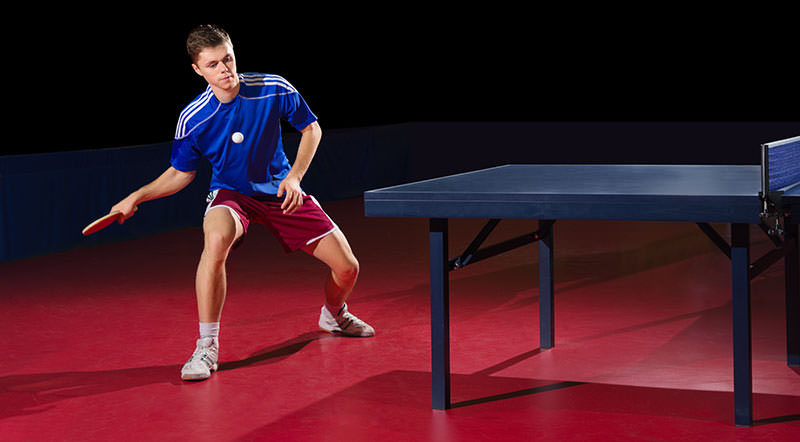
The most common error among developing players is gripping the paddle like a frying pan handle — what coaches call a "death grip" — which eliminates wrist mobility and makes generating meaningful spin nearly impossible. Your grip should remain firm but relaxed, with your index finger resting along the backhand rubber and your thumb bracing the forehand side in the standard shakehand configuration.
- Feet should be shoulder-width apart with knees slightly bent and weight loaded forward onto the balls of your feet
- Your non-dominant foot sits slightly forward for forehand-dominant players, creating a hip-rotation angle toward the table
- Movement starts before the ball crosses the net, not after it bounces — flat-footed players always arrive late and off-balance
- Your free arm extends slightly for balance during strokes; tucking it in kills your rotational axis entirely
Stroke and Contact Mistakes
Beyond grip, the following errors account for the majority of unforced errors at the recreational and early-intermediate level, and each one is correctable with deliberate, focused drilling:
- Swinging from the shoulder rather than initiating power through hip rotation and core transfer
- Making contact at the top of the ball's bounce rather than on the rising ball, which sacrifices both speed and spin window
- Opening the paddle face too early and sending shots ballooning high — a gift to any opponent who loops topspin
- Failing to reset to a neutral ready position after every single shot, leaving you reactive instead of proactive
If you've spent time developing discipline in other fast-reacting table sports, the fundamentals transfer more than you'd expect — the Air Hockey: How To Play and Improve Your Game guide covers positioning principles that reinforce similar ready-stance habits.
Ping Pong Myths That Are Actively Limiting Your Progress
Myth: More Spin Always Wins
Spin is a tool, not a strategy — players who default to maximum topspin on every single ball become entirely predictable, and experienced opponents simply adjust their block angle to redirect your own pace back at you. Mixing spin variation is what creates genuine difficulty: heavy topspin followed by a no-spin "ghost" serve reads identically to the receiver but behaves in opposite ways off the paddle, forcing errors without requiring extra power.
Myth: Just Playing More Games Is Enough
Unstructured match play reinforces your existing comfort zone rather than expanding it, which is precisely why most recreational players stay at exactly the same level for years on end despite logging dozens of hours at the table. Deliberate practice — isolated footwork patterns, multiball training with a feeder, specific serve-and-receive sequences — is what actually moves the needle when you're working on how to improve your ping pong game.
- Spend at least 60% of your practice time on structured drills rather than free play
- Identify your weakest single shot and dedicate one entire session per week exclusively to it
- Film yourself from the side during practice; grip and stance errors you cannot feel in the moment become obvious on a 30-second clip
Myth: Better Equipment Fixes Technique Problems
Upgrading to a $200 blade while your footwork remains broken is like fitting racing tires on a car with a bent frame — the underlying problem persists, and higher-sensitivity gear may actually amplify your inconsistencies rather than hide them, exposing errors that cheaper equipment was accidentally masking.
Core Techniques for How to Improve Your Ping Pong Game
Mastering the Serve
The serve is the one shot in table tennis where you hold complete control over every variable — ball speed, spin direction, spin depth, placement, and trajectory — and most players squander it entirely with a high, spinless toss that hands the opponent a free attacking opportunity. A heavy backspin serve, a fast no-spin "ghost" serve, or a short sidespin that skids wide all force immediate errors and short returns you can attack before your opponent ever gets settled.
- Toss the ball from an open palm at least 16cm above the table surface — this is an ITTF regulation that also naturally improves your contact angle
- Contact the ball near your end of the table to maximize the variety of trajectories available to you
- Develop at least three distinct serves with identical-looking wind-ups before expanding your repertoire further
- Practice your serves in isolation for 15 minutes per session until they become fully automatic under match pressure
Footwork and Positioning
Your footwork determines which shots are available to you in any given rally — poor positioning means you're always improvising from an awkward angle, while solid footwork means you're always executing from a prepared, balanced stance with a full kinetic chain to work with. The two-step side shuffle and the crossover step cover the vast majority of movement patterns you'll encounter at the intermediate level.
World-class players don't have faster hands than you — they have faster feet, because they arrive at the ball earlier and with better balance, giving their hands the platform to do their job cleanly.
Return of Serve Strategy
- Read the server's contact angle and wrist snap direction before the ball leaves their paddle — the information is there if you train yourself to look for it
- When uncertain about spin, push short to the server's backhand to neutralize their opening attack and reset the rally on your terms
- Practice flicking short balls that land close to the net — this one shot alone opens up hundreds of additional point opportunities per competitive season
- Never guess on spin direction; commit to a read, execute cleanly, and adjust your model on the next serve in that sequence
When Your Game Stops Improving: Diagnosing the Real Problem
Mental and Competitive Blocks
If your practice performance is strong but your match results stay flat, the problem is almost certainly mental — specifically, the tendency to tighten up on critical points and revert to low-percentage safe shots that give your opponent all the initiative. Playing more competitive matches against stronger opponents is the only real remedy, because pressure adaptation requires repeated exposure under actual match stakes, not drill simulations.
Identifying Training Gaps
- Track which specific shots you lose points on during live matches — most players lose 60–70% of their points on only two or three shot types
- If your backhand loop consistently breaks down under pressure, your opponent will camp that wing and exploit it every single rally until you fix it
- Invest in even a single structured coaching session; a trained eye catches errors that mirror practice misses entirely, saving you months of self-directed guesswork
- Cross-train by studying shot selection logic in other skill-based table games — the strategic thinking behind table shuffleboard and similar precision sports builds transferable pattern recognition
Setup and Environment Fixes
Sometimes the plateau isn't your technique at all — it's your practice environment and the limited variability it provides. If you always play on the same table against the same two or three opponents, you've optimized for that specific micro-context rather than developing general adaptability to new spin patterns, speeds, and playing styles.
- Join a local club or league to expose yourself to at least 8–10 distinct playing styles per month
- Add a ball robot to your game room setup for high-repetition footwork and stroke training without needing a partner
- Rotate practice partners deliberately — each new opponent forces genuine recalibration, which is exactly the stimulus that drives adaptation
Frequently Asked Questions
What is the fastest way to improve my ping pong serve?
Practice three distinct serve types in isolation for 15 minutes per session until each one becomes automatic. Focus on heavy backspin, sidespin, and a fast no-spin serve that mimics your backspin wind-up — this variation alone creates consistent errors from most recreational and intermediate opponents.
How long does it take to get genuinely good at ping pong?
With deliberate, structured practice three to four times per week, most players reach a competitive intermediate level within 12 to 18 months. Raw hours matter far less than the quality and intentionality of each session — drilling specific weaknesses accelerates development dramatically compared to casual match play alone.
Should I use a penhold or shakehand grip?
For most Western players, the shakehand grip is the stronger starting point because it offers balanced forehand and backhand access without requiring the advanced footwork that compensates for penhold's backhand limitations. Penhold excels in specific Asian playing styles but demands a significantly higher footwork investment to use effectively at a competitive level.
What is the best paddle for intermediate players?
A custom setup in the $80–$150 range using a control-oriented blade paired with Tenergy 05 FX or Xiom Vega rubber on the forehand gives intermediate players full access to spin mechanics without punishing inconsistency the way high-catapult offensive rubbers do. Avoid pre-assembled paddles at this stage, as the rubber specifications are rarely disclosed and rarely competitive.
How do I return a heavy backspin serve?
Close your paddle face — angle it downward toward the table — and brush upward through the bottom of the ball to generate enough topspin to clear the net against the backspin trajectory. Alternatively, push the ball back short with a controlled, downward-angled stroke that keeps the ball low and limits your opponent's attack angle on the third ball.
Can I improve at ping pong without a regular practice partner?
Yes, but you need a ball robot or a wall rebounding board to replace multiball drilling. A basic oscillating robot at $150–$300 replicates the repetition volume of a feeding partner for stroke and footwork drills, and solo serve practice requires no partner at all — just a table and a bucket of balls.
How important is footwork compared to hand technique in table tennis?
Footwork and hand technique are inseparable — poor positioning makes even technically correct strokes inconsistent because your contact point and balance are never the same twice. At the intermediate level and above, footwork is almost always the binding constraint on improvement, because players can usually execute shots correctly in isolation but break down when required to move and strike simultaneously.
What is the difference between topspin and sidespin, and when should I use each?
Topspin pulls the ball downward after contact, allowing you to attack with pace while keeping the ball on the table — use it on mid-to-high balls when you want to generate pressure. Sidespin curves the ball's trajectory left or right after the bounce, creating wide-angle returns that pull opponents off the table — most effective as a serve variation or a wide crosscourt attack to the opponent's weaker wing.
The player who wins consistently isn't the one who hits the hardest — it's the one who arrived at the ball first, with the right paddle angle, because they never stopped treating practice as a problem to solve.


About Mike Jones
Mike Jones grew up in the golden age of arcade and home gaming — a childhood shaped by Atari classics like Pitfall, Frogger, and Kaboom that gave him a lifelong appreciation for games of all kinds. These days he covers the full breadth of tabletop and family gaming: board games, card games, yard games, table games, and game room setup, with a particular focus on finding the games that bring different groups together. At GamingWeekender, he covers game reviews, buying guides, and recommendations for families, friends, and hobbyists who take their leisure seriously.
You can get FREE Gifts. Or latest Free phones here.
Disable Ad block to reveal all the info. Once done, hit a button below